
In this episode
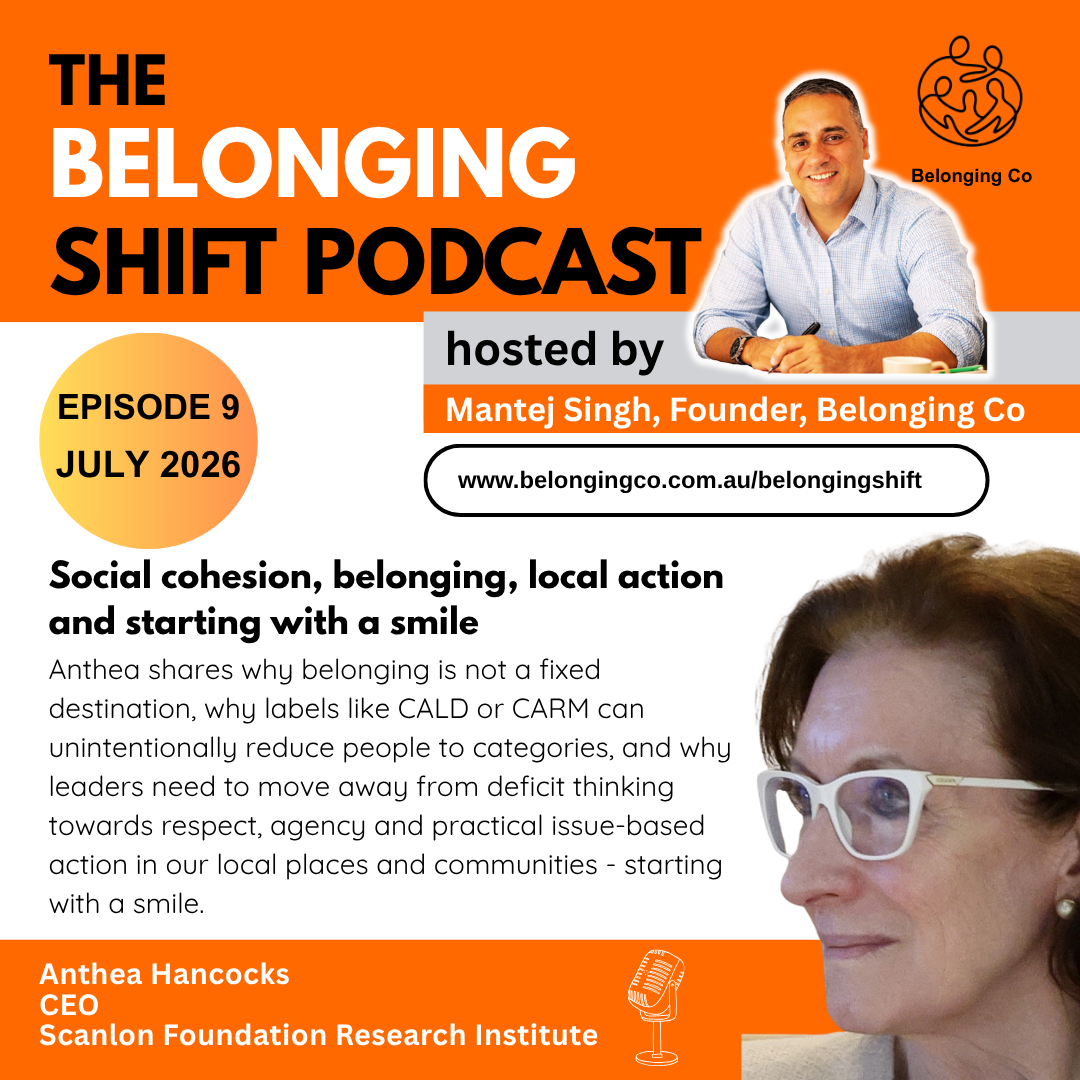
In this episode of The Belonging Shift, host Mantej Singh speaks with Anthea Hancocks, CEO of the Scanlon Foundation Research Institute, about social cohesion, cultural inclusion, trust, dignity, reciprocity and the everyday actions that help people feel they have worth in the places where they live, work and gather.
Anthea shares why belonging is not a fixed destination, why labels like CALD or CARM can unintentionally reduce people to categories, and why leaders need to move away from deficit thinking towards respect, agency and practical issue-based action.
Anthea’s advice for leaders and practitioners for making the #BelongingShift
Shift 1: Move from labels to the real issue people are experiencing.
Shift 2: Move from deficit thinking to dignity, agency and contribution.
Shift 3: Move from pity, paternalism and patronising behaviour to respectful peer-to-peer listening.
Shift 4: Move from national debate alone to practical neighbourhood connection and local participation.
Shift 5: Move from waiting for belonging to be created for us to starting with small everyday gestures — even a smile.
Listen to the full conversation using the links below or scroll down further to read the full transcript.
If this episode sparked a new idea, challenge, or possibility, share it with someone who’ll benefit or connect with Mantej to support your organisation’s work.
Connect with Anthea
Anthea Hancocks is the CEO of the Scanlon Foundation Research Institute. The Institute is dedicated to making research into social cohesion accessible and understandable while maintaining the highest levels of research expertise and integrity. She has a background in leadership positions in government, professional services, academia, philanthropy and not for profit organisations. Anthea is a Fellow of Monash University, a Civil Society and Public Administration Fellow with the Toronto Metropolitan University and a Fellow of the Australian Institute of Company Directors.
Connect on LinkedIn: Anthea Hancocks | LinkedIn
Website: The Scanlon Foundation Research Institute
Connect with Belonging Co
Belonging Co helps leaders drive participation, trust and engagement
Belonging Co delivers strategies, engagement, and programs for organisations and leaders to create connected communities and local networks with genuine impact across cultural inclusion, community participation and social cohesion.
For more information, see links below
Belonging Co website: www.belongingco.com.au
Book a discovery call
Follow and connect with Mantej on LinkedIn
Follow and subscribe to The Belonging Shift Podcast
Listen to audio
APPLE PODCASTS | SPOTIFY | YOU TUBE | AMAZON MUSIC | IHEART RADIO | RSS FEED
Read transcript
Mantej (00:00)
Hello everyone. Welcome to another episode of the Belonging Shift, the podcast where we talk to leaders across Australia and internationally on community, place, leadership, and the future of belonging, which is a thing that I'm really passionate about. And I think it's a thing that is belonging is a thing that the world needs, our country of Australia needs, and our society needs in the neighborhoods and suburbs. And in this podcast, we speak to leaders
about how can we build trust, participation, inclusion, and belonging in the systems and organizations and communities that we live in and we operate in. And I am so excited to have here today with me Anthea from the Scanlon Institute, who is the CEO there. Anthea, welcome to to the Belonging Shift Podcast.
Anthea (00:38)
thank you very much. It's a pleasure.
Mantej (00:44)
So, Anthea, let's get started and let's talk about belonging, which is such a big need in our society today. And you you and I spoke about it last week. so before we get into the business of belonging or the business of social cohesion and cultural inclusion in Australia,
I wanted to understand from you. Can you tell us a bit about yourselves, your journey, who you are, what do you do, and why does a sense of belonging matter to you in your area of work?
Anthea (01:10)
I'm the CEO of the Scanlon Foundation Research Institute. I used to be the CEO of the Scanlon Foundation, so I've been with this organization for now over eleven years, in one form or another, and it's been an absolute delight. to be involved, but particularly it's really important to have been around the research that the Scanlon Foundation started back in 2007, that we've been doing ever since then. And it is the only research of its kind anywhere in the world. And that's a great privilege to be involved in that. My career has been very diverse across a whole variety of different sectors.
And and so it's a it's a very long and complicated journey to get to to where I am right now. But say so suffice it to say that I have had careers in a number of different areas. So both government type roles I used to work when the Melbourne Museum and the was being built. so I worked for the Museums Victoria group then.
I've worked for Deloitte, I've worked for the National Australia Bank, I've worked overseas in the United States in a number of different areas, and and then I've taught at universities both here and in the United States. So it's a very wide-ranging particular role. In regard to belonging, I think one of the things that's particularly important for any individual in any role is that you feel like people respect the role that you are playing.
and the contribution that you're making, but also that you feel that you can respect others around you. And I think probably they're the the main components when it comes to where I work, for particularly for me, that's a very important thing. But also I think for others in any workplace, that's an important thing.
Mantej (02:55)
thanks for sharing that. That's such a sort of diverse career. You must have had s very interesting experiences along the way. so if I can sort of push you a bit more on the first question,
Anthea (03:02)
Yeah.
Mantej (03:06)
What does belonging mean to you personally? So if you were not in part of these any of these organizations in in any of these positions in role, what does it mean to you personally as a person, living in in a society, a community, a country?
Anthea (03:18)
I find that a really challenging question. I think I've always felt that I was I had a sense of belonging because of where I was born, as in I was born here in Australia, so I feel like I'm an Australian. so in that way I have a sense of belonging, but I've lived in other places as well where you have to create the the environment in which you operate because you're know a foreign entity within that particular space. So even though I was moving when I moved to the United States, even though I was moving to an English speaking country where some of the cultural components were similar, but at the same time I didn't know anybody and and I didn't have a job and I was trying to find where I sat in the world. So you do have to reach out and find opportunities that might give you some build up your confidence.
but also give you a sense of connection to those particular places. So I think seeking a sense of belonging is is just as important as whether or not you actually feel like you belong. so I do I do find it a very challenging question because I think there are some places where you feel like you belong and then other places where you don't feel like you belong. So, and both of those things can exist at the same time, and and I think that's off. probably the case with most people. mind you, if you feel like you belong in multiple entities, that's a really important thing as well.
Mantej (04:35)
think this is an interesting thing what you've said and some for some of my other guests have also said that, you know, belonging is not this finite thing that you achieve and arrive at. It it varies, it fluctuates, there's ebbs and flows and you may belong in some contexts but not in others, all at the same time. So which is what you are saying as well, which is really interesting because people assume that well, it's a tick. You you you got there and we achieved belonging and which is what you're saying that that's not the case.
Anthea (04:57)
Mm-hmm.
I no, I don't think it is. And I think we put an awful lot of pressure on people about achieving that sense of belonging. where in actual fact I think it takes different amounts of time for people and coming across the the opportunity to find that place, whether or not it's a workplace where you are actually going every day. And so finding the the group within your workplace where you do have a sense of belonging. I know there are experiences for all sorts of people.
where the the dynamics with two or three people might make you feel like you're you're really keen to go to work, but other dynamics that sit around that might actually make you feel that you don't necessarily belong in another department or you don't necessarily belong within a particular hierarchy and all of those things can be things that people have to navigate every single day.
Mantej (05:50)
Anthea, building on that, I want to ask a question sometimes people do ask the question, Well, what is belonging? You know? What are you trying to get here?
Anthea (05:55)
Mm-hmm.
Mantej (05:57)
I want to ask you, 'cause Scanlon Foundation and Scanlon Research Institute has done a lot of work and research in the area of belonging. You publish the social cohesion report, you publish sort of papers on belonging. So for people listening, I want to ask you this question. How would you define belonging? What does it mean? But if you can't use the word belonging?
Anthea (06:15)
I think that belonging is actually where you feel like you have worth within the environment in which you are actually operating. so people respect you for the contribution that you are making and that there is a degree of reciprocity so that it's a very much a peer-to-peer type relationship and that you you recognize because you bring something to the
the space in which you are operating and others bring something as well to that space and together you're actually creating something that is clearly where the whole is bigger than its individual parts. And I think that's a really that reciprocity is a really important component of belonging.
And sometimes building trust as well is also another component because then the reciprocity will build because people have started to experience who you are and what you can contribute. So building trust and and making sure that people have a sense of self-worth in in relation to others. I think that both of those are incredibly important parts of belonging.
Mantej (07:18)
Thanks, Anthea Yeah, so what you what I'm hearing from you is that, you know, obviously reciprocity, we don't just want belonging for ourselves. We we need to be creating belonging for others as well. So that's the reciprocity. But then you're saying making sure that people have a sense of self-worth, respect, dignity, trust, those are other sort of important elements of creating a sense of belonging for people.
Anthea (07:37)
Absolutely. Yes.
Mantej (07:38)
So when we think of those things as you just described and we look at cultural diversity inclusion in Australia today or social cohesion broadly as communities, what shifts do you think are occurring in that space right now, in the way people are experiencing belonging?
Anthea (07:54)
well, I certainly think people's economic circumstances are having a putting a lot of downward pressure. it it tends to be that when people are suffering from a degree of economic stress, then they sort of hunker down, if you like, in a self-protective type mode, which is completely understandable. but also other people that are aware That other people might be suffering even more than them around this sense of inequality or the experience of inequality, then they also have a lower sense of belonging and self-worth and others because they're concerned about the experiences that other people are having. So both the individuals that are going through more extreme economic stress, but also those that are aware of it will have an sort of an overarching impact on people's sense of belonging, or if you like, their preparedness to put themselves out there and contribute because they let feel less able to be able to do that. And whether or not that's economically, or simply whether or not they can feel find the the ability in themselves to go beyond the that protectionist mode that they might be feeling themselves in.then all of that will have an impact on their relationships with others.
Mantej (09:10)
building on that, Anthea, so we we talk about what in the context of cultural inclusion, we talk about words like culturally and linguistically diverse or culturally and racially marginalized. I remember when I came to Australia first, which is about twenty five, twenty six years ago, there were words like language other than English to describe a whole community and a group of people. Then it was NESB, was non English speaking background. And there's almost like a changing terminology to describe a group of people and sometimes it's around what they don't have.
Anthea (09:38)
Yes, yes, that's very true.
Mantej (09:40)
So how do we build belonging in our country, in our society, around cultural inclusion? Because half the Australia is culturally diverse, one-fifth of people speak a language other than English at home. How do we build belonging around cultural diversity and inclusion?
Anthea (09:54)
So we try to discourage people from using terms like cald or carm, you can understand that a government that lives in a society or operates within a society with more than three hundred different ethnicities tries to find a way to bundle up people so that they can then deliver services to them.
And certainly people who are newly arrived, and particularly those that might be coming through certain visa pathways, it's really important that those supports are in place. So you can see that government would create terminology that defines for themselves a group of people that can be serviced in a particular way. It's not necessarily all that helpful in breaking down barriers where people might be creating them.
that is based around people's backgrounds or heritage or ethnicity, whatever it might be. So we try to discourage people to stop to rather than labeling or putting people into a particular bucket, but more think about what's the issue that you actually want to respond to. And so I was asked this question this morning by some people who were going to be working on a project in a particular location.
And and I said, Well, what is the issue you're actually thinking about? And so their issue was actually unemployment or underemployment. So how to deal with that? And then you say, Well, who who in actual fact are you interested in speaking to? And so it would it came to be people who've got low levels of English, people who've got overseas qualifications that aren't necess haven't necessarily been recognized here, or overseas experience, or a newly arrived.
So those are ways of talking about the people that are requiring certain services being delivered to them rather than just saying, it's anybody that's CALD because the that term, the CALD, tends to make a whole lot of presumptions about people that sit in there but aren't necessarily suffering from any of those particular lack of service supports. So it it's more important to think about.
How do we how do we stop defining people based on their culture or their language, but actually think about what is the issue that we need to respond to? So essentially that's the rationale behind discouraging that type of terminology.
Mantej (12:06)
No, thanks Anthea for explaining that. That makes make that makes a lot of sense around targeting the issue and not sort of stereotyping a whole group of people, whether they whether they they have or don't have that issue or not. And is the same same thing applies to this term that's come up in recent years, which is culturally and racially marginalized or CARM
Anthea (12:24)
It it's exactly the same. It's another reason to bundle everybody in which suggests that everybody that that you might because it's probably people like me that are putting you into that bucket. And so if that's the case, then you're saying that everybody in that bucket is racially marginalised. And that isn't necessarily true. And it is also a way of labelling people as victims rather than actually people with agency within society.
Mantej (12:43)
Mm.
Anthea (12:50)
What I don't want to do is to suggest for one minute that there aren't people who are marginalized based on their whatever people might define as their race or their ethnicity. That is absolutely the case, and we should be trying to do everything we can to stop that. But essentially, the putting them into a bucket of terminology only encourages others to stereotype, and they will stereotype based on the broadest possible. characteristics which is you know skin colour or dress or language and that's not necessarily a healthy way either.
Mantej (13:23)
I think what you s what I've heard from you is don't put people into buckets, give people agency, focus on the issues and aim at self-worth and dignity and build trust. is the is the broad approach. And so that that's very simple. Like I that's not a very that's not a complicated approach. And yet social cohesion, belonging, inclusion are things that are hotly debated in our country at the moment, and people have lots of perspectives.
Anthea (13:32)
Absolutely. Ha ha ha.
Mantej (13:48)
So my question in that context is, if what we need to do is so simple that we could explain it in a sentence right here, what are leaders, organizations getting wrong in terms of cultural inclusion?
Anthea (13:59)
well, I think because they tend tend to come at things from a deficit model. So what they often do in in a generalized fashion is to form employee groups that are based around particular characteristics. So there might be one for people from LGBTIQ, or there might be people who are ethnically diverse, they might as in their characteristic, or there might be people that are they would put into a bu you know disability bucket, something like that. And then they presume that the people in those are all group are all individuals that have something that they need to support in some way, which is quite possibly true, but they actually don't know what the success element might look like. So what what are they trying to aim for? And and so they tend to sort of an analyse people based on those particular characteristics rather than again the issue that might actually run across all of those, which might be to do with accessibility or it might be to do with the characteristics of the way meetings are run. so that it might be to do with other characteristics that are actually broader and more organisation wide all that does is to encourage people to then again stereotype and and become annoyed at the fact that they're making an adjustment for somebody else rather than seeing that it's actually a better for the organization overall because you're talking about an issue that multiple people might experience.
Mantej (15:27)
Yeah. that's what I've advocated as well. That's such a fair point because people have also strengths and advantages. You if you just focus on the deficit, then we that's what the focus always remains. I just want to lift it outside workplaces to broader society and community Anthea. So in terms of cultural inclusion in our society, at the moment, there are lots of different variations and approaches to cultural inclusion and migration and social cohesion. There's undercurrents of different sort of ideologies and thinking at at the moment. And sometimes communities get caught in the middle of those competing or differing ideologies. how should people living in suburbs and communities and neighborhoods and moms and dads and families
What should how should they approach belonging and cultural inclusion in a diverse Australia?
Anthea (16:12)
So first of all, I want to say that Australia's social cohesion, when we measured it last, which was this time which was July in 2025. so we are interested in knowing what it is going to be in 2026. But essentially what our research has shown is that Australia's social cohesion is very is strong and it's resilient. And primarily that's because of what happens in the neighborhoods. That's where people have that greatest sense of inclusion.
and that greater sense of familiarity with others around them. And so first of all, I really want to recognize the the enormous contribution that communities make to our social cohesion because it is in those day-to-day type interactions that make an enormous difference. So the mere fact that you might smile at people or you say hello to the person that you go you see once a week when you go and do the shopping or
That you gather at a particular cafe one every Saturday after your bike ride, or those sorts of experiences are actually bringing people together from all sorts of different backgrounds and experiences. So it's continuing to do the things that communities and local neighborhoods do really, really well. And that is provide opportunities for people to interact. So I think we need to continue to do that. I would try to encourage people to continue to engage with libraries, with local sports facilities, with community groups and neighborhood houses in whatever way that they want, or simply to get out there and shop locally so that you are continually meeting up with the fish and chip shop owner or the person who runs the bakery or the whatever it is, because that's where you're going to start to become familiar with people from all sorts of different backgrounds.
Mantej (17:59)
So you are saying, kind of, you know, in a way, don't get caught up in this sort of debate necessarily and just continue to prosper in human to human connection, you know, support your neighbor, work with your neighbor, connect with local people and just just to practice it in the everyday rather than getting caught up in the debate.
Anthea (18:17)
Absolutely. And l and you know, keep an eye out for people who might be feeling more isolated. so older people that might not necessarily be able to get out, or young people that may well be staying at home, spending too much time engaging in social media, where potentially there might be able to be opportunities for them to be engaged in having a voice within their local areas. And we know that having a voice
Mantej (18:37)
Mm.
Anthea (18:40)
is very, very important to people. They need they want to be heard around the things that matter to them. And it is some an area where potentially at that local government level there isn't enough of that going on. And we certainly want to encourage more and more opportunities for people to be engaged and to be able to respond. Not not just generally to vent a grievance based on, you know, whatever the the big issue is. but more around very local issues. What are the things that are really annoying you? and creating forums for people to come together to talk about that, because then they will also recognize that people from all sorts of different backgrounds all actually appreciate that particular issue and that they will then strive to create a community that can resolve issues but also that are is the local government, if you like, is responding to the issues that are of concern to those the people in that local area. The places like the neighbourhood app, those types of opportunities, I know there are lots of groups that have even WhatsApp groups for their street, that type of thing is really important for people to be actually able to share thoughts, share concerns and then even resolve them.
Mantej (19:55)
so you're just a that getting take take charge of the situation, activate your neighborhoods, support each other and sort of grassroots action beats anything, basically is what you what you're saying.
Anthea (20:05)
Absolutely. And councils, local councils, because they're the most trusted level of government, are are really there on the ground. They they can tell you what some of the issues are, but they also need to be able to to engage more people in a broader range of of methods.
Mantej (20:09)
Yeah. So sort of building on from that, my question is around the fact that in the last two, three weeks, four weeks, we've heard words like monoculture, multicultural, all these being hotly debated, or appear suddenly. And if somebody is getting concerned by this, Because I have spoken to people that are concerned listening to these things emerge and that does affect your own sense of agency as you were talking at the beginning. What what's your message to people that how should they react to these things?
Anthea (20:50)
I think we have to be respectful of people who have differing views. and that's important. I think when words like this are thrown about, especially when they haven't necessarily been particularly common, then we have to try and really understand what's behind them and where why that terminology is being used. But at the very at the local level, if you like, or at the personal level, there are an awful lot of Communities with people reaching out to say, hang on, I've got real concerns about this. can we come together and have a conversation or a series of round tables around these particular issues? So there are people mobilising right now, and I suspect that will continue to grow.
and allowing people to be able to share their concerns and irritations or the things that they like in this particular moment in time and have that conversation about what the ramifications might be of those things. Just unbelievably important respectful conversations. So I think that's particularly important. Terminology, look that I'm not necessarily keen on labels of any sort. I think people should choose how the you know to be able to share how they actually want to be referred to. But the this debate between monocultural and and multicultural is certainly inflaming certain concerns and fears that people have. And and that that's it's completely valid. to have those particular concerns until we actually hear more and more about how that's anticipated to be realized. So right now they're they're sort of like grenades that have been dropped out there and people are just having a response to them. We need to know much, much more about what their intent actually is and what the what the type of activities are that might result from such a a move.
Mantej (22:40)
the fact that nobody talks about it is also a concern because then you say, Well, it doesn't bother anybody. Whereas it bothers you. So I think sometimes people assume that, you know, we'll just ignore it. But if it's affecting you and nobody talks about it, then that that's also an issue.
Anthea (22:46)
Yeah.
My my son actually often talks about all sorts of things, all sorts of issues in society, and he presumes that nobody else is talking about it. Sometimes it's just that you haven't found the avenue by which people are actually likely to have that conversation. So you either need to create it yourself or seek it out and find out where those those conversations are being had. generally there's somebody talking about everything somewhere.
Mantej (23:21)
Yes. Yeah. So look, we are coming to the close of this podcast, Anthea. So I want to ask here, this podcast is about belonging shift. my aim is to inspire people to shift towards belonging or make small shifts towards belonging as an outcome. So if there was a leader in a local government, an executive leader in local government or a state government institution somewhere listening to this podcast, and I hope there are many listening to this,
Anthea (23:44)
Ha ha.
Mantej (23:45)
What would be your three or five top shifts that you would want them to make to help achieve belonging as an outcome in the neighborhoods, suburbs and places?
Anthea (23:54)
I have three words that I often talk about which which I encourage people to avoid. one is patronizing, paternalism and pity. And I would encourage people to try at every opportunity they have to avoid patronizing people. Paternalizing. Yeah. So patronizing is is essentially putting people down for their views.
Mantej (24:12)
Can you elaborate on these three? Because I think this is really important.
Anthea (24:19)
which we need to discourage people to do. So respectful listening and and being treating people as a peer rather than being somewhere on a hierarchy in your thinking. paternalism is suggesting that you actually know better than the other person. So being open minded to in actual fact what people are likely to contribute. And pity is essentially where you believe that somebody else is has a deficit of some description or is less than and therefore needs your help because you're in a better position than they are. So terms like disadvantaged or marginalized are words that we also try to discourage because that's a way of labelling people and nobody wants to be thought of as being disadvantaged or being marginalized.
So trying to encourage leaders to be role models in regard to how they treat other people and coming back to that ensuring that you treat people with respect, listen to them and then respond to them. Now absolutely everybody should continue to learn and so making sure that people are in learning environments are where the sort of norms that should be created within any organisation or community group or wherever are abided by.
is particularly important as well. So those leaders who have the ability to reinforce positive and constructive norms within their areas by avoiding disrespect, not showing not giving people their sense of worth because you were they they come in either to volunteer or to s to work within a particular environment. So clearly there was something that they're bringing to the organisation and people should be respectfula and respected for that and then avoiding looking down on people or treating them as if there's a a hierarchy around humanity which i really is is not constructive.
Mantej (26:13)
Anthea, that's that's a really good point. we talked about leaders just now. now I want to talk about people living in neighborhoods, suburbs, places, communities. What's your message to them as as they and I think sometimes even if you're not culturally diverse, you still get caught up in that because you don't support what sometimes it's being said, but you know, you feel well it's not my position to say something about this. So what what would you say to people, the community at large about how to support belonging as an outcome, how to shift towards belonging?
Anthea (26:34)
I would encourage everybody to recognise that in their own heritage there is cultural diversity, regardless of what they look like. Some people, their culture is more obvious than for others, but in actual fact, if you tap into and think about your background and your heritage, you will discover that you actually have a whole variety of different cultures that have had some influence on who you are and how you think.
So recognizing that in actual fact there are things that go across our entire population and how do we value the contribution that everybody makes to ensuring that Australia is a place where people come together and cooperate in order to ensure that we all survive but also that we prosper. And and that's I think really, really important thing to think of when we think about the
social cohesion or what so social cohesion actually means. It means people being in in an environment where they are comfortable to cooperate with others in order to create the vision that they have for this country and and for their local community or their even their organization. So all of those things really matter.
Mantej (27:48)
Thank you, Anthea. You just corrected myself. I I talked in my trainings that I delivered that cultural diversity is not limited to one culture and I've and so just corrected me there. Thank you very much for that, Anthea. I think it's just been a very good conversation going from, you know, dignity, trust, agency to helping people prosper and thrive. And what I've really enjoyed listening to you is you've talked about that in our neighborhoods the local action and grassroots community action is really the glue.
Anthea (27:55)
Perfect.
Mantej (28:13)
that drives social cohesion at a at a national l and level because sometimes we wait for somebody to give us this social cohesion and belonging or lead the path, but we all have to lead the path for each other. In the spirit of reciprocity, as you said.
Anthea (28:24)
in in yes, in whatever way we can. So people shouldn't feel a burden from it. Just you know, start with a smile, start with a handshake, start with whatever it is that you feel comfortable with.
Mantej (28:37)
I think that's a great note to finish on Anthea. I have got the title of my podcast. I think this episode is, you know, a conversation with Anthea and Start with a Smile. and so thank you very much, everyone, for listening to the Belongshift podcast with Anthea from the Scanlon Institute. this podcast is brought to you by Belonging Co, which is a social and cultural inclusion consultancy here in Sydney, Australia. If this episode sparked
Anthea (28:41)
Yeah.
Thank you.
Mantej (29:01)
a new idea, a challenge, a possibility, share it with someone in your network, spread the word, and that's how conversations like this grow. Stay connected for more conversations and practical insights on leadership, inclusion, community, and the future of belonging. Thank you. Signing off.
