
In this episode
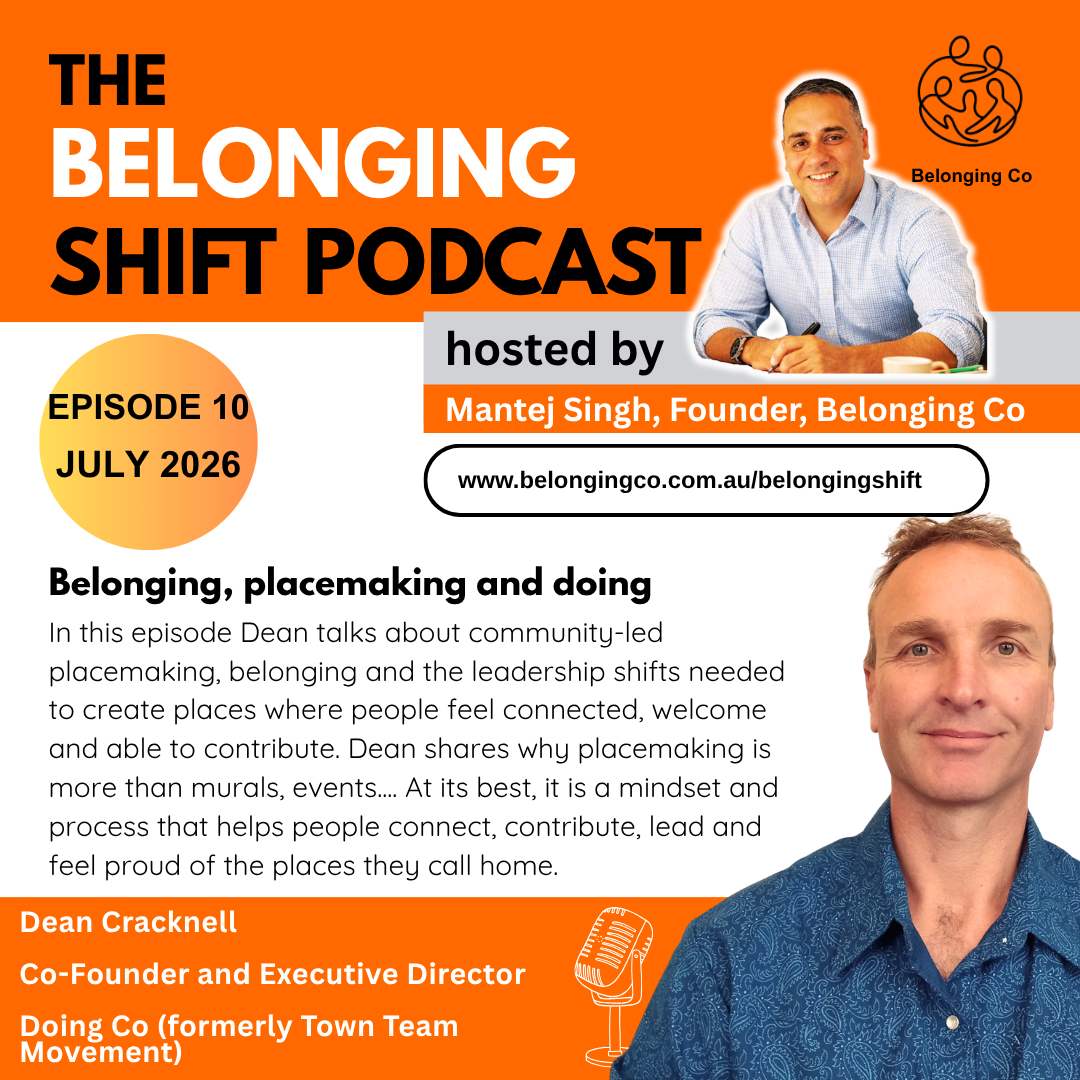
In this episode of The Belonging Shift, host Mantej Singh speaks with Dean Cracknell, Co-Founder of Doing Co and Creator of Placemaking Education. Dean shares how community-led placemaking can move beyond design, infrastructure and one-off activations to become a deeper practice of connection, contribution and community-led change.
He reflects on belonging as a human need shaped by people and place, and explains why leaders need to shift from doing things for communities to working with communities and enabling communities to lead so people feel connected, welcome and able to contribute.
Dean’s advice for leaders and practitioners for making the #BelongingShift
Shift 1: Start small, but start
Shift 2: Move from doing for communities to doing with communities
Shift 3: Reframe risk as disengagement, distrust and missed contribution
Shift 4: Let go of control so leadership can emerge from within community
Shift 5: Treat placemaking as a mindset and process, not just a product or outcome
Listen to the full conversation using the links below or scroll down further to read the full transcript.
If this episode sparked a new idea, challenge, or possibility, share it with someone who’ll benefit or connect with Mantej to support your organisations work.
Connect with Dean Cracknell
Dean Cracknell is Co-Founder of Doing Co and Creator of Placemaking Education. Dean loves helping people to create positive civic, social, economic, environmental or organisational change. He shifted from being an urban planner working in local government and local doer volunteering in my local neighbourhood to being a Doer, Dreamer, Enabler and Connector of people and ideas. He works in the gaps in between: people and places, local governments and local communities, community organising and action, social, economic and environmental improvement and top-down and bottom-up.
Placemaking Education website: https://placemaking.education/p/placemaking-in-12-minutes
Connect on LinkedIn: https://www.linkedin.com/in/dean-cracknell/
Website: https://doingco.org/
Connect with Belonging Co
Belonging Co helps leaders drive participation, trust and engagement
Belonging Co delivers strategies, engagement, and programs for organisations and leaders wanting genuine impact across cultural inclusion, community participation and social cohesion.
For more information, see links below
Find ways to work with Belonging Co and book a discovery call
Undertake the Free Belonging Shift self-audit
Follow and connect with Mantej on LinkedIn
Follow and subscribe to The Belonging Shift Podcast
Listen to audio
APPLE PODCASTS | SPOTIFY | YOU TUBE | AMAZON MUSIC | IHEART RADIO |
Read transcript
Mantej Singh (00:00)
Hello, Dean. Welcome to the Belonging Shift podcast. On a bright sunny day here in Sydney, Dean Cracknell is the co-founder of Doing Co. And I've known Dean for a very long time and it's great to have Dean on the podcast talking about place making, belonging and everything in between. ⁓ can you tell us a bit about yourself? What do you do, your journey? and why belonging matters to you.
Dean Cracknell (00:22)
Thanks, Mantej It's a pleasure to be here on the podcast. So I'm based in Tasmania these days in Launceston in Tasmania, which is the second city Hobart being the capital of Tasmania. I moved here six years ago and still feel like I'm trying to work out what belonging means to me in Tasmania. I'll maybe talk a bit more about that later in the podcast. I'm a co-founder of Doing Co. So for the...Eight years we were a town team movement and all about helping town teams and local people to get involved in their local community. But we realized the town team approach was a fantastic way, but not the only way of doing and contributing and getting involved in your community. So we've recently changed to Doing Co and that's, as the name suggests, all about doing and doers. And we think that local people are the real heroes that we're trying to elevate and support and inspire.
But also you can be a doer and a system shaper working within institutions and governments as well. So we want to help the community doers, but we also want to help the system doers as well to create places together, but create system change as well as local change.
Mantej Singh (01:33)
Thanks, Dean. It's quite an interesting ⁓ juxtaposition, which is Belonging Co and Doing Co. And I think we can all collaborate with that mindset as well. But ⁓ for our listeners, ⁓ Dean and I worked together at Sydney Olympic Park and of deliver some very interesting projects working with communities, both with that Doing Co ⁓ ideology and both with a belonging mindset.
So Dean, in a place making context, but in the context of your personal journey as well, What does belonging mean to you personally? And if you had to define belonging without using the word belonging, how would you describe it?
Dean Cracknell (02:11)
I know it's a pretty simple question, Mantej, but it's actually a really complicated answer for me. So as I mentioned, I moved to Tasmania six years ago, but I think I did a rough calculation. I've lived in something like 25 houses in my life so far. So questions like, you know, where do you belong and where are from are very complicated for me. And I'm sure for some of your listeners as well, you know, when you've moved to...different country or a different state or a different area, you know, it's sometimes not easy to explain, you know, what belonging means or where you're from or those sort of things. But for me, you belonging is a crucial part of being human and it's a very deep seated emotion. And, you know, psychological research, you know, sort of says that we need to feel that sense of connection and being part of something. whether that's a community or a family, a club, a society, but also belonging to a place. know, our Indigenous leaders talk about how belonging comes from being on country and being connected to place. So, I think belonging, you know, is all about people and places and feeling like you are connected, feeling like you're part of something that's bigger than just yourself.
Mantej Singh (03:30)
Now that makes a lot of sense, And if you look at your journey, you've been, you've done some great work in the place making space, place with town teams and your work that you've done before that. If you look at that, place making as a space and as an idea. because in a lot of places, placemaking is not called placemaking. It might be called community development. It might be called community engagement, localism. There could be different names to it, but the idea remains the same. So if you look at that space of placemaking and that sector with a belonging lens, what shifts have you seen occur in it in your time in that space and what shifts are occurring right now?
Dean Cracknell (04:11)
Maybe I'll start with what I'd like to see more of and then work back with some new questions. What I'd like to see more of is that placemaking is less about a product or a design and more about connections and feelings. I think we do so many fantastic things as professionals and as placemakers in Australia and I think we're acknowledged around the world with that, particularly on a design sort of sense, but we're very lucky to have
Mantej Singh (04:14)
Yes.
Dean Cracknell (04:35)
the cities and the places we do have in Australia. But I think we've missed the opportunity around belonging and feelings and connections between people and having people create places rather than professionals creating places for us. So I think over the time and certainly over my journey, I've sort of become more and more interested in belonging and connections and feelings
And going back to project for public spaces and others, which describe place making more as a mindset and a process rather than a product or an outcome. So that certainly resonates with me far more strongly than it was in the past. I was an urban planner working in local government. So my start of this journey was really around that design and planning and infrastructure, building heights, those sort of things. And now I feel that it is more coming from the community development or should be coming more from the community development and the bottom up. But of course, places are complex and part of the placemaking philosophy and approach is to break down silos so that we have urban designers learning from community development and engineers working with sustainability outcomes as well. So it's trying to create a collaborative approach between different people, disciplines and organisations to create better outcomes rather than everyone operating in silos.
Mantej Singh (05:58)
in your opinion, where do leaders, organizations, or institutions commonly misunderstand belonging or placemaking from this community development mindset or the bottom-up approach that you're advocating for?
Dean Cracknell (06:10)
Yeah, there's a asset-based community development leader, Cormac Russell, who's influenced some of our work and Cormac talks about four modes of doing. So there's doing to communities, doing for communities, doing with communities and doing by communities. And I think...
Often we feel as institutions or governments that our job is to do things for communities, you know, that it's a service delivery mindset. So the community says they want something or the consultation process suggests that this is what's needed in the place. And we feel as professionals that our job is to do things for the community. So we've heard what they said, we'll go away and do that for them.
And I think ⁓ that is sort of symptomatic of this silo based approach. ⁓ So you have a housing provider that provides housing for community or an infrastructure provider that provides transport or roads for community. And everyone is operating and doing a great job in their own silos. But
Mantej Singh (06:56)
Hmm.
Dean Cracknell (07:09)
we're missing the things in the gaps and missing the opportunity to work with people who actually often really care about their place and certainly care about the outcomes. So we're just sort of trapped in this service provider mindset and consumer mindset of, I want them to do this and they're going to do that for me and then the government. take on those expectations to do it for the communities. So I think, you know, having the starting point being around place and also about contributions and doing and not just doing it for the community, but doing with them. I think that opens up some really rich avenues for improving things that we might not even think of in our work, you know, about loneliness and trust. and belonging to Australian society. So I think we can get, if we do things well and we use that sort of placemaking collaborative approach, we can actually end up with multiple benefits rather than just delivering or creating houses and places for people to live in. We can achieve much more when we think outside the box and think creatively and collaboratively.
Mantej Singh (08:14)
Hmm. No, that's really beautiful, Dean. And I think that's certainly my mindset as well to ⁓ be community led and to actually work. work at that level where you're almost like you are enabling and facilitating the outcome, but you're not the community lead. that's, that, takes a certain kind of, uh, being, and we've talked about this in the past. takes a little bit. Not everybody is able to do that. And it's it requires a certain level of comfort by letting off, letting go of control and being guided and being led by people that you don't have direct power over.
Dean Cracknell (08:43)
Mm-hmm.Yeah.
Mantej Singh (08:48)
So if you keep that sort of thought in mind, can you share an example from the projects or work that you've done in recent times where you've actually seen that work really well on the ground?
Dean Cracknell (09:01)
Yeah, I think one of my favourite projects in Sydney was in Minto and this was prior to the pandemic. But we worked with the local council there around on a fairly small project to to activate and improve the town centre in Minto. And so our approach, you know, as I've talked about, is working with the local community. So the first sort of step was to talk to the officers there about why having community led and community involvement which is so important that we could come in as outsiders and paint a wall or do a thing but if it's not involving local people and they don't feel any pride or ownership over it there's kind of almost no point and in some ways it just reinforces the problem rather than making a place better and to the council's credit they took that on board and we ended up doing some engagement processes and
Mantej Singh (09:44)
Hmm.
Dean Cracknell (09:51)
As part of that, Bangladeshi community actually became very involved and helped to lead it, but they realised that they needed to work collaboratively with other community groups as well, and particularly with Indigenous elders. So it was a brilliant process, only a small amount of money, but it transformed a laneway in Minto from a place that the community actively avoided. and that was actually had seen some quite dangerous incidents and attacks in the past. And rather than that being a place to avoid, it actually could be a place to connect and belong and feel proud of because the community was involved in improving that sort of space. And they even had weddings and birthdays in this new space after it opened because they felt that this was their space and they were welcomed there.
And I think for Australian society, I think that's very important that particularly communities from elsewhere or different countries, they have so much to give, but often they don't feel that they're welcome to or invited to create spaces that they feel proud of and then they can connect. So there were so many benefits of that project. like many things. just wish the pandemic hadn't come along and stifled the momentum of a process like that. But if it can happen in Minto, it can happen in lots of other places in Sydney and New South Wales as well.
Mantej Singh (11:07)
Dean. And that's a really great example of a project for a moment when you said Sydney, I thought your best project was working with me, but I am going to assume. Because we, and I also worked together in creating a town team, which was the first town team at that moment in Sydney Olympic Park. that in itself was a very good project, which led, and that town team is still active and we community led, even though both Dean and I are not there. And that's
Dean Cracknell (11:14)
absolutely.
Mantej Singh (11:31)
That's the beauty of community-led placemaking. It's not driven by professionals. We enable it, we facilitate it, but the work continues. And when I get some of the Facebook posts or interactions in that town team, Facebook group, it gives me a high sense of fulfillment that that community is thriving and that's what we helped facilitate and build many years ago. So Dean, you talked about making sure people have feel welcome in society, welcome in a place and connected. And it sounds very simple, isn't it? To just make sure people get welcome, connected, they have a sense of belonging. These sounds like very simple things that anybody would understand. And yet they don't happen at many places. So if for any leaders in organizations that are listening, what do you think institutions and leaders commonly misunderstand about belonging and what gets in the way of progress from a place making context.
Dean Cracknell (12:24)
It's a really good question Manta. I think I'm still working that out. And as you say, it quite simple and it is surprising that it doesn't happen more often. But because is simple, it is easy to do if you have the right mindset. So I think the first barrier is around mindset and willingness to try something different. And I think risk is part of this conversation and people perceive risk
Mantej Singh (12:38)
Hmm.
Dean Cracknell (12:48)
in a slightly distorted way. So we talk about what are the biggest risks for an institution or a government and you know we feel the biggest risks are staff disengagement and community disengagement and particularly if the community as we're sort of seeing around the world now if the community is disaffected or don't trust the institution that makes everything that you do so much more difficult and the same with your staff you know if staff don't trust the leaders or the culture or the institution it makes everything else so difficult. I think reimagining or reframing risk into the bigger risks can help us to be braver about taking these actions to involve people more and make them feel that they can contribute. So when we've got a fuller understanding of risk, I think Lisa Sisson talks about this beautifully, that risk starts and ends with people.
And I think better understanding and appreciating risk will help us to move into this space of collaboration and trying new things and letting go of control in order to reduce the bigger risks but also learn new things, engage people and actually have people interested and excited to turn up to work ⁓ or to be involved in a community-led place making process.
Mantej Singh (14:02)
Yeah, I think that that's a, that's an interesting point around risk. mean, yesterday I was talking to somebody else and they were talking about, you know, addressing risks. what, what is, is letting go risk or is the final outcome where people don't trust you and disengage, that is the bigger risk. And one is short-term immediate, you can control it. And one is the long-term, which you can sort of say, well, somebody else will have to do it. Maybe not consciously, but maybe subconsciously. So Dean, if that's
That's a constraint. That's a risk that you see, risk mindset is a concern. For people listening, especially for leaders who are listening, who may not be comfortable with community-led place making, with letting go of control, letting go of narrative, because it's not easy when you let go, it can go in directions that you don't want it to go as well. And that's concern people have.
Legitimately, people may have concerns around resourcing and things like that. So what can you advise leaders, especially executive leaders, who have to embrace community-led placemaking for it to actually thrive in their communities? What are the practical, on-the-ground things they must do? How do they embrace it? What are the things that they need to do to embrace community-led placemaking?
to embrace the doing co-approach. What's your tip and advice for them?
Dean Cracknell (15:16)
Well, firstly, realise that none of this is new. It's been done quite a few times before so we can learn from those other places. So Sydney Olympic Park, as you mentioned, Mantej did some brilliant work in this space, particularly in a new sort of situation where people hadn't lived in that precinct for years or decades.
you know, local governments like Burwood Council and the New South Wales government has actually got some fantastic resources on placemaking, so learning from what others have already found or have done, but also just starting small. So that could be starting small within the organisation, just with staff involved or starting in a space or a place with the community. You don't need to change everything straight away.
And that allows you to test and try ideas. But the biggest risk and the biggest mistake is not doing anything different. You know, if you're trying to manage the organization the same way you did 10 years ago, that ignores all the things that are happening, you know, in our city and in the country and the world. So not changing is the biggest risks as well. And the best way to start is to start small, but start. and also involve people so make them feel that they're part of this and they can lead as well. So part of the art of leadership I think is leading at the right times and helping others to become leaders and I heard a brilliant quote last month that you the test of leadership is about bringing on more leaders so that when you step back or retire you've helped to create a culture of leadership and new leaders to come through and and take over that leadership mantle. yeah, yeah, just try some different things and have a go and reach out to people like Manta Asia or myself to get some tips if you need some.
Mantej Singh (16:59)
No, thanks, Dean, for the shout out there. what I would like to, because when people are listening to this, they will hear about leadership, they will hear about community, community-led placemaking, letting go. I want to paint a picture for people who are listening who have not heard this word, placemaking, or are removed from it in their work directly. If the community-led placemaking happens, leaders embrace the doing core philosophy, the leadership, the silos break, people are working on the ground. What practically do you see happening on the ground? What are the kind of projects and initiatives that you want that's in your vision? Or what should be happening in any community or a local government area if the organization and the people embrace this philosophy?
Dean Cracknell (17:40)
I think PlaceMaker is all about creating cities and streets and places for people. know, often we get caught up in the technical requirements of how a building is built or how tall it is or, you know, what kinds of things we need in a new train station and we forget about the people, know, the users of those spaces. And the way we have built cities over the last 50 years is inherently creating problems. So isolation, loneliness, disconnection, distrust. And that's not by accident, that's by design. And this goes into that risk conversation again, we're actually creating much bigger risks by what we're doing at the moment. So place making is about creating places for people, places that are healthier, more socially connected, but also more economically prosperous as well. So one of the best economic development strategies is to work with the people in the places and make them sticky because as you know, everything shifts online. If people aren't going to your shopping center or your town center because they can get everything online, you need to give them reasons to come and gather and to frequent the local businesses. So there's just so many benefits to this approach. But the biggest one from a democratic point of view is that It's about citizenship and belonging and social cohesion as well. So we talk about citizenship as a verb rather than a noun and placemaking and doing and getting involved and contributing is one of the best ways to create connections and confidence and belonging in people and also in community groups.
Mantej Singh (19:13)
I'm going to push you a bit more on this. I guess what I want to understand is like, I mean, I understand it for people listening. Sometimes when people hear the place making, they can think, that's just murals and, you know, community gardens and an odd event once in a while where the community comes in and they celebrate them. And that's what it is. Is that what it is or is it much more than that?
Dean Cracknell (19:34)
It's much more than that. mean, that just is describing the outcomes. you know, anyone can get a painter to paint a mural. But if the community is not involved or doesn't feel like that's their mural or even appropriate, then that's not placemaking. So placemaking is more about the mindset and process and the involvement of people in creating what the outcome is. So it's less about the outcome and more about the process. And it's a bit like turning a house into a home. So
Mantej Singh (19:59)
Hmm.
Dean Cracknell (19:59)
you know, if you were to come to where I live and make it your home, then that's not my home. You know, I would put up maybe different pictures or have furnitures arranged in a different way. just like, you know, we'll experience creating a home for ourselves and the way we want to set up our garden or our apartment or our house. It's a bit like that in communities. And if. an outside interior designer is just coming, they might make it look beautiful, but you might not feel that that's your home and you have that sense of belonging. So I think it's a little bit like turning a house into a home and a space into a place and a place where you live into a place or a community where you actually feel proud of and want to contribute and feel like you want to belong here ⁓ or do belong here. So. think that's kind of what we're missing in many particular city areas but also in country areas as well.
Mantej Singh (20:49)
Now that makes so much sense, Deen. And thanks for sort of going a bit longer with me on that. So we are at the home stretch here, Deen. And this is the belonging shift. We are here to talk to leaders and listeners about what needs to shift. So if you reflect on this conversation that we've had just now and your own experiences over many years in this space, and you had to identify two or three shifts that particularly leaders and organizations and institutions need to make to move strongly towards community led place making to move more strongly towards to this idea of converting spaces to places to convert converting making an apartment and home. The thing that you just talked about. What are the two or three shifts that people need to remember that they need to make in order to achieve that direction that goal.
Dean Cracknell (21:38)
think the biggest and most obvious one is just get started on something. know, often there's a tendency to overthink things or analyze things, or we don't have any budget for this, but just get started on something. As the name suggests for us, it's about doing. The second one would be around collaboration. So don't try and do it all yourself. It's all about helping and creating connections with others. and helping them to do what they want to do as opposed to what you want them to do. And it's also about learning, you know, this is not a destination, it's more a journey. And I think that many of the principles of placemaking also can help with organisational development as well too. doing this within your organisation will help to create connections.
between different teams and departments as well. So I think that there are quite a few commonalities between doing things in community and in places and also within the organisation to help make it stronger and more effective.
Mantej Singh (22:34)
Thanks, Dean. Is there anything else that you would like to add before we sort of finish up this engaging conversation? I think you and I can keep talking on this for many hours. So is there anything you would like to add for people listening, especially leaders, that we haven't discussed so far?
Dean Cracknell (22:51)
I think what you're doing is so important, Manta, is belonging and inclusion are just such massive opportunities for the people involved, but also for the country. So I think it's really important what you're doing and there's always room for improvement. So I think we need to challenge ourselves about what we can do differently and better. And I think making people feel like they belong and they're included and can contribute is hugely important. So well done on your work.
Mantej Singh (23:17)
No, thank you, Dean. So here we are with Dean Cracknell from the Doing Co. Talking about important shifts around just, I think the first thing, Dean identified is we've got to start with the starting shift. And the second thing is the trust shift to actually trust the community and the collaboration shift to collaborate with people and not do things to them or for them, but to actually work with them and collaborate with people. I think if organizations can achieve getting started, collaborating and trusting people, we can go a long way in achieving community led outcomes and community led placemakings and converting spaces to places and to homes. So thanks everyone for listening. Thanks Dean so much for your time. It's always great to talk to you and I have very good memories of working with town teams and hopefully we'll get to work with the Doing Co in the future as well.
For everyone listening, this podcast is brought to you by Belonging Co. If this episode sparked a new idea, a challenge, a possibility, share it with someone in your network, get connected with Dean and get connected with Belonging Co. And let's try to shape and inspire community-led placemaking in a neighborhood next to you. So thank you very much for listening, and thanks again, Dean, for your time.
Dean Cracknell (24:31)
Thanks, Mantej.
Mantej Singh (24:31)
Thanks, Dean.
