
In this episode
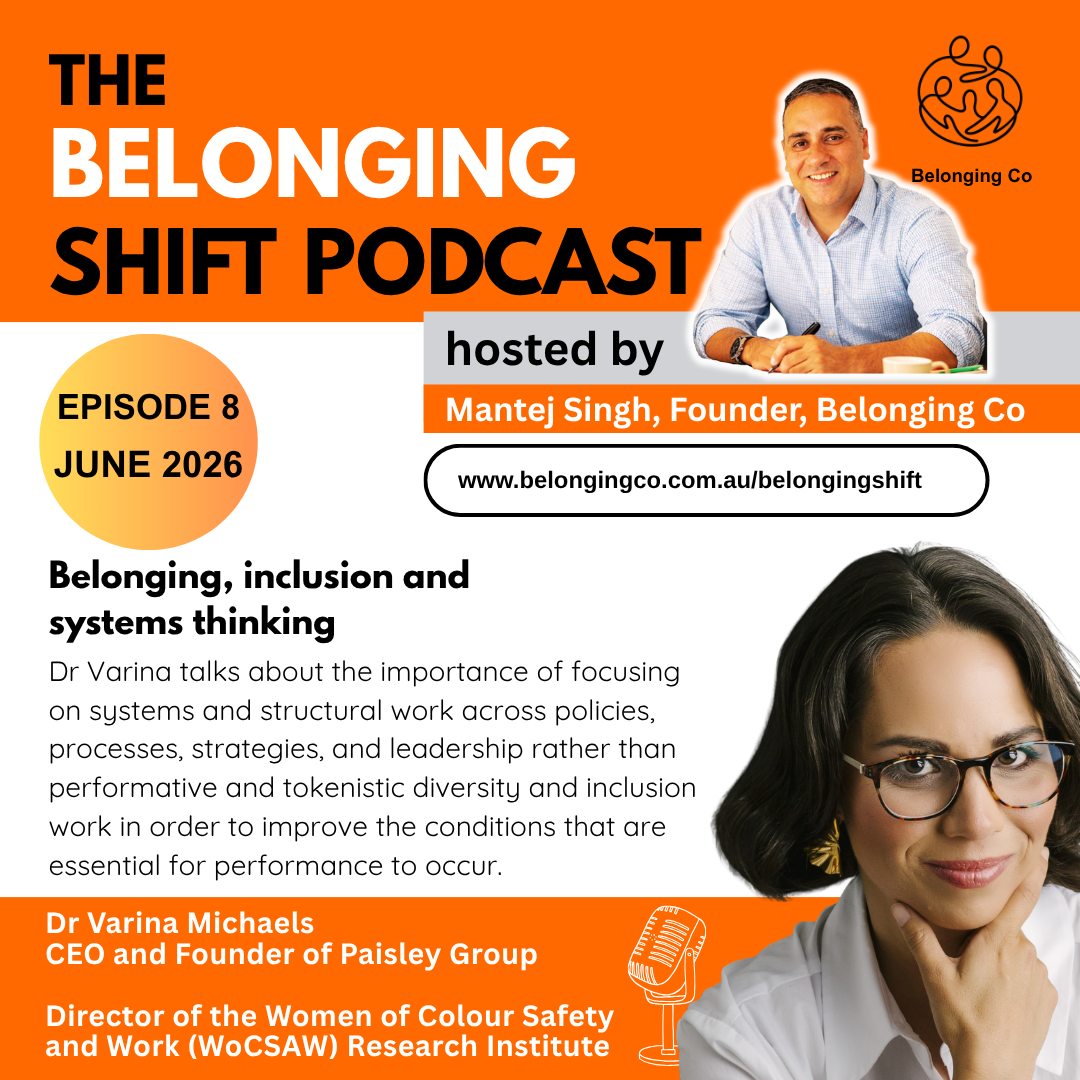
In this episode of The Belonging Shift, host Mantej Singh speaks with Dr Varina Michaels, CEO and Founder of Paisley Group and Director of the Women of Colour Safety and Work (WoCSAW) Research Institute.
Dr Varina talks about the importance of focusing on systems and structural work across policies, processes, strategies, and leadership rather than performative and tokenistic diversity, equity, and inclusion (DEI) work in order to improve the conditions that are essential for performance to occur. She says this structural shift is more than just advocacy. DEI shouldn't even be a thing that we have to actively seek and advocate for. It should be something that's embedded in the core way that the business functions, in the core strategy of the organization and in the culture of the organization.
Dr Varina’s advice for leaders and practitioners for making the #BelongingShift
Shift 1: Move from performative diversity and inclusion to systems and structural work
Shift 2: Don’t rely on marginalized people to carry the change; leaders and systems must take responsibility.
Shift 3: Simplify overlapping policies and build one coherent approach
Shift 4: Leaders need to replace assumptions with consultation and genuine and regular listening
Shift 5: Treat belonging and inclusion as infrastructure, not atmosphere
Listen to the full conversation using the links below or scroll down further to read the full transcript.
If this episode sparked a new idea, challenge, or possibility, share it with someone who’ll benefit or connect with Mantej to support your organisations work.
Connect with Dr Varina and Paisely Group
Dr Varina Michaels is a globally recognised expert in intersectional DEI, culture, leadership, and ethical community engagement. Dr Michaels holds a Ph.D. in Intersectional Identities at Work, is Founder and CEO of Paisley Group, Director of the Women of Colour Safety and Work (WoCSAW) Research Institute and Head of Programs and Impact at Women of Colour Australia.
She has designed and led programs that have reshaped organisational cultures, developed genuinely inclusive leaders, and dismantled systemic barriers with measurable business results to show for it. Her work has reached thousands across the globe and been featured in Forbes, Women's Agenda, and the Indian Sun.
Paisley Group is where lived experience meets professional excellence - all backed by science and through an intersectional lens. Centering community, we create spaces where everyone can collaborate, innovate and thrive.
Connect on LinkedIn - Paisely Group: www.linkedin.com/company/paisleygroup
Connect on LinkedIn - Dr Varina Michaels: www.linkedin.com/in/varina
Website - Paisely Group: www.paisleygroup.com.au
Website - Women of Colour: www.wocsaw.com.au and www.womenofcolour.org.au
Connect with Belonging Co
Belonging Co is a social and cultural inclusion consultancy helping executive leaders and organisations to strengthen inclusion, engagement, and participation outcomes across workplaces and communities — grounded in a unique belonging approach and a community perspective.
For more information, see links below
Book a FREE discovery call to discuss your needs.
Follow and connect with Mantej on LinkedIn
Follow and subscribe to The Belonging Shift Podcast
Listen to audio
APPLE PODCASTS | SPOTIFY | YOU TUBE | AMAZON MUSIC | IHEART RADIO | RSS FEED
Read transcript
Mantej Singh (00:00)
Hello everyone. My name is Mantej Singh. I am the founder of Belonging Co, which is a social and cultural inclusion consultancy here in Sydney, Australia. And I am so glad to have Dr. Varina Michaels, founder and CEO of Paisley Group with me on the Belonging Shift podcast to talk about all things, diversity, inclusion, belonging, cultural inclusion, and everything that surrounds that. Welcome to the podcast, Varina. So glad to have you here.
Dr Varina Michaels (00:26)
Thank you so much. I'm really excited to be here, Mantej. It's an important area and I'm looking forward to having a chat.
Mantej Singh (00:33)
Fantastic. So, Vareena, this podcast is the Belonging Shift and the intention of this podcast is to have conversations that shift the thinking, especially of leaders and organizations around how do we inspire organizations, communities to be places where people have a high sense of belonging across communities, place, leadership.
In that context, we're going to have this conversation, but before we get into the nuts and bolts of what is inclusion and what is not inclusion, can you tell us a bit about yourselves, who you are, what you do, and why does belonging matter to you in your area of work?
Dr Varina Michaels (01:11)
Yeah, great. I'm Dr. Verena Michaels. I'm CEO and founder of Paisley Group, a global consultancy. We specialize in intersectional diversity, equity, inclusion, culture, leadership, and community engagement. So I'm also director of the Women of Color Safety and Work Research Institute, and I head programs and impact for Women of Color Australia, a leading not-for-profit organization.
And I think my work is really entwined with this sense of belonging, but much of that comes from my own personal experiences and hearing the experiences of others. We talk about belonging like it's a nice to have or something that is optional. And what I have found both through research and practice working with international
multinational fortune 20 companies whether that's working with community grassroots organizations belonging is something that is essential to the key ingredients of having a happy and healthy life yes but also organizations functioning and people being productive being able to collaborate being able to innovate and thrive safer, respectful place where everyone can belong.
Mantej Singh (02:32)
So you've just talked about why belonging matters to this area of work. If I can take a step back and ask you, what does belonging mean to you personally? And if you had to define belonging without using the word belonging, what does that mean?
Dr Varina Michaels (02:46)
think early through life and certainly early through my career had a number of experiences that have shaped, meaningfully shaped my drive for this work. I'm one of those people and neurodivergent so I have a very natural sense of justice and I cannot sit back and see injustices happen without either saying something or it having an impact on me.
And so I think personally that has shaped my work in this space. And I have had a lot of experiences of being excluded or being asked to exclude others. Things like, I mean, I've worked in a lot of very male dominated spaces. And so the intrinsic, you know, sexism and harassment and safety issues that occur, the...
not so micro microaggressions. I mean I've experienced them personally but I've also been in spaces where that is commonplace, that's business as usual. And then unsurprisingly those same places and organizations can't work out why they don't get better performance or attract more talent. So I think there's a missing piece here for me around common sense approach. If you don't make people feel like
they are included, that they are seen, that they are valued. If you don't reward them for the work that they do, if we're talking specifically in the workplace, well, of course they're not going to give their all to you. Of course you're not going to get the most out of them. Of course they're not going to collaborate and innovate in the ways that you want them to. So I think a lot of times we focus on, you know, performance outcomes. but we don't focus on the conditions that are essential for performance to occur.
Mantej Singh (04:37)
So there's a sense of justice driving this work somewhere.
Dr Varina Michaels (04:42)
Yeah, absolutely. I think that's very strong for me and I'm very good at advocating for other people. Advocating for myself has been something that I've had to work on a lot but I'm very good at advocating for others.
Mantej Singh (04:56)
I think we can share that feeling for sure. I think that's when I speak to a lot of D&I practitioners, that's a common thing. That advocacy for others comes from passion, a sense of social justice, but it does cause in its way a lot of, you've to put yourself second many times and it does cause burnout and other things as well. So let's go dig a bit deeper into belonging.
You are an international expert in diversity and inclusion in cultural, intercultural inclusion in intersectionality practice. So when you look at that practice and that area of work, which is driven by research, lived experience, and on the ground work, what shifts are happening right now in this sector, in Australia, internationally, that are changing how people are experiencing belonging?
Dr Varina Michaels (05:39)
Well, I think the ongoing polarization and politicization of diversity, equity, inclusion is a significant challenge in the world right now. We can see very clearly the reverberations of what is happening in the US all over the world in terms of funding for this, in terms of legal appetite, in terms of the political appetite, but also just the dialogue. the conversations that people are having where we get into situations where perhaps, you know, we have a cost of living crisis at the moment. And it's very natural for people to want to find someone to blame and easy answers. And so we get into the circle of finger pointing and scapegoating. And again, that's just driving us further and further away from each other. Instead of being able to have these constructive spaces of dialogue. where we can come together and solve bigger systemic challenges. So I think what I'm seeing is in the workplace in particular, kind of twofold. You have those organizations who probably were largely doing performative and tokenistic work going, whew, okay, I don't have to do that anymore. I can put my resources into something else. And I wasn't genuinely committed to doing systems work.
structural changes. So I didn't see any of the upside or advantages of doing DEI. I'm also at the same time seeing increased appetite from people who have seen the changes and do understand that this work is systems work, is structural work. Having an awareness day and having cupcakes doesn't meaningfully change the conditions that people are working in. And so I think there is also segment and perhaps the segment that's less vocal and less seen that is leaning more into this work and wanting to really do it properly, do it meaningfully and measure it so they can see what the outcomes are because when you look at the data from a really well-designed program or structural change or initiative you can see the change in the numbers. You can see the change in
performance in levels of collaboration, in engagement. And so naturally you want to keep investing in that. And so I think there are two kind of camps at the moment in terms of this work.which is really interesting to see.
Mantej Singh (08:13)
Thanks, Varina. So the difference between cupcakes and systems work is what way this is. You're saying that's where the shift and the tension is between somebody who is genuine and somebody who is just doing it as a tick-box exercise.
Dr Varina Michaels (08:13)
that's it. in Australia, a lot of our DEI work has been that tick box exercise. So I think that's a really interesting shift.
Mantej Singh (08:32)
Right.
So for people who are not from this DEI world that might listen to this, and I guess many executive leaders are not from a DEI world, if I can make that assumption, what's the difference between systems work and performative DEI work? If you have to sort of outline for somebody listening and say, well, this is what this looks like.
Dr Varina Michaels (08:38)
Mm-hmm.
Yeah, absolutely. I think that there are different levels of maturity and so many organizations that I'm working with a lot at the moment get stuck in visibility and awareness work. So that's like your events, your lunch and learns, giving people information.
getting a panel of speakers together, that is necessary but it is insufficient for meaningful change. So we want people to have an awareness that these things exist, that these things matter. Great. But we also then need to start moving up the maturity level into inclusion in practice. So what does that mean? That means we're now looking at systems. We're now looking at
doing HR audits. We're looking at where biases might be embedded in the systems and processes that we're using. We are looking at leadership training and upskilling people on inclusive leadership because leadership is its own skill set and if we can sit down with a leader and talk to them about then what we want to do is go up another level of maturity and get into more of the structural change. That's where we're developing policies, we're developing strategy, we're embedding inclusiveness and also the measurement of equity outcomes in those policies and processes.
We live in these systems and organizations are systems and they, systems are reinforcing and mutually reinforcing. So you've got policy, you've got strategy, you've got leadership behavior, you've got culture.
All those things are parts of the system. And if you only change one thing, when whoever is driving that leaves the organization, the organization and the momentum in the organization tends to reset and go back to status quo. So in order to really have an effective and meaningful change on building an inclusive workplace where people can come to work to collaborate, innovate and thrive.
What we need to do is at the same time, all these pieces of work, get them all moving in the same direction so that the momentum of the organization meaningfully changes in a sustainable way that is going to continue beyond just the couple of advocates that you might have within the organization.
Mantej Singh (11:17)
So it's about building advocacy. It's not having a few passionate people, but as you say, across the system, everybody being a passionate advocate and a passionate supporter of diversity, equity and inclusion practice of work.
Dr Varina Michaels (11:30)
Yeah, it's to a degree, but I think in some cases, a better outcome than having everyone advocate for it is having it as business as usual. That's where we want to be. Like it shouldn't even be a thing that we have to actively seek and advocate for. It should be something that's embedded in the core way that the business functions, in the core strategy of the organization and in the culture of the organization.
And the more we can embed these things, the less we have to rely on people advocating, right? We don't want to have, and let's face it, the advocates are normally the most marginalized people within the organization. And so we're disproportionately putting the burden on people who are already underrepresented, who are already facing marginalization, who might be in conditions that are unsafe to then have to advocate for change. Like how is that?
fair and how can you expect good outcomes from those people when they're simultaneously having to deliver their job and advocate and educate the people around them. It really needs to be listening to the needs of the people impacted but changing the structures, changing the leadership behaviors, making leaders accountable for this instead of relying on people who are already
under significant pressure who are already facing burnout to not only do be the engine of the organization but also to be the advocates for structural change.
Mantej Singh (13:03)
I think that is so well said. certainly resonates with my experience. Advocacy comes out of passion from lived experience, but it has a huge cost, especially if you have Keep on doing it on top of your job. it's a cumulative ⁓ sort of pressure. It takes a toll on you So very rightly called out by you because you're right. We shouldn't be relying on a few passionate advocates.
It has to be embedded in the organization for the change to sustain. Otherwise it looks good for a while. And then when those people leave, then we go back to the baseline normal. so you've talked about that for diversity and inclusion work, to work, to be sustainable, leaders have to be Accountable for that. has to be, this work has to be embedded sustainably in the organization systems.
Dr Varina Michaels (13:41)
Mm-hmm.
Mantej Singh (13:50)
and with leadership accountability. I want to first ask the question, what do leaders and organizations commonly misunderstand about belonging and inclusion, and what do they get wrong?
Dr Varina Michaels (14:01)
Mantej, I could be here all day on this question.
Mantej Singh (14:03)
I know, I know, but take
your pick. What is your top four or five things that you want to tell leaders? So if any executive leader is listening right now to this conversation, and if we can convey to them, this is where leaders and organizations usually get wrong about how they approach belonging and inclusion.
Dr Varina Michaels (14:20)
certainly all the things that we've just touched on around the performative tokenistic, what getting stuck in visibility work. I think one of the biggest misconceptions is that they're doing it for someone else. Leaders think, I'm doing this because of this particular marginalized group or I'm doing this, I'm boosting representation but I'm
nine times out of 10, probably more in certain spaces. I'm the member of the dominant group, so it doesn't impact me. Actually, belonging and inclusion work does impact you. It makes the workplace a nicer place to be. It makes the workplace a more human place where people can be connected, where you can create really great ideas with other people and have other people thriving.
I don't know any leader who likes to go to work with a team who's burnt out, cranky and underperforming. So if you want your teams to perform at their maximum, if you want people to get to their full potential, if you want to have a bit of fun at work, then being an inclusive leader will help you achieve those outcomes. And I think that's the biggest misconception. And yes,
part of it is because of the leadership capability gap. Most leaders don't understand how that works and how to actually do that as a practice. There are also structural barriers that might be in place, but ultimately inclusion benefits everyone. It doesn't just benefit the people who are most marginalized and represented. And if you extrapolate that out to broader stakeholders,
Having a more representative organization, for example, in government means that you're going to be able to better deliver services and meet the needs of the community that you serve, the reason why you exist. If you're in a for-profit organization, it's going to help you better understand your customers and be able to get new and innovative ideas coming through so that you can keep making money.
Mantej Singh (16:26)
That's the most simplest, but the most sort of easily engaging pitch I've heard for belonging and inclusion in a long time. To have fun at work, you've got to value diversity and inclusion. That is really good.
So if through this podcast, if you can get to leaders and say, look, there's lots of barriers and challenges, but what is, if you have to pick the top thing that you've observed in recent times or across your practice, that that is a barrier or the hardest constraint in terms of leaders championing diversity, inclusion and belonging. What is that one top thing that you would want to advise leaders that you need to address this as a first thing?
Dr Varina Michaels (17:03)
Again, a few things come to mind. Certainly, I think having more conversations and doing more listening. So consulting with people about changes that impact them. Not only are you legally supposed to do that as an organization, it also produces better outcomes. I think we don't consult well enough. We're not accountable enough when we do consult.
And we need to do more listening.
Mantej Singh (17:31)
we've talked a lot about is what do leaders get wrong? And we've talked about where things don't work, the difference between structural issues and performative inclusion. We've talked about listening. Let's not talk about what do leaders and organizations get right.
So in your work and in your experience, what are some of the approaches that you've seen working well in and actually helping drive inclusion and belonging outcomes?
Dr Varina Michaels (17:58)
think there is an increased recognition that the law and compliance whilst useful can get in the way of implementation. Now what I mean by that is I do a lot of work in the areas of psychological safety, psychosocial safety which is now legislative and I support some work on positive duty.
for example. So they're all different types of safety within organizations with different mechanisms for compliance and also process. And what I see is that we have organizations have typically just layered new laws, new compliance, new policy, put another thing in the system and another thing in the system.
And what that means practically is that if you're a manager or you're a worker and you're trying to work out, you know, what should I do in this situation? You have to search out this information in like five, six, seven, eight, you know, 10 different policies and the policies don't talk to each other. They might have conflicting advice or standards or things that you need to do. It makes it operationally a really big mess.
And I have a lot of empathy for leaders who have to go through that and try and work out, you know, even if I want to do the right thing, what does that look like? And why do I have to wade through all this documentation and layers and layers of compliance to work out what to do when I'm really trying to do the right thing? And so what I've seen work is there is a bit of a movement to simplifying some of that.
to consolidating some of that. Now I'm not saying you still have to be compliant, right? You still have to make sure that your organization does the right thing and is protecting their staff. But there are ways to collapse things in a way that makes sense for the person who is ultimately going to have to implement that policy or make that decision. And so what does that look like? So for example,
My work and Mantej, you'd be familiar with this, with the Department of Climate Change, Energy, Environment and Water, New South Wales. We last year did quite a big project which started with community engagement through an intersectional lens and led to us creating the first ever Intersectional Action Plan, DEI Action Plan for Government. So instead of them having to go as a manager or a worker, having to go to
seven separate action plans, one for gender, one for multi-generations, one for LGBTQIA +, one for called culturally and linguistically diverse people, one for veterans, one for carers and so on and so forth. We were able to combine that into an intersectional action plan that identified the overarching things that were similar across people's experiences.
but also call out those different aspects within each of those groups as well and be compliant across those seven different action plans that are typically required in government.
Mantej Singh (21:07)
I really value the work that's happened there and well done to you and the DCCEEW team for producing that intersectional action plan. It's really good.
So to sort of finally end the podcast, I wanted to ask you if an executive leader was listening to this podcast and you could give them one final message to say,
to inspire them about diversity, inclusion and belonging practice, what would you want to say to them?
Dr Varina Michaels (21:32)
treat belonging and inclusion as infrastructure, not atmosphere or a nice to have or a soft skill. These are things that have meaningful
and often significant impact on the people within your organizations. And organizations are ultimately a collection of humans doing great work, hopefully. So if you want to have a great organization where people can innovate, collaborate and thrive, then you have to be embedding more structural work, more systems work when it comes to inclusion and belonging.
and support your leaders, train them, give them capability uplift, ⁓ show them what the process might look like and what that looks like in real life, and try and simplify some of the compliance, which is, ⁓ I'm sure, most people's least favorite part of their job is admin and compliance. So if you can simplify that for people, you'll get better outcomes.
Mantej Singh (22:36)
thanks, Varena. That is the title of this podcast, Build an Architecture, Not the Atmosphere, and create the place as a nice place to work both for people and leaders. So thank you so much for your time today. And thank you to everyone who is listening to the Belonging Shift podcast. This podcast is brought to you by Belonging Co., which is a social and cultural inclusion consultancy here in Sydney. If this ⁓ episode sparked any idea, challenge,
Dr Varina Michaels (22:40)
Mm.
Mantej Singh (23:00)
⁓ inspiration for you, connect with Dr. Verena Michaels from the Paisley Group, or myself from Belonging Co. Or anybody else that you think can support you in your work in inclusion and belonging practice, creating the architecture beyond the atmosphere.
continue this great work in diversity, including the belonging practice, because that is what, as Dr. Varina says, is going to make the workplace a nice place to be, both for leaders and for people. And that is going to drive the business impact, the monetary impact for organizations. Eventually, if people are happy, if people feel a sense of belonging, that'll show up in your balance sheet, and that'll show up in your business impact and community impact.
Thank you very much Vareena and thanks everyone for listening. This is Mantej Singh signing off from the Belonging Shit podcast. Till we see you next time. Thank you.
Dr Varina Michaels (23:50)
thanks. Bye.
