
Episode 11: Belonging, placemaking and healthy people, places and planet
In this episode
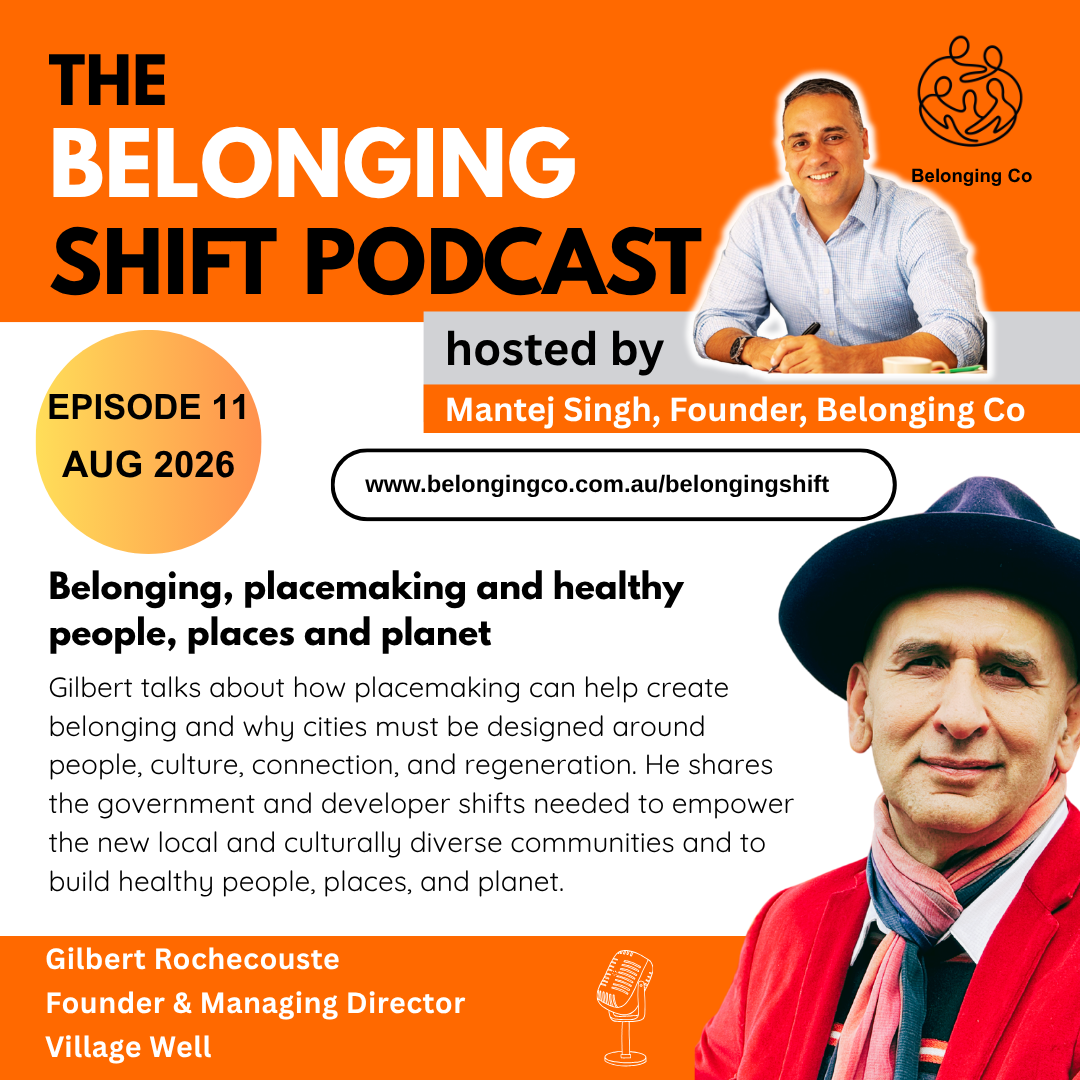
In this episode of The Belonging Shift, host Mantej Singh speaks with Gilbert Rochecouste, Founder and Creative Director of Village Well, about how placemaking can help create belonging in a time of social, economic and climate disruption. Gilbert reflects on his 30 years of placemaking experience and shares why communities need agency, why public places matter, and why future cities must be designed around people, culture, connection and regeneration. The conversation explores the new local, culturally diverse neighbourhoods, creative bureaucracy, developer and government responsibility, and the shifts needed to build healthy people, healthy places and a healthy planet.
Gilbert’s advice for leaders and practitioners for making the #BelongingShift
Shift 1: Create power with communities, not power over them
Shift 2: Become place-led and people-led, not planning-led, design-led or finance-led
Shift 3: Create places where people can live, work, gather and connect
Shift 4: Move beyond sustainability towards regeneration
Shift 5: Make the personal shift to belonging, self-organising and being community-led
Listen to the full conversation using the links below or scroll down further to read the full transcript.
If this episode sparked a new idea, challenge, or possibility, share it with someone who’ll benefit or connect with Mantej to support your organisation’s work.
Connect with Gilbert and Village Well
Gilbert is a globally recognised placemaking expert, known for creating vibrant and resilient places. Over the past 35 years, he has collaborated with more than 2,500 cities and communities worldwide. A sought-after speaker and master facilitator, he is skilled at unlocking potential and engaging stakeholders. Previously, the General Manager of Chadstone Shopping Centre, Gilbert also developed and managed Melbourne’s iconic Queen Victoria Night Markets. He pioneered the application of shopping centre management principles to main streets and went on to found Village Well, Australia’s first placemaking consultancy, and now its first Regenerative Placemaking consultancy.
Connect on LinkedIn: Gilbert Rochecouste | LinkedIn
Connect on LinkedIn: Village Well | LinkedIn
Website: https://www.villagewell.org/
Connect with Belonging Co
Belonging Co helps leaders drive participation, trust and engagement
Belonging Co delivers strategies, engagement, and programs for organisations and leaders wanting genuine impact across cultural inclusion, community participation and social cohesion.
For more information, see links below
Find ways to work with Belonging Co and book a discovery call
Undertake the Free Belonging Shift self-audit
Follow and connect with Mantej on LinkedIn
Follow and subscribe to The Belonging Shift Podcast
Listen to audio
APPLE PODCASTS | SPOTIFY | YOU TUBE | AMAZON MUSIC | IHEART RADIO | RSS FEED
Read transcript
Mantej (00:00)
Hello everyone, welcome to another episode of the Belonging Shift podcast, where we have conversations on leadership, community, place, and the future of belonging. I'm Mantej Singh, founder of Belonging Co., which is a social and cultural inclusion consultancy based here in Sydney, Australia. And in this podcast, I'm bringing in guests that are working across Australia, across the world, to build trust. participation, inclusion and belonging in the services, organizations, and communities they are helping shape. And it is my pleasure today to have with me Gilbert Rochecouste from VillageWell, who I have been a big admirer of and have interacted with in the placemaking space where I have spent some time over the years. And so welcome Gilbert It's so glad to have you.
Gilbert (00:52)
you. Great to be here, Mantej and thank you for having me.
Mantej (00:55)
Fantastic. So we'll get to talking to Gilbert about belonging in the placemaking space and his take on what's shifting, what needs to shift, and what probably needs not to happen. but Jil a renowned expert globally in placemaking. He's worked for over thirty years in the placemaking space. Even I guess I can say Gilbert much before even when it even if it was called placemaking you were doing this work. and Gilbert has led from shopping centers to community based placemaking globally across the world. And we we'll explore that in this in this podcast conversation today. So let's get stuck into it. Gilbert welcome again. It's great to have you here.
Gilbert (01:40)
Fantastic. Looking forward to having a great chat, Mantej.
Mantej (01:44)
Thank you. So Gilbert so let's get started. can you just tell us about who you are, what do you do, and and why does a sense of belonging matter to you in your area of work?
Gilbert (01:58)
Great question. Thanks, Mantej. Look, my name is Gilbert Rochecouste Good. I founded Village Well in 1992, and as you said, we're a placemaking organisation. We weren't called a placemaking organsation in its early days. We were really community activists and community enablers, as you said, Mantej. the name just came a little bit later. And I was born in Mauritius. I'm of of French, African and Indian descent. So I I see the world with many different eyes. And I suppose being born in a village in Mauritius was really where the DNA in the story started. I you know it it's the old saying it takes a village. and I think the the future of of of the world and where it's going is like we have a primal connection to
Living in a village, we did that for tens of thousands of years. And so my passion has always been around how to bring people together, how to bring people together to create good things, and how to bring people together to create safe, vibrant, flourishing communities for all, and that it's welcoming for all. So it's been a a journey of almost thirty-five years and over two thousand communities and cities and
And for me, what's been important, Mantej, is the glue of community. is that sense of connection and we would call it a sense of belonging. and I've always called it the glue. you know, when you find a community that is connected, deeply connected and knows itself, they're very resilient, they're very collaborative, they know who they are, they don't know they know who they they're not. they have a clear vision of how to work together and and it's something that I'm very interested in because I'm interested in the human condition and how we can unleash creative potential of people's creativity to do good. And I think there's we're in this interesting time where we're in between stories. you know one of my teachers, Johanna Masick Says that we're in we're in the time of the great turning, moving from an industrial growth society that we've had for a few hundred years to a story that's life sustaining. We know this story just does not work for everyone. It's a broken story now. And and a few people have really extracted from that story and have been have had great success. But now we're in between stories and we're looking for a story that I feel that nourishes life. And I think one of the
Pillars of that is belonging. How do we find place and sense of place and sense of community and a sense of dignity and a voice and agency in our own places? Because as the world gets more complex, you know, we can't really fix the world, but we can influence our places and and the place we live, work and play in. And I think this is where I think we're in the next evolution of democracy.
where that sense of belonging is now wanting to have a stronger voice. And I think that's coming through the agency of a new level of citizenship that's coming through, in particular, Australia, where I think we've got over 200 cultures, and a lot of those cultures don't have a voice. you know, 50 something percent of Australians are either got a parent born overseas or they're born overseas. So we have this extraordinary tapestry to tap into. And I think it's an exciting time. but also you know for some people it's a very anxious time, you know, with the loneliness epidemic and cost of living epidemic and wars and stresses and climate crisis and all these what I call a polycrisis of many factors has really created the conditions for change. And I think belonging is definitely a core pillar where people will find meaning. And I think as Hugh Mackay said, Mantej, a very learned scholar researcher, Australian scholar researcher said that, you know, the the greatest
Challenge of Australia is the search for meaning. You know, people have lost meaning. And that's what he found is that Australians are are really looking for something bigger than themselves, you know. and I think the dominant story of consumption just doesn't hold anymore. So we're looking for something bigger than ourselves. And so we live in interesting times. And I think what I'm interested in as a facilitator, as a placemaker, as a community activator and community organizer, is to give people agency and a voice through a bottom up approach. so people can find agency and a voice to build their own belonging.
Mantej (06:20)
Right. So you've taken us on a whole journey of, you know, voice and citizenship and agency and what's happening in terms of polycrisis and identity and meaning. I was really sort of so in tune listening to you describing what's happening in the world. But before we get go further and delve into belonging from a placemaking perspective, I wanted to understand what belonging means to you personally. So How would you, Gilbert define belonging if you couldn't use the word belonging? What does it mean to you personally in terms of your your own genesis story?
Gilbert (07:00)
Yeah, so great question, Mantej I think for me this whole work and journey is I call it it's an inside job.
Mantej (07:08)
Yeah.
Gilbert (07:09)
and I need to find belonging in myself. And I think that's the concept of the care of self and the self love of self and self-awareness. So for me what's important is that I find that sense of connection within myself and having my own meaningful narrative of belonging and how I you know it's you know it's the old saying know thyself and once you do that I think you can see the humility, the grace, the intentionality, and how they create belonging around them. You know, it's almost a magnetic field.
But I think there is always something a few elements of that. It's always something bigger than yourself. And I think that's where we get to the concept of service, service to others. So for me that's really important. And I think where that comes from for me is obviously through my service to community, but also, you know, I have a strong connection to friends and family and my local community, which I support and help. with, you know, of vulnerable groups or the local shops and retailers. So I think we need to find belonging through ourselves and in place.
Mantej (08:14)
So what I've heard from you, Gilbert is that belonging starts with knowing thyself, then knowing the community, the place, and then investing in community and place. but as you said at the beginning, Australia is at a great turning. There's, you know, fifty percent people with cultural diversity, and everybody
When when you have a diverse society, diverse community, you have more people with different senses of belonging about what matters to them, what values they bring to that melting pot of a community and place and a neighbourhood. So if you reflect on that, what shifts are occurring in in the placemaking space or the sector that you've been working in over the last few years or in recent times, when you reflect on that that people want different things contribute to their sense of belonging.
Gilbert (09:07)
Yeah, look, I think and challenge it's been happening for some years now, where which I mentioned You know, when there's when a story's broken and the story's not really helping all society, all communities, we need a new story. So I think COVID was a real catalytic point. It was a a wake up call and I think that shifted a lot of people to pause and reflect and a lot of people obviously were
COVID had some silver linings, but also it was very traumatic for a lot of people. but I think what it did do was for many, for many, for many elements, including nature, it gave nature a bit of breathing space. It gave families and communities a bit of breathing space. It brought us back to pause and reflect, you know, it brought us back to the local, our local communities, you know. We saw hundreds of thousands of verges being illegally planted because we couldn't go anywhere. We planted seeds and plants on our nature strips and we talked to our neighbours, we shared food. so when you think about that as a catalytic point, I think we're emerging into a concept called the new local. It's birthing the concept of a new local and a new belonging. as I said before, as the world gets more complex.
the only thing that we can influence is our place and is our local community. and you know, one of the crises of Australia is the crisis of loneliness. As I said before, so I think people want connection. And where we're seeing the grassroots come into to be now and local communities and local artists through culture through festivals or local markets or local rituals.
They want to find forms both online and and in in place to connect. But more than connect, find some form of meaning. so ultimately, I think what we're finding is that in our cross-cultural lens, we're seeing a lot of these groups, cultural groups, starting to form their own what I'll call cross cultural gifts back to Australian communities. 'Cause I think immigrants and people from different cultural groups in the last fifty to a hundred years have got great gifts that they can give to the whole of society. I'm talking about Australia and I'm talking about food and the arts and community,
A lot of multicultural groups present their gifts back to their in in in main streets, you know, you see places in where I'm from, in Melbourne, little Korea town that's just emerged in the last three years, you know, in the center of the city, a dozen Korean shops, and it's created this extraordinary buzz. But we've always had, you know, Ligon Street, little Italy, we've had little Africa, little India, little Saigon, you know, we have Spanish town. We have all these cultural groups really through place and place activation and place making, but really presenting themselves. 'Cause these groups and cultural groups come from a very different framework of engaging in place. Most of their communities were street based and street life where there wasn't a lot of rules back in Africa or Asia or in India. We just did stuff.
And look, there's there's a reason why we have good planning, good, but we've sanitized our environments. where we've lost that sense of imagination and spontaneity and pop-up things happening and so you know it We need to rethink our models of planning and design and architecture, and city making through place making, 'cause there'll be places where you know, we're potentially we're creating environments for half a million people, but sixty percent of that community will be from this Indian subcontinent. What does that actually mean culturally for cemeteries and rituals and cultural retail and street life and religious anchors and parks and but how do we create harmonious connections with all the different cultures? So there's the great opportunity for our time and a great challenge because there's a lot of blocks that stopping a lot of that creativity to be unleashed and that voices to be unleashed.
Mantej (13:01)
Gilbert, want to build on what you just said, on from two perspectives. The first question is when you say that, you know, there's more diversity and we need to understand and embrace street life and empower people to activate places is Essentially what you were saying, and design places for new emerging diverse communities.
In that context, would people who are not diverse or not culturally diverse or living in Australia for a long time, would they feel that they are losing something because places and spaces are being designed differently or activated differently, and it's sort of challenging their sense of belonging? Is is there a chance of that?
Gilbert (13:43)
Well, I think there there is, and we have to be very mindful of we don't go to the extreme. We have to build places for all people. And I think this is where the concept of public anchors are really important. And that's for everyone. Like I'm talking about a public piazza, you know, or public parks or public cultural anchors we all use. But in these public, say piazzas or agoras, we can have many different cultures. having festivals and celebrations in that. They're gathering places really. And I think it's the key, that's the key. It's really create designing gathering places. And I think Mantej last time I spoke to you, one of our projects we did for the GPT group, Lend Lease, was Rouse Hill, I know you you live not too far from that, but you know the concept of
Mantej (14:29)
No, I'm very close and I'm very fond of it. I go there regularly.
Gilbert (14:32)
There you go. But you know, it's a very rare space in Australia because most shopping centres are big boxes and they're very sanitized and closed off and they're placeless. But Rouse Hill was created with a main street, with a piazza, with a library, a secret garden, and lots of open air. you know, the they've planned public transport as part of that you know, connect connectivity. it's very walkable. So That that is the seed, I think. You know, many cultures live around Rouse Hill, but they have a cross-cultural sort of festival program. And when we helped design and create the activation plan and brief the designers in that making sure that the art reflected that the place and the essence, that became a you know, that in itself was a town. It wasn't a shopping centre, it became a village.
So that's the key, I think, to make sure that everyone's welcomed. And I think when there is a critical mass of a cultural group, let's not sanitize the shopping center and make it what I call very beige, because what I think is that we need to create street light, but also share and activate the needs of that community. And if say they're either Asian or from Africa or say from the Indian subcontinent, you know, we need to have their needs met. And that could be cultural food, cultural fashion, cultural retail, cultural events, but only on a component, not all of it. But this is where I think when we do research with the Anglo communities from Australians who've been here for three or four or five generations, especially in the cities, and sometimes in the country towns, they love their, you know, their Indian restaurants, their Chinese restaurants, they love their festivals.
You know, sometimes they have you know, in a place in city, I forgot its name, there, they've got a Japanese garden, but you know, they have a Japanese festival every year. all of these things create a sense of diversity but also celebration and embracing difference. There's always gonna be a small group that doesn't want change, Mantej, and that's just in every society. But on the whole, Australians are very, you know, embracing of newness of different cultural groups and we need to really be on our toes with that at this moment because globally we're sort of getting a push towards right wing thinking and anti immigration. So I think the more you know we that we focus on the arts and the cultural elements and embracing celebration can be a great connector for all cultures and all communities.
Mantej (16:56)
So embracing diversity you're saying is key to placemaking, diversity of arts, culture, people, community. And so if I wanna build on that, can you do two things for me? One is for people who are listening who don't understand what placemaking is. If you can just define placemaking and also talk about if you have to tell People working in the placemaking space, what should be the do's and don'ts of building belonging through placemaking?
Gilbert (17:29)
Nice one. Yeah, look, so the first question is about a definition and there's a thousand definitions I want to say of placemaking. So but just one or two definitions is, you know, one it's simple one is about creating lovable places, creating places that people love. And that can open up a huge amount of you know, discussion and one is also how do we help create and design, you know, places that people not only love, but they're connected to, you know, connecting people and place. So there's some key words there about co-creation, designing, planning. but it's about people. If you start with people and place, you get people in place. If you start with design, you get design. If you start with infrastructure, you get infrastructure. We have to start with people and place.
That's what humanity is always connected to from the oldest human, you know, gathering and habitats and cities of yesteryear is like we really come together to share stories and and and exchange. And those key exchanges are economic exchange, it could be a market or local shops, it could be social exchange, and that could be through, you know, connection to people on the street, your community.
There could be cultural exchange through activation and also, you know, festivals and the arts. There could be also ecological exchange where there's trees, there's parks, there's gardens. And there could be spiritual exchange, you know, where the art inspires you around indigenous thinking or or there's a church ground where you can have a little space where you can just reflect for everybody. You know, these things are all important, those five pillars.
ultimately, what we want something and I'm very passionate now that we need regenerative placemaking. We need to put back more than we take out because placemaking in the past has been extractive. And for your audience, what I mean by regenerate is putting back more than we take out. But placemaking is also about the software. And what I mean by that, like an easy thing is like when builders and infrastructure and architects come, they like to build up the hardware, you know, the buildings, the roads, you know, all of those things that's solid and we we need them all. But what brings all that to life is people. You know, local shops, local festivals, little areas to sit in, you know, shade, beautiful trees, pocket parks, a look great library, a great art.
Gallery, a great community harbour, community centre, neighborhood center. All of these things are where the activities and where we meet, where we exchange. That's the software. So we need placemaking is really about the software of community building. But we don't we don't do all the do that very well, unfortunately.
Mantej (20:06)
So this is the belonging shift and we're asking for shifts. So if you reflect on your practice and you work with so many organizations, so many places across the world and in in Australia, what are the top three or five, if you want to indulge in go to five, shifts that you would want people in government, in the development sector to make? Things they're not doing properly. And that you would want them to shift or flip or do differently. what's your top five tips or or shifts you want people to make?
Gilbert (20:38)
Great question. And I think one of the ones that community is yearning for and really Asking for is a level of empowerment and agency. That was that's the first shift. We need to sort of create power with, not power over. And we need to sort of embolden the grassroots. And governments need to be facilitators of change, not the directors of change. They need to allow communities to do what communities do well, and that's create community. It takes a community, it takes a village. So get out of the way, facilitate.
you know, the second part is to reimagine the culture of our organisations to be place led. And that's really important because at the moment they're planning led or design led or or financially led. So that loses that concept of the people. So that's where we need to make sure all our org you know, take example for a council, you know, that ten organisations can come together in a framework that becomes place led and people led.
So they're all working together to embolden and give agency to people. So that's the second one. The third one I would say is the largest and biggest institution on the planet is business and developers. So we need a new ethic or social responsibility band-aid for the development industry. But they need to be incentivized. At the moment, we incentivize our development.
community to do bad things, you know, urban sprawl. We cut up land and just sell it and then we leave it to councils to fix up or you know, this is where we got the loneliness epidemic in our suburbs. So we need to make sure that, you know, developers lead with place and placemaking, that they're building amenity and work to invest back in you know, creating good level of transport hubs through to
Creating towns and villages, not boxes, and mixed use centres that people can live, work and play in so they're not stuck in traffic for four or five hours. I think the third the fourth one would be the concept of that we need to shift our stories. You know, we need to move from sustainability to regenerative practices. it's an old story - sustainability now. But what are we sustaining? We're sustaining a very, dare I say, a very a system that's eating it itself to death. It's a toxic system. So it's very extractive. So, we need to radicalise sustainability towards regeneration and regenerative agriculture or regenerative communities, regenerative design, regenerative finance. And then the fifth one I would say we need to shift ourselves.
You know, it's a personal shift. That we are the ones that we've been waiting for. We can't wait anymore. So we can't wait for a you know, the guru or the you know, another saviour. I think it's gonna take a village. And I think this is the exciting bit, Mantej I think this is where people power is coming to the fore and and I'm seeing lots of young people you know adopting radical simplicity, we're seeing transition towns, we're seeing communities building resilience, we're seeing crowdfunding from local communities to crowdfund their own destiny.
So all of these things are coming back to what I call, in the bigger narrative of those five things, back to place and back to back to the local and back to an agency where we can work together as communities and we can come together and build new visions and new places for the next generation and future generations. And it's happening now. So that's the exciting things that are happening.
Mantej (24:01)
great shifts, Gilbert So from you know, community led, place led, challenging social sustainability to regenerative social sustainability, shifting stories, and you know, be the change that you want to be, is what you're suggesting. And I mean, that's kind of very aligned with the values that I've worked with across my career in life. it it's not always based on dividends, but it's at it's definitely in alignment with myself.
So my question to you is if all of this is not complicated, you know, giving power to the local, bottoms up decision making and empowering people. So what's preventing leaders and organizations from doing it or embracing it in in the way we want to? Because it's not happening everywhere.
Gilbert (24:46)
No, it's not happening everywhere, and that is the issue. And I think we're people they don't know what they don't know. This is the thing, I think, Mantej, when we present these extraordinary case studies from around the world and people go, Ding, well, we can do that.
So these grassroots stories are not promoted or told. That's the issue. And when we know that there's other transformative processes and ways, we click in. And I think this is where this the work is. We need to get to the five percent. We don't need the 95% to change. We need the tipping point of five percent, and we know that from science, you know, you get that that early adopters, the five percent, and then bang. So that's what I think is important. And what's stopping them is the lack of they're stuck in an old story. They can't can't even see the trees from the forest. And the importance of what is that new story.
Mantej (25:40)
you know, change has to start somewhere and you've got to take charge of the situation. And that's very connected to my own story why we are talking right now, because this conversation would not have happened in that system that I was operating in. my last question to you is this if you had two minutes and you had the top ten developers, the top ten top of government people and people listening, and you had to say, in order to build belonging through placemaking, and as we build cities and infrastructure in places. This is my message and advice to all of you about building a country, a place with diverse communities. this is what I want you to do to build a sense of belonging. What's your message?
Gilbert (26:26)
Well if I had the top ten developers in front of me, I would actually target their collective self interest gene, you know? And that's the only way you're gonna change because I used to manage the biggest shopping center in Australia, Chadston Shopping Centre, and it's all about self-interest.
So but let's let's talk about collective self interest. So if they can make a dollar and make more money, this is the way I would say it, that there's a new generation of what I call cultural creatives and consumers coming into the fore and what they're really wanting is a the good life. And if you can create the good life in in creating beautiful places that they love.
And sticky places that they can stay longer in that's full of meaning and connection. Great coffee, great food, a great day economy, a great night economy, beautiful spaces, and give them opportunities to do good for the planet and themselves around the inner life and outer life. You're gonna make a squillion dollars. And if you don't do it, you're gonna be out of the game. And the smart developers get this in Australia and they're onto it. And so doing good is good for business, doing good is good for the planet, doing good is good for our inner selves and also our families, our friends and our villages.
Mantej (27:42)
thanks Gilbert. and if instead of developers you had the top ten government people, the top of the department secretaries and be the same advice?
Gilbert (27:49)
Well I would say to the to the government people is that the future is about creative bureaucracy. And what that means is really your role is to facilitate if and your role as to create healthy people and healthy citizens. And your role is to open up and create a new system of governance that unleashes the creative potential of the local people. You know, simplify everything and bring it back to empowering individuals and communities and empowering resilience on the local level, including business small business, and building that resilience is the future and key to great, you know, what I call creative local governments and you know larger governments. If you can do that, you're really landing in the sweet spot of your greater goal as a government official to create great, you know, healthy citizens and healthy places and a healthy planet.
Mantej (28:42)
I think that's a that's you can't get better than that in finishing a podcast. So healthy people, healthy places, healthy planet. And and give more than you take and create spaces where people have a good time and and are able to do good for the for the planet. So I think that's beautiful, Gilbert. Very well said. and thank you for your time. And thanks to everyone for listening to the Belonging Shift Podcast.
this podcast is brought to you by Belonging Co., which is a social and cultural inclusion consultancy here in Sydney, Australia. If this episode sparked a new idea, challenge, or possibility, share it with someone in your network. Stay connected for more conversations and practical insights on leadership, inclusion, community, and the future of belonging.
And Gilbert, let's stay connected and build healthy places for healthy people who are doing good for the planet. Thank you, Gilbert
Gilbert (29:35)
Thanks so much, Mantej. All the best.
