
Episode 12: Belonging, Universal Design and welcoming
In this episode
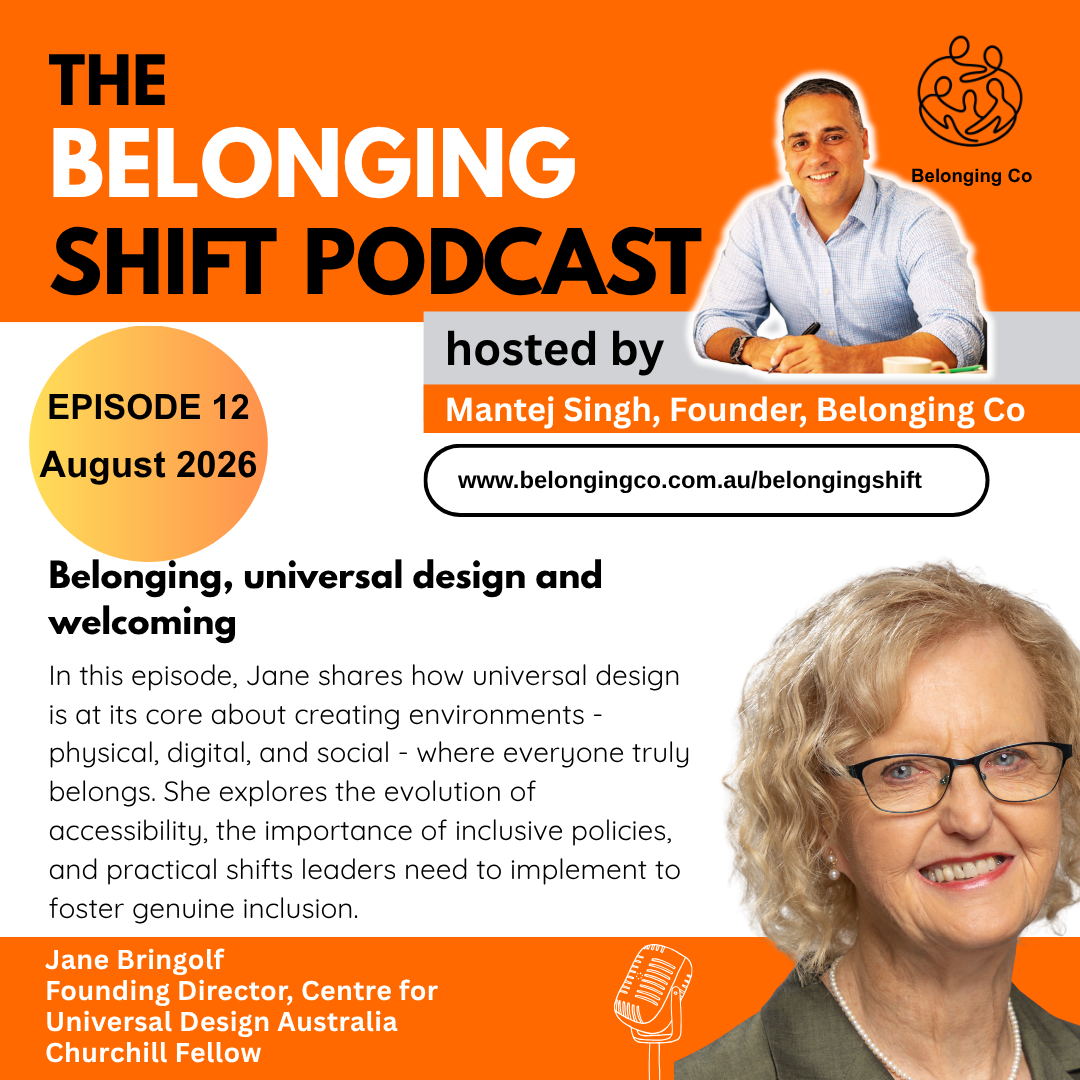
In this episode of The Belonging Shift, host Mantej Singh speaks with Jane Bringolf, a long-time advocate, writer and leader in universal design and inclusive practice and a Churchill Fellow. They explore why universal design is not just about ramps, access standards or compliance but about designing places, services, policies and cultures where people are welcomed, considered and able to belong without having to ask for special treatment.
Jane and Mantej also discuss the origins of universal design as a rights movement, the difference between universal design and universal access and how belonging and welcoming underpin universal design. The conversation also goes into Australian values, cultural inclusion and days of significance, and most importantly - Why does a ramp not say "you belong"?
This conversation is for executive leaders, community builders, designers, policy makers and practitioners who want to understand how belonging can be built into everyday decisions: not added later as an afterthought.
Jane’s advice for leaders and practitioners for making the #BelongingShift
Shift 1: Move from access and compliance to welcome, dignity, and belonging
Shift 2: Design for everyone, everywhere, every time
Shift 3: Replace separate policies with one universal intersectional approach
Shift 4: Go where people are. Listen and engage in everyday places
Shift 5: Share power with people as contributors, not problems to be fixed
Listen to the full conversation using the links below or scroll down further to read the full transcript.
If this episode sparked a new idea, challenge, or possibility, share it with someone who’ll benefit or connect with Mantej to support your organisations work.
Connect with Jane
Jane Bringolf has worked in the ageing and disability sectors for more than 40 years and has a strong interest in universal design and inclusive practice. She was a founding director of Centre for Universal Design Australia which is now managed by the Melbourne Disability Institute. She writes regularly on universal design and inclusive practice and participates in conferences and forums. She wants to see a world where designers and policy makers automatically consider the diversity of the population and create inclusive built environments, products, policies and digital services. She continues to contribute to government and industry advisory panels and working parties to promote inclusive thinking and universal design.
Connect on LinkedIn: Jane Bringolf | LinkedIn
Connect on LinkedIn: Centre for Universal Design Australia
Website : Centre for Universal Design Australia
Connect with Belonging Co
Belonging Co helps leaders drive participation, trust and engagement.
If your organisation needs help in embedding belonging, engagement and participation in your place, program and organisational outcomes then reach out to Mantej at Belonging Co or visit www.belongingco.com.au for more.
For more information, see links below
Find ways to work with Belonging Co and book a discovery call
Undertake the Free Belonging Shift self-audit
Follow and connect with Mantej on LinkedIn
Follow and subscribe to The Belonging Shift Podcast
Listen to audio
APPLE PODCASTS | SPOTIFY | YOU TUBE | AMAZON MUSIC | IHEART RADIO | RSS FEED
Read transcript
Mantej Singh (00:00)
Good morning, Jane. Welcome to the Belonging Shift Podcast. and for everyone listening, my name is Mantej Singh. I'm the host of this Belonging Shift Podcast and the founder of Belonging Co., which is a social and cultural inclusion consultancy here in Sydney, where we work with executive leaders, to drive the understanding, awareness, and outcomes that build belonging in organizations, both internally but in the work organizations do.
And I'm so glad to have with me here Jane Bringolf, who is the founder of Center for Universal Design Australia. And we'll hear a bit more about that. Jane is somebody that I've known for some time. we were on an access advisory committee at Sydney Olympic Park together, but Jane over the years has spent a lot of time advocating for disability, aging, and broader inclusion outcomes ⁓ in
in the sector, in various organizations, but as part of various boards and advisory capacities she works in But welcome Jane to the Belonging Shift Podcast. It's so good to have you here.
Jane Bringolf (00:58)
Thank you, Mantej. It's honor to be invited to talk about belonging
Mantej Singh (01:03)
So, Jane, let's get ⁓ going about to learn more about what across your broad career and long career. What what is your advice and wisdom gained around belonging and inclusion that can inspire today's leaders about what works, what doesn't work,
Can you tell us a bit about yourselves? Who you are, what do you do, and and why does a sense of belonging matter to you?
Jane Bringolf (01:25)
a sense of belonging is everything that universal design is about. Now I didn't understand that when I first started investigating and becoming involved and ⁓ interested in the concept of universal design. because ⁓ when we when we take the history of universal design it goes back to things like curb cuts and ⁓ being able to get wheelchairs across the street, you know, and that was, you know, the sort of nineteen seventies, nineteen eighties idea of accessibility. And that then grew into well, if a wheelchair can get across the street, so can a pram and a and a a shopping trolley and and so on. And then that is how the term universal
became because it was seen as good for everybody. Now that's a very simplistic idea in the beginning and it's become much more nuanced as the years have gone on. Now I mean we're more than 40 years on from that idea. And for me it is personal because I was born with a cleft palette, which affected my speech. I did have a palette repair I spent years two years I remember of my school life going to speech therapists. But it wasn't just that, it was being excluded in the schoolyard, being bullied because of the way that I spoke and because I looked a bit different. I was very, very thin at the time. And
I I can remember some all I wanted to do was to be part of the group. I wanted to be invited to the birthday parties, the same as all the other girls. And so for me, I think that understanding of exclusion came very early in my life. And so the that's why I think that I became ⁓ attached to the concept of universal design. quite easily is because instantly I understood that inclusion is one thing, but inclusion really is the route to belonging. that's where it is for me. It begins and ends. It begins with a curb cut and ends with belonging. But belonging is only still part of that because you can belong to a family
But when you go to the wedding or the funeral or the Christmas party, are you actually welcome? And I think that welcome is another word that we need to introduce into the language of inclusion but belonging. So ⁓ that's that's where where I'm at in terms of my own experience of wanting to belong and and being excluded.
I think if you have really experienced that kind of discrimination, and and it happened again when I came to Australia because I came from London. While I had English as my first language, my accent wasn't quite the same as everybody else's. And some people might think that because ⁓ I was English
That I automatically fitted in. Well I didn't, because there are so many different cultural aspects of fitting in. So I guess you could say I had a double whammy, but I I mean it also gives me that concept of how how when you come to this country that how hard it is to have that sense of belonging.
Mantej Singh (04:47)
No, thank you, Jane, for sharing that. I think ⁓ you you've talked this interesting journey from welcome to belonging to fitting in. These are these are very interesting words that have each have their own meaning. And we'll explore that in this podcast. But I think that the the interesting thing you are saying also is that you know, as they say, just be because you fit in, you don't necessarily belong. Fitting in and belonging in are different things. And I also think that you know you're talking about coming from London. and not fitting in in Australia. And I think in that context also about migrants and refugees who are coming in from ⁓ countries where they are more oppressed and marginalized. And that's what might they be facing also in addition to like if somebody like you, which is educated, ⁓ you know, knows what they want to do, coming from you know, UK, which is a developed country, and if you are finding it challenging,
And you've experiencing that, then it must be another multiple other layers for lots of other people.
Jane Bringolf (05:43)
Yeah, absolutely, absolutely. So I don't claim to have the same lived experience by any stretch of the imagination. And but what I can say is how much accent matters because gradually as my accent accent changed, first of all people thought I was from New Zealand, then they thought maybe I was from Perth and then Adelaide.
And then eventually they stopped asking. So but it is all also that thing of how can you belong when someone says where do you come from? And what they really mean is not did you come from, you know, Tarumara, they mean what country did you come from? You know, and ⁓ you know, 'cause
Mantej Singh (06:22)
Yes.
Jane Bringolf (06:25)
I really like it when people respond, who who have have come from another country and they say, well, ⁓ I come from Burwood
Mantej Singh (06:33)
Yes, yes. I've yeah, I I've certainly been through the experiences myself and I think as I say in some of my trainings, you know, it's it's when you ask that question five times in a row, even when somebody's given the answer, you're actually wanting a different answer. You're wanting to sort of almost reinforce what you think, but you want the other person to confirm it and ⁓ it's stereotyping in a way, but it also goes into fitting in and belonging because essentially that
Jane Bringolf (06:48)
Yeah.
Yes.
Mantej Singh (06:59)
puts somebody in a position where they've got to say that they are not from here. And that's the intention behind it. Okay. So before we go further into it, I guess I wanted for our listeners to understand sort of your professional journey. And if you can talk a bit more about the Center for Universal Design, what does it do and and where it's at currently because that's an organization you founded and that's played a pivotal role in championing universal design in Australia.
Jane Bringolf (07:04)
Yeah, yeah.
Mantej Singh (07:26)
And what are you currently ⁓ doing? And then we can get it stuck into questions around belonging.
Jane Bringolf (07:31)
Okay. So the Centre for Universal Design ⁓ began from ⁓ a conference in twenty fourteen on universal design and at the end of it the then disability and aging commissioner Susan Ryan stood up at the end and said, What we need in Australia is a centre for universal design. And before I knew what knew what was happening, I found myself investigating how to do that, how to set it up. And ⁓ eventually, long story short, we became a legal entity and started I started working totally as a volunteer and continued for the next 10 to 12 years working as a volunteer to just sell the message as best I could.
And I was using the concept from my Churchill Fellowship where I met someone who said, if you want something to happen, you have to be everywhere on the issues. And that is what I did. I grabbed every opportunity that I could find to be able to talk about universal design in the context of whoever was asking me because universal design covers absolutely everything you design. So even these podcasts.
need to be universally designed. So that's things like captioning and being able to speak in a plain language and have ways in which people can join in. I notice that you also have a transcript. So all of that is really telling people that they're included and those are the sorts of things we like to see. The What I've seen over time is how much the concept has evolved from just basic access on the street to buildings and how that might let people in but it doesn't encourage them to belong and ⁓ and to feel welcome.
Mantej Singh (09:28)
Jane.
Thank you for sort of giving that sort of background and history.
And so what you really advocate for is it's not just the built environment, it's the it's the environments, physical, virtual, online, digital, products, policies, service, universal design applied universally to everything, basically, is what you're advocating for. And if if and and you're the point you're saying is that if and it goes back into your context of fitting in and belonging, right?
Jane Bringolf (09:47)
Yeah.
Mantej Singh (09:54)
that if if it's if you design everything universally, then people don't have to fit in. The everybody just belongs, I guess is the idea behind it. so if if you can if you can elaborate that a bit in in the context of what's the relationship between universal design and belonging?
Jane Bringolf (10:10)
completely underpins it. It's what it's what you aim for.
A universal d universal design started as a rights movement. You know, I have the right to have entry. I have the right to be there. But I think universal design has moved past that to you know, rights are important. I don't don't dismiss them and
They've done a lot in this space. but the problem with rights is that someone has to give them to you. So it means that someone is withholding them from you and they decide when you get them. And that is the people who have the rights or rival already are then in my mind privileged.
And a lot of privileged people do not want to give up that privilege or they think that by giving people their rights they will lose some privilege. And that is I think the the hard part. So the the aim of being able to get in the building, to get onto the train, to be able to use the footpath, goes beyond just physical access. it's a bit like it's i if you don't feel if you get to the place and you don't feel welcome and you don't feel like you belong, your time there is going to be very limited. You will only do exactly what you need to do. And if you can avoid doing it altogether you will. So I think we have to think a lot more broadly
Than what a lot of access consultants consider is universal access. Now, I just want to say something about universal access because it's neither universal design and it's not access auditing either. It's put trying to put the two things together and make them into one thing. But universal access is always built around. what is compliance and what are the standards. And maybe we can tack on a little bit more beyond that. And I I think a ramp does not necessarily say I belong. A ramp, in fact, says you are special. You are the others. And you know we I I'm using the real standard stereotypical wheelchair user. here in terms of disability. It also says the same thing to anybody who cannot climb steps. So even a even a parent with a stroller is being told you are not welcome in the same way as anybody else who can walk through the main entry door. So I I think it is the essence of what we're trying to achieve in universal design is belonging and feeling welcomed.
Mantej Singh (12:53)
I think you said a really good point here, Jane. I I really like it because when I look at cultural inclusion also, when I look at how we we look at migration, when I look at how we look at sort of things like neurodiversity, organizations, institutions, not necessarily people but systems, are certainly treating this as a special case. You know? I remember 20, 30 years since I've been working in the sector and I started there in India. And we we there was a term which was commonly used which was called people with special needs. And so and so it it is like, you know, somebody is giving you access and making you feel special because you are special. But but what you're saying is we don't want people to feel special. We just want people to just be people and not actually get attention at all. They should they should be. able to go in, get the same services experiences without anybody treating them special at all.
Jane Bringolf (13:41)
Yep. Exactly. Exactly. Yeah. And I and I think that the that in one of your other podcasts this this was this was also ⁓ alluded to that special treatment continues to other. And we see that in terms of I mean one of my things that, you know, like either the people who know me know that I like to be a bit provocative at times, but I think that we should be doing away with special days, you know, like seniors week and, you know, a special day for people with disability, international, you know. I mean they have their place and they have been needed, but I really would like to see a time when we don't perpetuate that that othering through having days I mean w we don't need one day a year.
we need every day of the year. And, you know, so I I think that all this I I feel like it's a real charity hangover from, you know, last century that you you know so these are these poor, unfortunate people over here who aren't like us, whoever us is, and ⁓ we we could guess at that. they are the people who make the rules and they are the people who say they are in the they're the norm, they're the normal. and so one day a year we'll make a fuss of them, you know. And so I I find that quite patronizing myself. So as a senior myself and even that word has problems, you know. I'm I'm just older. but you won't see me at any seniors event.
Because just the language is enough to put me off. And it also makes assumptions that I only want to be with older people. And that's not true either. And I can remember my mother making the mistake with me one time talking about ⁓ the Paralympics and how it was nice for all those people to be together with each other, you know, like as if they were
only wanting to be friends with other people with disabilities, you know. And I I was quite sort of my mother obviously was much older than you know, I mean a t total generation away. but, you know, that I I still think there are some hangovers from that.
Mantej Singh (15:57)
No, I think Jane, you've hit the, you know, ⁓ it's like a universal design belonging jackpot, I guess. i i in the sense that that's the core of the issue. Whether you to talk about cultural inclusion or disability inclusion or any other kind of inclusion and belonging area, it's it's it's the sense of you know, people wanting that somebody else has the right to create belonging for you and make you special and make you it's straight away.
It gives away your power that you don't have the power to do it for yourself. You don't have the right to get it by yourself. Somebody else has to do it for you. And that's the whole concept of other ring, right? It's a concept of dominant culture. It's a concept of, as you said, those somebody will have to do it for me. And that very fundamental thing is is the is the challenge to belonging that I've worked in the spaces for and I guess you worked in for a long time, much more than myself.
so when you look at your career in in universal design and disability inclusion. What shifts are happening? What what shifts are happening in this space, in this area of work that are changing how people are experiencing belonging?
Jane Bringolf (17:01)
right, okay, so how are people experiencing belonging? I I you mentioned neurodivergence earlier. more recently I think that that group and that advocacy has done more for belonging in the last two or three years than perhaps has been achieved. by the disability advocacy, you know, people with physical disabilities, the the obvious disabilities, the visible disabilities. and and I say that because what I've seen is policy work evolving that I didn't see before. and the the policy evolution in this in this regard seems to have
alerted the powers that be, the people in power, that there there is this group of people who the only way that you can acknowledge and include them for ⁓ a sense of belonging is to is to think about ways in which you can include them. and so I think a lot more thinking has gone on because this is much more because belonging is about the social aspect. I mean it's one thing to physically get into a building and physically get into a workplace and have what is in the literature called accommodations. and but the the neurodivergent population has challenged all of that by saying,
We want you to consider us as people, not just wheelchair users, or people using a cane or a dog, or people using listening devices. we we don't want us, you know, it's more than just a special screen on our desk. This is about how you include us in what goes on in the actual fabric of the organization. And I think that that that might have flow-on effects for other people with disability. The the rights movement has done its work, but if the rights movement had worked fully, we wouldn't be having this conversation. ⁓
Mantej Singh (19:07)
Mm.
Jane Bringolf (19:08)
So it needs more than just rights and it comes down to attitude, it comes down to individuals understanding. The other side that I'm seeing creeping up is that backlash now that we saw with the women's movement. and that is that we have this far right trying to divide us on ⁓ racial lines, on cultural lines, on s on saying things like our Australian values without even saying what Australian values are and what they mean is their values. you know they assume that their values are the same as everybody else. So that's the challenge I think is for people who think that they have the right way of doing things and therefore everyone should do it the same as them without having any insights whatsoever that
diversity is humanity. That that that's it. no two humans are exactly the same.
Mantej Singh (20:07)
Thanks for that, Jane. So when you look at those shifts and what's happening, because as you say, we're all diverse. It's a diversity is a fact, values evolve, values need to be fair for everyone. And that came up in my episode with Aleem as well. Around the we have this concept of fair go, and fair go is a universal sort of Australian value, but who defines fairness, right? i because if communities evolve, then everybody has to collectively define what fairness means rather than we sort of carrying on with the notion of fairness that was that applied to a social context ten, fifteen, twenty, thirty years ago. and wh whose sense of fairness are we applying? So in that context, when you look at leaders and organizations in the context of universal design and belonging.
What what what in your work that you see, what what don't executive leaders understand about universal design and belonging? What do they usually get wrong? And then what what do you instead want them to be doing?
Jane Bringolf (20:50)
look.
Alright, so I I think it it where some of it is going wrong is that organizations, especially large ones, are still very mechanistic and you can't treat this as a mechanical kind of tick the box have a policy,
let's tell everybody about the policy and then it's business as usual. so I I think just using my own experience I think we're looking more and more now at people who are educated and professional in the workplace is you have to let them do their job. They are trained to do the job let them do the job if you let them talk about their work, if you let them say what they think should happen, if you actually listen, because that's the key word, isn't it, listen, you you will find out things
Mantej Singh (21:50)
So just to build from that, So what are the top three or top five belonging shifts you want executive leaders to make to so that they can start to doing things from a universal design perspective?
Jane Bringolf (22:01)
Okay. So I'll just start by making one point, and that is that universal design covers intersectionality. One of the issues that we have is some idea that you have a policy for this and a policy for that and a policy for disability, a policy for older workers, a policy for migrant workers.
You you only need one policy for everyone, a universally designed policy. If you are following the concept of universal design and you look it up online, you will discover a thing called the seven principles of universal design. Please throw them away. Please throw them away. They are they they're not in plain language.
they could mean anything. They're used too much as a tick the box and they are so out of date. This is going back to nineteen ninety, right? Please throw them away.
Mantej Singh (22:57)
Right. I can see my the title of my podcast being thrown away 'cause I was call going to call it universal design and belonging, but you're gonna bring it back to that, hopefully.
Jane Bringolf (23:01)
Ha ha.
Yeah, no, I mean you still have universal design, but the seven principles that have they've served their purpose, but we have moved on. You need to think about the concepts, the words that you would want to use in your value statement. And I think the value statements need to be really clear one-word statements. You don't need hold sentences. You need to bring it back to really sound you know plain language. What are your values? Are they profit? Are they caring for staff? Caring for customers, including people in so words like inclusion, words like care. words like belonging, words like welcome, words like finding a place, fitting in.
You just have to give some time to this. So and the other one is go where the people are. I was saying earlier to to just condense that down is be with the people, sit at the reception desk, do do the things in stand in the kitchen. it's it's an old phrase which is management by walking around and and understanding that when you walk around you carry with you as a boss, as a CEO or senior manager, you carry an aura with you that people you don't necessarily feel it, but other people feel it. And to be conscious of that aura, that power that you have, that they recognize. And you need to be able to relax people sufficiently that they will tell you really what you think. And I found kitchen conversations really valuable.
Mantej Singh (24:55)
Right. So bring band the kitchens is the access is the doorway to universal design and belonging.
Jane Bringolf (24:59)
Well, everyone belongs in the kitchen, if it as long as it's accessible ⁓ and designed well, everyone belongs in the kitchen. As one thing about making a cup of coffee is it makes it brings everybody to the same level. but the ⁓ but the kitchen it can be a place where a lot of unseen work can be done.
Mantej Singh (25:04)
Yes.
Jane Bringolf (25:23)
So the the other one other thing is the concept of co design and co creation. And I think that what I was describing before with my experience is that I was allowing staff to co create with me, to co design how we would do things, how they were more comfortable doing things and how could I provide that service to them to make that possible. And so that what that means is if I understand how they need to work, how they need to feel like they have some ownership of what is going on. Now ownership in in that sense is part of the belonging. You know, if if if you own it, you belong to it. And the and so the the idea there is to bring people to a point where they feel competent and confident enough to speak up and say what it is that they really need and I think i asking them for their solutions not what are their problems and I think one of the one of the issues with co design is the fear that people will just say, This is a problem, that's a problem. But often people when they say it's a problem, they've usually thought about the answer as well.
Mantej Singh (26:41)
And what if you tokenistically want to listen to stuff and tick a box and say we've done the consultation or we've done the co design. What if as a leader and an organization you're not actually prepared to do the things that people would want to achieve universal design? Then what?
Jane Bringolf (26:53)
you could bring someone in. You can you can bring someone in to help you do that. Or you can bring someone in to train you to do that because this is a different skill set. This is about this is about a skill set which makes you feel comfortable about giving away your power for a while. Giving well I say giving it away. It I
Mantej Singh (27:14)
Letting go of control.
Jane Bringolf (27:15)
Letting go and control but also sharing your power. So maybe not giving away your power, but sharing your power. we see this a lot within the community sector. We talk, you know, about the you know, working with capabilities. and I think the the capability argument here is really a good one in in terms of assume people are capable and they will be, in in most instances.
And there will be people who will say, I'm not gonna work with people with disability, I'm not gonna work with older people, I'm not interested in working with people who come from this country or this religion or whatever. And you have to have to then decide
so what is it that you're actually wanting to belong to?
Mantej Singh (28:00)
That's a very powerful note to sort of almost finish on. And I I just want to ask one quick question. For people who have not heard the word universal design, can you give give us a quick definition of what is universal design? If somebody has has never approached it, what's the entry point definition of what universal design is and what does it stand for? Because you've to asked us to throw the book, Seven Principles Out. So what's your definition of universal design?
Jane Bringolf (28:22)
it's considering everyone, everywhere, every time, in everything that you design,
Mantej Singh (28:33)
So it's the theory of everything.
Jane Bringolf (28:33)
And everything everywhere all at once. Yeah.
Mantej Singh (28:40)
Fantastic. I think I I think that's a good note to finish on where we sort of I was saying that you universal design teaches us to consider everyone every time, all the time, in everything that we do. And if we can do that, we will create a place, a country, an organization where people belong, because they are considered, they are welcome, they are safe.
That's I think that's a very powerful note to finish this on. Thank you, Jane. Thanks very much for your time and for sharing your wisdom of so many years and and talking us through your journey as well.
Jane Bringolf (29:09)
Okay. My pleasure. Thank you for inviting me.
