
Episode 13: Belonging, agile placemaking, citizen model and inventors mindset
In this episode
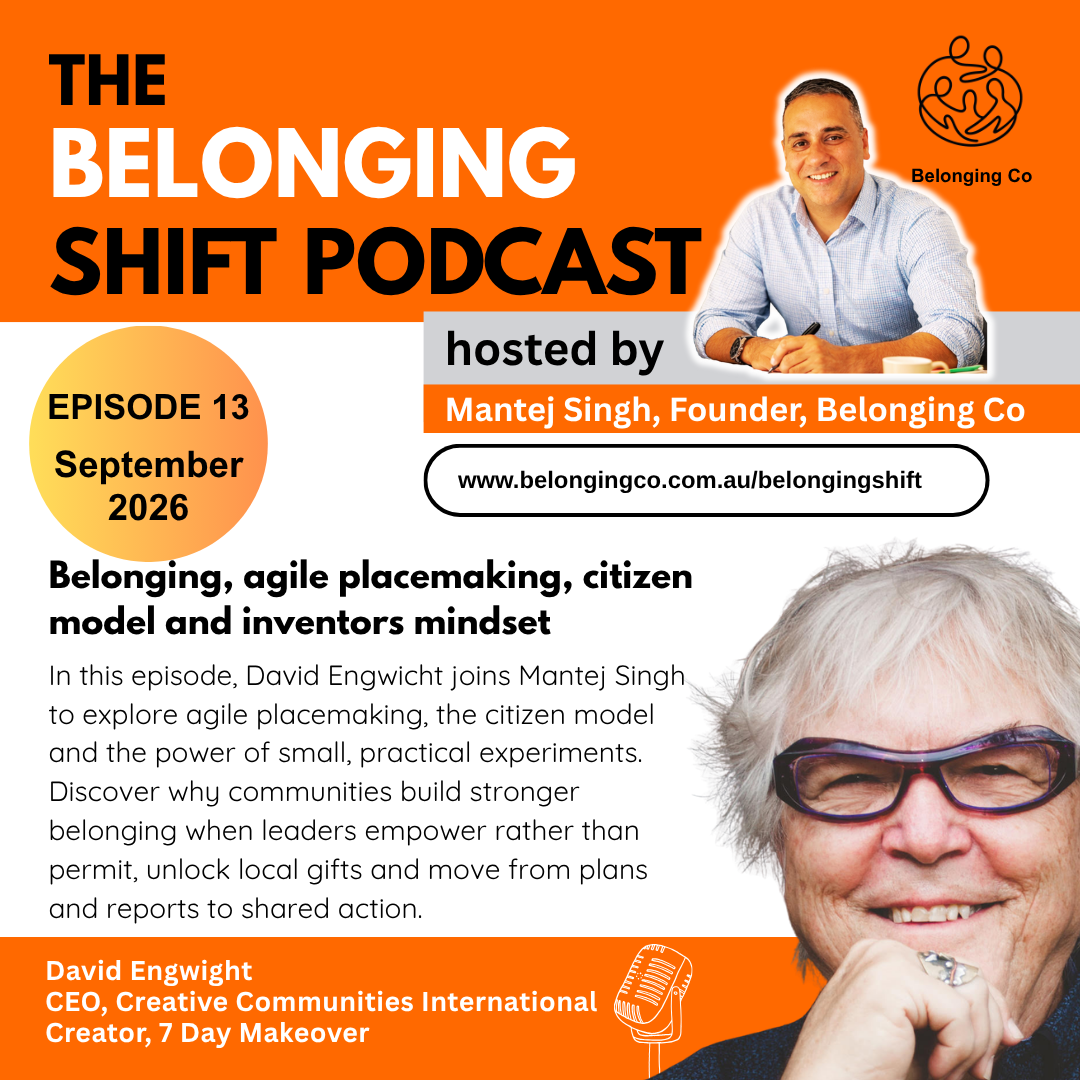
In this episode of The Belonging Shift, host Mantej Singh speaks with David Engwight on how communities, leaders and practitioners can create belonging through placemaking, participation, practical action and mutual contribution rather than treating belonging as a product delivered by professionals. David is the CEO of Creative Communities International, a placemaking legend, and a passionate designer, artist, author, social inventor, and the creator of the 7 Day Makeover.
David talks about the importance of intermediary public spaces and spontaneous encounters in diverse communities. His advice to leaders is practical: evaluate honestly what the current system delivers, work with what is already available, replace restrictive rules with clear boundaries, and treat every initiative as a trial from which to learn. The episode inspires us to make a shift toward meaningful community experiences and away from purely transactional engagement with public life, organisations and civic spaces.
David’s advice for leaders and practitioners for making the #BelongingShift
Shift 1: Empower communities to create belonging rather than delivering it as a product.
Shift 2: Replace restrictive regulation with clear permissions and room for creativity and invention
Shift 3: Work with what you have now, not what you wish you had
Shift 4: Move from master planning mindset, unaffordable wishlists, and endless talk to agile implementation, small trials and visible action
Shift 5: Move away from a customer model to a citizen model of contribution and shared ownership
Listen to the full conversation using the links below or scroll down further to read the full transcript.
If this episode sparked a new idea, challenge, or possibility, share it with someone who’ll benefit or connect with Mantej to support your organisations work.
Connect with David
David has over 35 years experience in place making. He is a passionate designer, artist, author, communicator, and social inventor, best known as the creator of the Walking School Bus and the 7 Day Makeover. Nothing gives David greater joy than working with communities to breathe new life into dead spaces.
He is author of books on urban design, community development, revitalisation of town centres and creativity. He’s a TEDx presenter and popular speaker at international conferences. David is the creator of Civosity Park, a practical demonstration of how private land can be used for public good.
Connect on LinkedIn: https://www.linkedin.com/in/david-engwicht/
Website: creativecommunities.com
Connect with Belonging Co
Belonging Co helps leaders drive participation, trust and engagement
Belonging Co delivers strategies, engagement, and programs for organisations and leaders wanting genuine impact across cultural inclusion, community participation and social cohesion.
For more information, see links below
Belonging Co website: www.belongingco.com.au
Book a FREE discovery call
Follow and connect with Mantej on LinkedIn
Follow and subscribe to The Belonging Shift Podcast
Listen to audio
APPLE PODCASTS | SPOTIFY | YOU TUBE | AMAZON MUSIC | IHEART RADIO | RSS FEED
Read transcript
Mantej Singh (00:00)
Hello everyone. My name is Mantej Singh. I'm your host of the Belongingshift podcast conversations about leadership, community, place, and the future of belonging. I'm the founder and director of Belonging Co, which is a social and cultural inclusion consultancy here in Sydney, Australia, where we work with organizations and leaders towards shift towards trust, participation, inclusion, and belonging.
And the purpose of this podcast is to inspire many more of those shifts towards belonging, but also to bring in great people doing great work in this space, great practitioners from this space, and to inspire us all about how to make those shifts. And today I have a great legend from the placemaking space with us here from Brisbane, Australia.
Welcome David Engwhite from Creative Communities. David, welcome to the Belonging shift Podcast.
david (00:48)
It's great to be here. I feel like I belong already.
Mantej Singh (00:49)
Yeah.
That's great. That's great. That's what we're aiming to inspire, David. But thank you
david (00:55)
Yes.
Mantej Singh (00:56)
before we start the podcast, I just want to build on what I've just said. I think we are at a point of great turning in our modern society globally, but especially in Australia, we have a diverse community with people gearing more and more towards meaning a balance in life, meaning desiring great community experiences.
wanting more rather than just transactional engagement for community and civic spaces, for public life, from organizations and leaders. And I think it's in this context that I'm interviewing you that what more can happen, how do we as communities, how do we as leaders shift towards belonging as an outcome, both in place, but as a society as well. So let's get started.
david (01:39)
Yes.
Mantej Singh (01:40)
tell us a bit about yourself. Who are you? What do you do? And why does a sense of belonging matter to you in your area of work?
david (01:48)
Okay, so when I was a kid, my dad was an itinerant gospel preacher and we travel from town to town. and each new town we'd go to, the school bullies would all rejoice because they'd just got a brand new punching bag. so I grew up with no sense of home, no sense of place, no sense of grounding.
and I don't think it's an accident that I therefore ended up in the placemaking realm, which is about giving people that sense of home and that sense of place that I never had as a kid. And one of my key insights is that whatever you want for yourself, the quickest way and the best way to get get it is to give it away to somebody else. and so
I guess it was a part of my journey was about 40 years ago. I involved in a community fight against the road widening through my community. I started interviewing residents about what life used to be like in our suburb you know, 30, 40 years ago. and so became fascinated with the way our urban spaces and our social structures impact on that sense of belonging.
that you so eloquently say has kind of gradually disappeared. and so I think there are a number of shifts that need to happen. I think we're in danger of placemaking continuing what I call the customer model. That is that people are saying to government, please provide for us a sense of belonging, a sense of place.
which we used to provide for ourselves in the way that neighborhoods used to work. And I think we're in danger of of of placemaking becoming part of that customer model, which is professionals saying, we can give you that sense of belonging. We we we can produce that as if it was some kind of product.
so in the work that I do, it's all about empowering communities to basically create that for themselves. So, for example, we do a process called the seven-day makeover where we're making over town centers in seven days, and that's with community volunteers. And it's not so much much what we do physically in the town center as we've got
two hundred, three hundred volunteers all experiencing for themselves what it's like to start reshaping their town centre.
Mantej Singh (04:09)
thank you, David. I think you've highlighted some very interesting points,
give an introduction to what do you as David Engwicht do, what's the organization, and why does belonging matter in that work?
david (04:21)
Okay, so we would define ourselves as social inventors. so we're about what kind of structures do we need to create for for people to feel like they they have a purpose that they belong within a community. and so
And we we do have an emphasis on what does that require both from a a physical change to the environment but also the social changes to that environment. so we've invented processes that help us move from the current customer model where
Government and professionals, whether they're economic development officers, whether they're community development officers, whether they're urban designers, we're saying you have to move beyond that professional prism and start to see this as a psychological task, which is how does the work you do
And the loneliness epidemic, how does it start connecting people to people? How does it create a feeling in people that there's a sense of home that's both physical but it's also emotional? so our work is informed by the observation that in times past people's sense of home.
Used to extend out their front door, out into the street in front of their house, down to the corner store, down to the the center of town. And that sense of home territory has been slowly shrinking over time, to the point where some people don't even feel at home in the in their own house. and so technically what placemaking is is re-establishing that sense of
Home territory extending past the lounge room, past the front door, out in at the end of the street. And what we've what's happened in our in our towns and cities is all of those intermediary spaces between the intimacy of the lounge room and the collective life of the town centre, all the intermediary spaces have died and been stripped out.
so our task as creative communities is how do we start rebuilding those intermediary spaces that allow people to establish relationships, feel like they belong, etcetera.
Mantej Singh (06:39)
Brilliant. think that's fantastic, David. I couldn't agree with you more as more and more high density residential starts to emerge as more and more diverse communities, newer communities start to emerge that organic relational thing that's built over years and years of living together has to be almost either manufactured, which is the professional customer model you are saying, or either it has to be organically nurtured
david (07:03)
Yeah.
Mantej Singh (07:04)
so that it
grows and evolves naturally, but somebody's got to catalyze that. So I think that's really great that Creative Community is doing that great work. So let's take one more step back before we delve into the future. You
david (07:17)
Yes.
Mantej Singh (07:18)
highlighted this already, David, but if you can elaborate on that, what does... So we're going to talk about what needs to happen in society, world, professionally, the place, making space, all of that. But before we get there, I want to...
understand what does belonging mean to you personally. And if you had to define belonging without using the word belonging, how would you, what would you say?
david (07:41)
I would say it's having a sense that I have a purpose that and and that that purpose is bigger than just me as a person. so for me personally, what that meant was that I've turned my entire yard into a public park and
opened it up to the general public. So I'm a a great believer that that you have to take whatever it is, whatever gifts you've got. And in my case, you know, I had a a block of land and I had a house on that block of land. And the question becomes how could I use that to enrich my community, to give other people a sense of belonging, a sense of purpose?
And in and in giving that gift, that is what gives me a sense that I'm contributing to my community, that that I'm part of something bigger than just myself. you know, if I want to wa wax lyrical about it, it'd be, you know, I think what my purpose is it is to cooperate with the creative life force of the universe. You know, it the there's something bigger than me going on.
and and I want to be part of that adventure. I want to be part of not just sitting in my bedroom kind of you know one wondering what I could be doing or what my life amounts to but going on a wild ride and and and and and trying things and just seeing what the hell happens as a result of that. and so what what has happened as a result of my
turning my entire yard into a public park. it it is that first of all I changed the story that my community was telling itself about its identity. So when I first did it and I put expensive furniture in the park, half of my neighbourhood thought that furniture would get stolen because they had a particular story about their neighbourhood.
Now, stories are what puts a glass ceiling on what's possible for any community. So if you're sitting there saying, I live in a community of thieves and robbers, then you're gonna withdraw into yourself. You you're you're gonna set in motion a vicious cycle, you're gonna put up a high fence, you're gonna you're gonna start doing things that are gonna kill community life even further. and so
What has happened is because that furniture is still there ten years later, the community starts to change its own story about its identity. And and so now we have other people who are putting furniture out on the footpath for people to sit on. We've got people reclaiming traffic islands to put swings and tables and chairs. and so that's the wild adventure. That's you know, me starting where I
with what I had and saying what can I do? So from a professional point of view, I I do that in my practice, but in my personal life I also do it.
Mantej Singh (10:30)
Thank you, David. There's so many gold nuggets there in what you just said, and I can relate to so much from that. I remember a project only a few years ago where I also put as part of a place making project, expensive furniture out in a public park, and I was told it'll get stolen and, you know, it'll be on me. And I said, well, let's see what happens. And it's still there and people have been activating that. And so it's a story that was told.
david (10:56)
Yeah.
Mantej Singh (10:56)
otherwise you can keep wondering all the time and hoping somebody else does it and you'll take part in it. But if everybody keeps waiting for somebody else to do it, then nobody does it.
david (11:05)
Correct.
Mantej Singh (11:05)
And the other thing I relate very well to what you just said is about, you said something about the
being in partnership with the creative life force of the universe. I don't think we'll find that as part of any corporate plan of any government organization as a vision,
david (11:17)
Yes.
Mantej Singh (11:18)
but as community activists and as people passionate about community, we can certainly go on that journey.
So again, in your own words, drawing on what you just said, how would you define belonging? And if somebody said, this is what needs to happen for belonging to emerge as the outcome.
david (11:34)
I guess it's the opposite of loneliness. so what does it take for people who currently feel lonely to no longer have that feeling?
it's the opposite of no sense of purpose. I have a role, a positive role in my community. It's the opposite of sitting around waiting for other people to to fill that.
aching hole inside of your chest. It's it's filling that hole by by giving your own gifts, however meager they might be, to the rest of the community. when I'm explaining placemaking to whether that's community people or or planning professionals,
I say it's really homemaking within the public realm. It's taking homemaking from inside the house to the street outside your house, you know, to the to the center of town, wherever it happens to be.
The work that we're doing is probably about how do we empower people who think they have nothing to give to say to them, look, it doesn't matter how meager the resources you've got are, you can start to make a difference in the world. one of the things I've observed is that big dreams become straitjackets that restrict what is possible.
So if you've got a big dream to start a soup kitchen for homeless people, you can spend all your energy looking for a commercial kitchen. You can write grant applications to raise money to start that. They're they're all means to fulfilling your big dream.
But if you just start by saying, what do I already have? I've got a one extra kitchen chair, I've got a table, I've got a a stove, I've got a kitchen. I'm going to go out and find one homeless person and invite them home for dinner tonight. Now
Mantej Singh (13:26)
Hmm.
david (13:27)
it's not your big dream, but
Mantej Singh (13:29)
Hmm.
david (13:30)
it's using what you've already got to start a journey potentially towards your big dream.
Now, what happens is if you start the journey, you don't know where it's going to end up. You know, so for example, if you if you did that, and the first night that you had this homeless person home, they told you stories, and you went, wow, that that story would enrich so many people's lives. And and so you publish the story online.
And that inspires somebody else to invite a homeless person home for
Mantej Singh (14:03)
Hmm.
david (14:03)
dinner and they listen to their story and they publish that story. And suddenly you're feeding a thousand people a week, as opposed to if you had a started the soup kitchen, you might have only been feeding 50. so it it's about I think people get really caught up.
in in what these big dreams are, you know, this is the contribution I want to make to my to my community. Instead of what have I got already? What are the resources I have? How do I use that to start enriching my community? And and in doing that, I'm going to find my purpose. I'm going to find my place in in in the world.
Mantej Singh (14:41)
Hmm
david (14:41)
And
and that philosophy goes with with bureaucrats as well. I find you know people within local government or or other levels of government are are constantly thinking about the big picture and they're they're spending millions and millions of dollars to try and paint a picture of this big picture rather than what are the resources we've already got and how do we use those
Today, in the present moment, to start
Mantej Singh (15:08)
Hmm.
david (15:09)
enriching the life of our communities.
Mantej Singh (15:11)
Thanks David, that all resonates really well with me and I think it will be with a lot of listeners as well because we are all kind of caught up in either in our own straight jackets or either in somebody else's straight jacket if you're working in a job
david (15:23)
Correct.
Mantej Singh (15:23)
or a role and so I think it's how do we break those sort of straight jackets as you put it and inspire things now rather than planning for this future which nobody controls and nobody knows what will happen or emerge.
david (15:35)
Yeah.
Mantej Singh (15:36)
you're talking about society and creating home and using the power that you've got. And I just want to hear your opinion about, Australia.
50 % of Australia is almost culturally diverse. speak a language other than English at home. I think one fourth of people. And many people have connections with ethnicities, heritage, cultures outside of Australia. When you mix that, and migration, cultural diversity is a big hot topic in Australia at the moment. How do you see that playing into what you are asking for in terms of
a multicultural diverse community coming together as a society.
david (16:12)
It's very good question, and and I do think we're in huge danger at the moment. That as as these middle earlier I described the middle grounds between the lounge room and the and the town center, all those intermediary spaces. so what we're what what we get forced into what's called the intimacy gamble.
That is the only way that we can actually get to know somebody that's different to us is, you know, fifty years ago we would have got to know them by bumping into them at the corner store and having a an informal conversation and then a friendship would have gradually evolved. And we wouldn't invite them into our lounge room until you know for another two years until, you know, we we'd really got to know them.
Now when all those intermediary spaces have disappeared, we have this intimacy gamble where
To get to know somebody that's different to me, I've got to invite them straight into my lounge room. And and so that is so threatening that we get into a vicious cycle, we then put up, you know, a six foot high fence and and and put an electronic gate on and and and wall ourselves in as opposed to being open to new connections. And
I wrote a my first book that I ever wrote, I talked about the role of two kinds of it of exchanges that used to happen in cities. There was what I call the spontaneous exchange, which I've just described, meeting somebody at the corner store or while you're walking to the bus stop or while you're waiting for the bus, and the planned exchange, which is when you make an appointment to go and see the doctor or or whatever.
And in the book I explored the fact that the spontaneous exchanges are of much higher social value than the planned exchanges, because you can only plan to interact with that which you already know.
Mantej Singh (18:05)
Hmm.
david (18:05)
And so you you you get walled in where you're not being exposed to difference. You're not being
And and and what the spontaneous exchange does is it opens up new possibilities. Or meeting the person with with a different beliefs.
so that's the importance of this spontaneous exchange realm, is that it starts opening this up to to to other possibilities.
Mantej Singh (18:34)
Hmm.
david (18:35)
So it's about how do we create those spaces in which the dialogue can happen between the you know different perspectives, different cultures, we and we we find out that all the propaganda about
people who are different to us isn't really true. They're they're they're they're people just like us. Maybe
Mantej Singh (18:55)
Hmm.
david (18:56)
with a different set of values, a different set of beliefs, etc. So I think we're in danger of polarizing at at the moment the political climate, not just here but around the world is,
And so it's it's that exposure, that it's it's that spending time with people of hearing their stories that can radically shift the way that you see a situation and and and what you can do.
Mantej Singh (19:20)
we get back to this juxtaposition or dichotomy between a
a customer and a community model, which we have gotten into ourselves. The governments have certainly gotten into that. So let's now look at where does that sit. So when you look at the organizations that you work with, building on that example that you just gave, both government, private, corporate, I'm sure you're working across a whole spectrum, what shifts are right now occurring in the placemaking
space or sector that are changing how people experiencing belonging.
david (19:54)
Okay, so I so one of the major shifts that we're promoting, first of all, is a move away from the customer model where you're doing it for the community and instead in empowering the community. and a shift away from talking about what changes you want happening to
standing beside people and helping them make that change actually happen in the real world. So action as opposed to talking. So I'll illustrate how we do that in in our practice and the shifts that have had to happen in order for that to happen. The first is to get the authority to take what we call a permissions approach rather than a regulatory approach.
So regulations basically say to people, this is what you can't do, and these are the reasons why you can't do it. Permissions approach says we'll let you do anything you like, but here are the boundaries of the playground that you can play within. So I'll use real-world example. So before we do a seven-day makeover, we negotiate a one-page document, which is we call it the what is allowed document.
Which is basically a permission statement. And it might have something like if it's movable, it's allowable.
Another example of that is there are a thousand regulations about what you can and you can't do on the footpath.
And we say, what are you actually trying to achieve with all of those regulations? well, you want a continuous walkway that can pe people can walk along. You want people with certain disabilities to be able to navigate that space. Okay, so a permission statement is do whatever you like on the footpath as long as you leave a continuous walkway of a certain width and it's accessible to all people.
Now you've opened up the field of play rather than being restrictive about there's only one way to solve this problem, and that is don't put anything against your shop window, don't put anything within sixteen inches of the gutter, etc., etc. etc. So that permission statement and and that changing mentality of let's define what the problem is that we're trying to solve.
And give people the maximum freedom to find the most creative way of solving that problem or fulfilling
Mantej Singh (22:09)
Hmm.
david (22:09)
that. That's a change in mentality on the part of the authority figure. So we negotiate that before a seven-day makeover. the other thing is we have to be upfront about what resources are available to produce the change. so in the past, the way that
local government has operated is it will commission a study for how we might revitalize the town centre, employ a consultant, but there's no implementation budget attached to that. And all
Mantej Singh (22:40)
Hmm.
david (22:40)
that attracts is this talk, talk, talk, talk, talk, and what I call the unaffordable wish list, which is because there's no constraints on anybody's thinking.
We say if you've only got a thousand bucks to spend on the revitalization of your town centre, be up front and say that's what we've got.
Mantej Singh (22:58)
Hmm. Hmm.
david (23:00)
so we won't start working with a community unless we know what resources.
and so work with what you got, not with what you wish you had, but you've got to know what you what you're actually working with.
Mantej Singh (23:13)
Hmm.
david (23:14)
Then what we do, the the other major shift is not to assume that the community knows what the possibilities are. We say if you go to a community and say, What do you want for your town centre? all they'll give you back is what they already have experienced somewhere else.
Mantej Singh (23:31)
Hmm.
david (23:31)
Right, they can't imagine their town center having a point of difference, which is different than anywhere else in the world. Mm most people just don't have that capacity.
Mantej Singh (23:41)
Hmm.
david (23:42)
So it's understanding that what we're doing is taking them on a journey. And the first part of that journey for me is opening up the possibilities. So I take them for a walk and I go, This is why your town center's not working.
But here are the possibilities. Here's a space
Mantej Singh (23:58)
Hmm.
david (23:59)
you could do XYZ in. And then we get them to start generating the maximum number of potential ways forward using the resources they've got. And then here's the the transformative point. We don't ask them to vote for their favorite idea.
We say to them, if you had 10 minutes to invest in your community,
Mantej Singh (24:22)
Hmm.
david (24:23)
what idea did you hear today? Would you use that 10 minutes on? And
Mantej Singh (24:26)
Hmm
david (24:27)
what we're testing is what are people actually willing to do, not what do they think is a good idea? And then we put them into project teams, around those where they want to invest their 10 minutes.
We've we identify leaders who want to give more than two minutes to making it happen. and and within two days we can have project teams ready to go. And the next day on the Monday morning they start implementing their idea. And a week later
Mantej Singh (24:56)
Hmm.
david (24:57)
they've transformed their town centre. so it's a shift to what we call agile placemaking as opposed to master planning.
And that's going to be the big shift in organizations is to understand how you take people on an agile journey as opposed to let's start by creating the vision of the final product and then we're all we're gonna sit around paralyzed for the next ten years trying to find the resources to make that actually happen.
Mantej Singh (25:25)
Yes, well, thank you, David. I have certainly sat through both. I certainly led the first one in many times and certainly sat through many meetings that has glimpses or based on the latter model.
So David, thank you for giving that great glimpse about the two models, which is about doing and which is about planning. I think a lot of civic places across Australia, across the world, sit in a very master planning mindset, which means that there's a of great visions and thinkings and idea boards.
We don't have the resources to execute it. So we spend a lot of time doing that. But what you are talking about is a different model, which is to say that, which is agile place making, as you call it. And that's about starting with your philosophy of what can we do now? What's within our control? What's within our gifts? What within our assets that we own? The skills that we can bring to the table. And we do it now rather than having a grand vision or a straight jacket, as you called earlier, and hoping someday we'll be able to get that.
And sometimes by focusing too much on that, we don't even do what can we do now. So that's really great. Now, organizations are bureaucracies and leaders of town centers, of state government, local government, federal, they work in bureaucracies and complex systems. So keeping on what you have observed and practiced over the last many decades that you've been doing this work.
If you have executive leaders and organizations listening to this podcast, what would you say to them? What do leaders, organizations and institutions commonly misunderstand about belonging in the context of placemaking and what do they do wrong?
david (26:55)
Okay, so it I think what they're doing wrong is that they are starting with a predetermined solution to a problem that hasn't been defined.
Mantej Singh (27:08)
I think I relate to so much of that. think David, the examples you've given, I've certainly lived through them as a practitioner, as a manager, leading and advocating for that kind of space of empowering communities. We are getting close to this podcast time
these last two questions are aimed at executive leaders, people with power, budget, resourcing, decision-making, authority and organizations, because that's what we're trying to inspire, because sometimes I think that's where change has to occur as well. We focus a lot on the ground and what practitioners should do, but at the top,
people should change as well. So in that context, not everybody is a placemaking expert. everybody subscribes to that agile placemaking methodology or has the skills or the courage to say, well, we'll just work with community. Let's see what happens and stand besides community. And many leaders at the top, I would say, are like that.
They may have good intent, but they may not have all these awareness and skill sets that we've been talking about. So if you keep that in mind, what would you advise to these leaders in organizations that in order for success to occur in a place perspective, in order for going back to that story of belonging, what are the things they need to change?
david (28:23)
Okay, so I think the first thing is to be honest about how the system is not working at the moment.
Because unless you're willing to admit that you're spending all your time at at meetings, that you're commissioning studies that don't have an implementation budget, and that you're in ten years' time you're going to be doing the commissioning exactly the same study yet again. you look at all of the reports on your shelves and go, how many recommendations in in that meter of reports have actually
Come to fruition. Be honest. Do an honest evaluation of how effective the current setup is in delivering real on-the-ground change. Do you really want to get to the end of your life and just think, you know, my working life has resulted in a bookcase full of reports.
And three of the recommendations in those reports got implemented. There's 5,000 that never did. And then it becomes a question of what are the small things that I could start changing that may interrupt that cycle.
How do we start getting people focused on positive action? and and being honest that a lot of the activity in bureaucracies is for show. it's we've got a problem, we've got to look like we're addressing that problem and and not
Mantej Singh (29:49)
It's a performance theater.
david (29:50)
it's a it's a absolutely, absolutely. and and so yes, again, it gets back to that honesty question of you've got to see it for what it is currently and then go. Where are the small changes that that we could implement? What are the little radical experiments you can try that start
Mantej Singh (30:10)
Hmm.
david (30:10)
to upset the existing mechanics of this performance theatre? introduce a bit of improvisation into the system?
Mantej Singh (30:20)
we've got time for one last question, you said things like honest evaluations, starting with the small things, radical experiments, improvisation, facilitating authentic self-help work. These are really great shifts that if you could all make that in organizations, It will transform organizations yeah, go for it, David. Yes, go for it.
david (30:37)
can I throw one other in? I think the biggest change is for people to start to realize that everything they do within the organization is a trial.
Tell the organization that everything that you're doing, even the really big decisions, running another study is just a trial of a methodology.
Mantej Singh (30:56)
Hmm.
david (30:57)
But break break those trials down and call them trials and you'll get a lot more shit done.
Mantej Singh (31:02)
Thanks, David. I think that's really excellent because a lot of time organizations get caught up into this risk mentality and don't do things because of fear of risk, fear of what if something goes wrong. And then, I I operate on the other end of it. What if something goes right and let's go for it?
david (31:19)
Yeah.
Mantej Singh (31:21)
if you get a great leader who shares that mentality, you can achieve a lot. And if you don't, then there are lots of friction burns along the way.
in the context of belonging in a modern, diverse Australia, and if we want everybody from all diverse backgrounds, cultural diversity to disability, to any other sort of regional, city-based, any other kind of diversity.
We are all diverse. Wherever we go in the world, whether in Australia, whether in a city, whether in a suburb, there is always going to be diversity.
My final question from you is, for people listening, especially for leaders listening, people who have the power to change things, how do we create places where people belong? When communities are diverse, people have different desires and ambitions and capacities to contribute economically as well. How do we bring it together? What's your final message to the audience listening?
How do we create places where everyone belongs? What should be our approach?
david (32:17)
to understand that that is not something that councils or consultants or design professionals can deliver as a product that unless the community is actually empowered to create that for themselves, it's not going to happen.
It's in the community actually providing it for themselves that produces the sense of belonging. So I go back to when towns or villages were first invented, whenever that was, they were created on an assumption of mutual cooperation.
That is that everybody put their gifts into the center of the circle, and then everybody got to take more out of that than what that actually put in. It's like a magic putting.
And and we've got to get back to that which I call the citizen model, which is that that that we are not going to get the sense of belonging unless we go back to that.
Mantej Singh (33:14)
Thank you, David. We have certainly had lots and lots of stories today from your great career spanning, I think I can say four decades in this space, which has taken you from Brisbane to all over the world, but also inspiring people on this journey of creating a sense of belonging by being honest, by trying radical experiments, and by working with each other at a community level.
So that people create belonging for themselves and we go into this community model rather than a Sticking to a product customer model where we are trying to manufacture belonging Without understanding what people actually need. So thank you very much for that David It's been a fascinating conversation and it's been great to connect with you And thank you for everyone who has been listening to this episode the podcast is brought to you by belonging co
which is a social and cultural inclusion consultancy here in Sydney, which I lead. If this episode sparked a new idea, a challenge, a possibility, share it with someone in your network. Stay connected for more conversations and practical insights on leadership, inclusion, community, and the future of belonging. And thank you once again, David, for your time and for sharing your life journey and your stories.
david (34:26)
Thank you.
Mantej Singh (34:27)
Thanks everyone. Have a great day. Signing off, this is your host, Mantej Singh.
