
In this episode
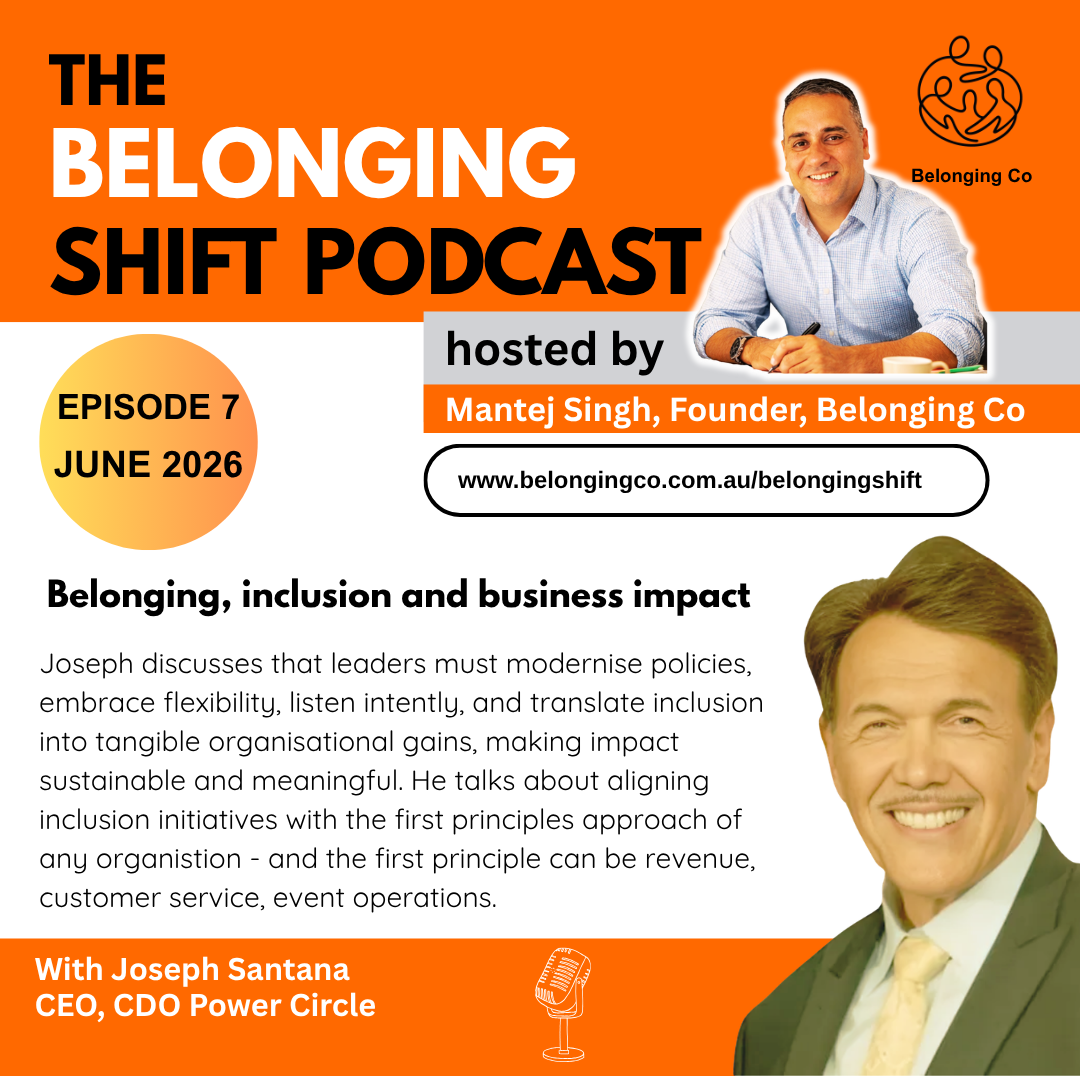
In this episode of The Belonging Shift, host Mantej Singh speaks with Joseph Santana, Chairman, CDO Powercircle from the United States. Joseph shares his journey from a business executive to a diversity and inclusion advocate, emphasizing the importance of aligning diversity and inclusion initiatives with business impact.
Mantej and Joseph discuss that leaders must modernise policies, embrace flexibility, listen intently, and translate inclusion into tangible organisational gains, making impact sustainable and meaningful. Joseph talks about aligning inclusion initiatives with the first principles approach of any organistion - and the first principle can be revenue, customer service, event operations. Listen to the podcast to discover practical strategies for leaders to embed belonging into organizational systems, overcome misconceptions, and drive meaningful change.
Joseph’s advice for leaders and practitioners for making the #BelongingShift
Shift 1: Align belonging with business impact
Shift 2: Connect inclusion work to what the organisation actually needs to achieve
Shift 3: Treat staff networks, ERGs and diverse team members as sources of intelligence
Shift 4: Listen for blind spots — every person brings a different lens on the world
Shift 5: Close the loop to build trust - leaders must act on what they hear
Listen to the full conversation using the links below or scroll down further to read the full transcript.
If this episode sparked a new idea, challenge, or possibility, share it with someone who’ll benefit or connect with Mantej to support your organisations work.
Connect with Joseph and CDO Powercircle
Joseph Santana is Chairman of the CDO PowerCircle, a network of senior inclusion leaders from Fortune 100 and Global 100 organizations representing hundreds of billions in revenue. Members lead initiatives that deliver measurable business results. He is the creator and host of the award-winning ERG PowerTalk podcast, which delivers leadership development to ERG and business leaders worldwide. A member of the Association of Professional Futurists, Joe advances inclusion as a core business discipline. His book, The New DEI and ERG Frontier, and his contributions to Forbes and Fast Company equip executives to link inclusion directly to revenue growth, cost reduction, and market expansion, making the work financially relevant, operationally integrated, and defensible under executive scrutiny.
Connect on LinkedIn: linkedin.com/in/joesantana
Subscribe to The Bizclusionist Weekly: substack.com/@thebizclusionist
Listen to ERG PowerTalk: linktr.ee/Joesan58
CDO Powercircle: https://cdopowercircle.com
Connect with Belonging Co
Belonging Co is a social and cultural inclusion consultancy helping executive leaders and organisations to strengthen inclusion, engagement, and participation outcomes across workplaces and communities — grounded in a unique belonging approach and a community perspective.
For more information, see links below
Book a FREE discovery callto discuss your needs.
Follow and connect with Mantej on LinkedIn
Follow and subscribe to The Belonging Shift Podcast
Listen to audio
APPLE PODCASTS | SPOTIFY | YOU TUBE | AMAZON MUSIC | RSS FEED
Read transcript
Hello everyone. Good morning at seven o'clock here in Sydney, Australia. Welcome to the Belonging Shift. My name is Mantej Singh. I'm your host for this podcast, the Belonging Shift Conversations on Leadership, Community, Place and the Future of Belonging. In this podcast, we speak to leaders across the world to understand what shifts need to be made to build trust, participation, inclusion and belonging. in our organizations and in our communities. I'm so glad to have Joseph Santana here from the US, who is the chairman of the CDO Power Circle and a great thought leader on building business impact with diversity and inclusion and going beyond the talk to actually embedding it across organizations. Welcome, Joe. A very good morning to you.
Joe Santana (00:44)
Hey, Mantej, it's a pleasure being here. So here it is the evening and it is a day before, so it's the 14th over here. And my wife asked me to ask you what's going to happen tomorrow since you're one day ahead of me.
Mantej Singh (00:58)
Right. Well,
I think there's a lot happening want reveal too much of the future, but one day ahead, inclusion has transformed the world and we have more inclusive communities and workplaces.
Joe Santana (01:06)
Hahaha
That's wonderful news.
Mantej Singh (01:12)
All right. it's great to have this conversation more about business impact because diversity and inclusion, as we have spoken in the past, has been caught up in this sort of language and moral correctness. And I'm really excited to see how do you suggest leaders and organizations shift from the talk to the actual walk. and how to deliver it on the ground. tell us a bit more about yourself, Joseph. Who are you? What do you do? And how did you get into this space? And what does belonging mean to you in your area of work?
Joe Santana (01:44)
Okay, let me unbundle all those questions. So I'll start a little bit with my own background. I am a former line executive, I ran an outsourcing organization. And while I always thought that from a moral and social standpoint, everything that inclusion and equity stood for was good. I wasn't as involved in the beginning because being a business person, I was always looking for
a real powerful business case. And I wasn't finding that in just quoting McKinsey and things like that.
Joe Santana (02:14)
I while I felt that these things were really good ideas, we were also looking for or I was looking for, you know, how do you position this in the business so that they take it seriously, not just something that they're doing for cultural reasons or because of
compliance and so forth. And I found that in an experience that I had where we were having difficulty finding enough leaders to meet all the business needs we had. And I found that the reason why was because the way we were set up, we weren't allowing everybody who could potentially be a leader to rise to that level. And it was hurting the company. The company was losing out somewhere in the neighborhood of seven to $8 million a year as a result of not having a fuller leadership bench.
So I worked with a couple of people, we made some corrections to that. And lo and behold, our revenue went up by 17%. And the number of women in leadership increased dramatically. In fact, in that company, a couple of years later, they had the first female CEO. But the interesting thing was that the thing that I learned that really struck me was that you can address business problems in an organization caused by a lack of inclusion or a lack of belonging.
in a way that benefits the organization financially so that the CFO and the CEO can see it on the P &L and the balance sheet, while at the same time as a byproduct creating social good. And that was the trigger that told me now I have a way of talking about this and of working with this so that I can bring about that social progress, but do it in a way that's also benefiting the business.
And so I gradually transitioned over into a role as a diversity officer. And I was the architect of the diversity and inclusion practice for this organization. But everything that I did Mantej, everything was focused on creating a business impact. And every time I did that, it also created as a byproduct, a social good. And that lesson then became sort of my mantra of focus on the business.
And when you focus on the business, if you have a team working on this problem with you, let's say a staff network or ERGs as they're called here, every one of them gets more visibility, the opportunities open up. And this is a lot more powerful than just having them do things like Heritage Month celebrations or having speaker series and so forth. So it really worked, it really worked well. And when I left the organization back in 2011, I decided to start a consulting practice helping
other diversity leaders to do that. And I found people that wanted to do that and effectively did it. But now what I'm finding is it's becoming more and more important to inclusion leaders to really understand how to position themselves as driving business impact
of the world that we live in today. It's no longer enough to say, we're doing this because it's to correct past wrongs or for social good. You need to give your CFO and your CEO a solid business reason for why you're doing it.
Mantej Singh (05:14)
I really like this sort of convergence of belonging, inclusion and business impact, because that's what I feel also that lacks in the sector that we are, we don't have a business case for business impact. We have a business case for doing good and treating people well, but that business case many times doesn't stack up in an organization or
across the board for everyone equally.
Joe Santana (05:38)
what you just said right now is that the very crux of the difficulty that sometimes inclusion leaders have. So if you think of any business or process, and I was just talking to a group of people earlier about this, everything that you do, let's say for example, whether it's in a nonprofit or a for-profit, always rests on top of some initial first principle, right?
So the first principle of a company that's designed to be profitable is increased revenue, lower costs, increased market share. The first principle of a company that's designed to accomplish a mission is accomplish that mission. So if you're a hospital, then that first principle is provide the best medical care to the greatest number of patients possible.
Mantej Singh (06:23)
Yeah, yeah.
Joe Santana (06:23)
And the challenge is when you have an inclusion practice in any of those organizations and the inclusion practices first principle is increase the number of women in leadership, remove obstacles to fairness, do this other stuff. That's a different first principle than the rest of the business. So marketing, operations, sales, R &D, everybody is operating on that first principle of the business.
And over here, you've got this other practice that's operating on a different principle altogether. And that's the reason why it's so hard to present the business case to the business, because you're going to the CFO and saying, well, our business case is, well, how do you explain how this is good for that company when what you're trying to do is actually focused on doing good socially? And what I'm saying is you can do both, but what you need to do is take the inclusion practice and align it, put it on the stack with the business
Mantej Singh (07:21)
Yeah, now that makes complete sense. So the question that I have to ask you now, going from business impact to my first principal question about belonging, what does the word belonging mean to you personally? And how would you define it if you couldn't use the word belonging?
Joe Santana (07:39)
because you want people to feel like they are part of the team. But the practical one is also important because if in truth you are not completely part of the team, eventually that's gonna show up in some form or another and it's gonna break that perception and it's gonna hurt the trust.
Mantej Singh (07:56)
And that's at a workplace level Joseph, that's really important one that how much you feel you have a sense of belonging, how much you're connected and are part of networks, but at a personal level what does belonging mean to you outside the workplace?
Joe Santana (08:10)
at a personal level, think, mean, for me personally, belonging is the sense that I feel like I am part of the group, that I am a member of this particular group, whether it's friends, an organization, a family or whatever, it is perceptual. And generally, that perception is acquired through
how people engage with you, how they listen to you, how they involve you in things, how much they respect your opinion and weigh it in. They may not necessarily always do what you want, but they at least are open to listening to you as a respected member of that particular
Mantej Singh (08:51)
thanks for sharing that, Joseph. Now, you are in the US, we are here in Australia, and that's, we can say, worlds apart, but it's a connected globalized world. We're all connected all the time. Here we are talking.
on diversity and inclusion practice across the world as well. So when you look at the diversity and inclusion practice what shifts are happening right now in this sector that are changing how people are experiencing belonging and inclusion.
Joe Santana (09:16)
There are a lot of shifts going on. can just say here in the United States, a lot of those shifts have to do with laws being the same. They haven't changed, but they're being interpreted a little bit differently. And quite frankly, I think that in the eagerness to address things that happened in the past, sometimes organizations made statements or said things. that probably the pendulum was swinging a little bit too far the other way. So when an organization says something like, well, we want to increase the number of women in leadership by 30 % and we want to increase the participation of people formerly considered minorities by 15%. So you're talking about changing your leadership by 45%. How do you plan to do that? Do you plan to get rid of 45 % of the leaders you have to empty the seats? for the women and for the underrepresented people? Are you buying another company and doubling in size? Like, how are you doing that? So people would make statements like that and nobody would challenge them back then. It was kind of like, yeah, you know, they get it, they're in the right place. But not everybody agreed with that. A lot of people would hear that and would say like, well, wait a minute. Now, let's say you're a man and you're applying for a job and you feel like, I feel like I'm being discriminated against. Now I'm being told that I'm not gonna get an opportunity because the company has and what's the business reason for doing that? So I think that what's happening now is that there has been a backlash and some people really would love to crush, you know, these DEI programs, diversity programs or inclusion programs or equity or belonging. They would like to make them go away. I don't think that they're going away.
I think what's happening though is that now that these other questions were raised, we're never gonna go back to the way we were before. I don't think that there's gonna be a lot of companies in the future, regardless of what the administrations are, that are gonna be saying things like, we're gonna increase women in leadership by 30 % or whatever. I think those days are gone because I think people now realize that that's extreme the other way.
But I think what's happened is that there's a normalizing that's going on or a maturity that's going on where organizations and people are beginning to realize that there is a way of doing this that's effective for organizations. It's effective for everybody involved and that is inclusive of everybody. It's not just because I think there are so many
Joe Santana (11:43)
There are so many ways of thinking about this that I think sometimes even the people within the practices themselves have a little bit of a difference of opinion about what this is all about. Some people think, well, this is all about helping minorities and women to have a more fair environment. Other people, it's about making everything more even-leveled for everybody. It's about
And in that, there are so many different clashes of opinions and you have so many different constituencies that want different things. And I think that that's becoming more more apparent now than it ever was before. And it's forcing everybody to think more carefully about what they're doing. Personally, what I think is that when an organization is going to undertake any kind of inclusion or belonging practice, the first thing they have to ask themselves is,
What is the reason why we're doing this in this company? What is the benefit of doing this to the organization and the people in the organization writ large? this? How is this good for everybody?
Mantej Singh (12:46)
Yeah, very interesting point Joseph and I, if I can challenge some of that, not from that I don't disagree with you, but I think from a lot of leaders will have a challenge with saying that values are not important. know that everybody will say values are really important, diversity and inclusion is really important. And you are talking about that it can't just be about values and it can't just be about the D &I. It has to have a business impact as well. It has to be embedded in the business as well. And as you said earlier, both have to happen. Both can happen together. You can deliver on your values and you can deliver on your business impact, but don't try to do either or you have to try and combine the two. So in that process, Joseph, when you look at your work in the D &I space, in the belonging and business impact space. And you've just talked about, you know, what needs to happen. If I can flip that and ask a different question, what do leaders, organizations and institutions commonly misunderstand about this and what do they get wrong?
Joe Santana (13:44)
So I think that if you're talking about the leaders at the top of the organization, the business leaders and others, I think one of the things that they get wrong is that they automatically assume that you're coming to them to talk about how to help other people, that it's not about them and their company. They don't see themselves as part of it. They see themselves as sitting there and listening to a pitch about how to help other people. and not about how to help themselves. In fact, a lot of DEI leaders tell me something that's really interesting, especially when I'm working with them and we're talking about going out and positioning what they do to drive business impact. So one of the things that I advise them to do is go to your business unit leaders, go to people that run, let's say, a sales group or a marketing group, go sit down with them and ask them,
What's going on in your world? What are some of the challenges that you're facing? Because what I found when I did that and with people that I've worked with is that the more you listen, the more you realize like what the inclusion problems are. You begin to see it.
A lot of times when inclusion leaders approach business leaders and say, so I want to chat with you to learn more about what's going on in your business. The business leader will turn around and try to preempt you and say, well, know, Mantej, we're doing really good with people of color, but we're not doing so good with women. And you're like, I just asked you about your business and how you're doing and what they're answering because they're assuming that everything that you're there for
has to do with how to make the world more fair for women and for people that are underrepresented and so forth. They don't see you as being someone who could potentially have a positive impact on their business. So I think that that's one of the things is that because of the way that these practices started,
originally, especially in the United States, with the racism that existed in the 60s and in the 50s and holding back people of color and later on women having trouble in the workplace, able to rise to levels that were actually levels that they were more than equipped for, but because they were thought of as well, you know, it's a woman and this is a job for a man. Because of that, a lot of these
A lot of these practices came into existence when people protested and when the government heard those protests and when they set up legislation that said, you know, equal opportunity and all that stuff. So executives, especially older executives, have been trained to think, ⁓ this is about compliance. This is about doing the right thing for the poor woman or the poor underrepresented person and so forth. And a lot of them, unfortunately, miss out on the fact
Joe Santana (16:30)
that this is a tremendous opportunity for them to actually make their business even more competitive in terms of getting talent and in terms of gaining business as we move deeper into the 21st century.
Mantej Singh (16:42)
As we move deeper into the 21st century, that's a great segue Joseph into my next question which is about, so we've talked about the approach by leaders and where leaders sometimes get things wrong and we've talked about the approach of inclusion leaders that the approach that sometimes what they get wrong and how they pitch D &I to executives but if we take go a little bit higher up in level Joseph and we look at the system and the structures independent of people, what's the challenges and barriers embedded in the systems and structures of organizations that are preventing inclusion and belonging outcomes?
Joe Santana (17:17)
Most of the policies and most organizations, especially, I mean, I know for sure here in the United States, the same thing is probably true globally. Most of the policies and practices that organizations have were developed in a different era for a different workforce. And that workforce did not include a lot of people of color and did not include a lot of women. Well, because when those rules were created, because those rules were created for a 1950s workforce. And we could go down the line and look at different policies that organizations have. And they have an assumption that's almost as if we were still living in the 1950s. So essentially what's happened is the workforce has been essentially evolving and changing. more women, more people from different groups. Now with the capabilities that we have remotely, we've got people from all parts of the world participating in teams together. And yet most of your human resources rules and other rules in the organization, are all designed for a workforce in the 1950s. And so what we've evolved is we've evolved having celebrations and saying, we're open to everybody. But still to today, most organizations have not changed their core practices and policies or their institutional structure in order to be able to support the modern workforce.
Mantej Singh (18:37)
inclusion at its core is about flexibility. What I need might be different from what you need. For the same kind of operating environment, we might need different things. I have kids, I need to take time off to drop them, pick them up from school. Somebody else needs time off for some other reason. And so somebody could have an aging parent at home, they need different arrangements for that. And if the organization and leaders are flexible to allow and understand that diversity of workforce, then they can get better outcomes from all of those workforces if they are not rigid in how they need to work and function and come together. so I think at the core of it is a leadership mindset that is flexible and an institutional system that enables that flexibility at a structural level.
Joe Santana (19:21)
Exactly, yeah. I think when you get to a place where we are now and where we're rapidly heading even more so, where your workforce is very diverse both locally as well as interconnected globally,
Mantej Singh (19:35)
Yeah, that makes so much sense Joseph. What would be your advice to people listening that are leaders in some shape or form that what are some of the shifts they need to make to strengthen inclusion and belonging outcomes in their organizations and in their communities? What are the three or five top shifts you want them to make?
Joe Santana (19:55)
Well, I think just based on what we were talking about before, one shift is look around you at your workforce that you've got right now and ask yourself, are we set up to support this team of people to do the very best they can, to be able to contribute the best? And that is literally something that's a benefit to the company. You don't want to hobble people. You don't want to have rules that fit one group of people but leave some people unsupported.
because then you're not operating at full capacity. So the first thing I would say is look at the rules you have in your organization and talk to other leaders, talk to whoever makes these rules in your organization and say, look, this is what we've got and we probably could improve our revenue per employee if we just made a couple of small changes so that we better support the workforce we have instead of the workforce of the past that these rules might have been created for.
So that would be the first thing. The second thing I would say is start looking at every person inside your team as someone who has a different window or lens into the world around you and who can basically tell you where your blind spots are. Because all of us have blind spots. I have them, you have them, we all have them, right? And everybody else has a different set of blind spots. When we combine ourselves together and we listen to each other and we look for
Joe Santana (21:17)
these opportunities with each other, we perform better. If we try to, our view is the master view and everybody else has got to just fall in line with that view.
Mantej Singh (21:27)
Thanks Joseph. Anything else you would add from a business perspective?
Joe Santana (21:31)
Yeah, I I think the shift around the business mindset is instead of looking at these groups like staff networks or ERGs as making your company look good and having them sort of go out there and be the, know, to provide the photo opportunities, look at them also as a source of knowledge, an engine of inspiration, of different ways that you could reach different people.
And sometimes the cost of making little changes in the organization can save you millions on the other end in terms of turnover in the organization. And people then feel valued and heard because you're asking them to participate in the process to give you input. that's one of the shifts is utilize the fullness of all the people that you have in your business instead of looking at what you're doing relative to inclusion as I'm doing this for somebody else.
Joe Santana (22:26)
You're actually doing it for everyone, including yourself, right?
Mantej Singh (22:30)
Yeah, thanks Joseph. And I think part of it is also not just listening to people so that they hear and value it, but it's also about the promise then has to be that you go to act on that listening.
Joe Santana (22:40)
Precisely, precisely.
Mantej Singh (22:41)
Because if you just listen and you do the photo opportunity, as you say, you're not able to actually implement the change and honor that time people have given you to share their opinion, share their perspective, then you lose trust and people actually, it does more harm sometimes than not listening.
Joe Santana (22:58)
Precisely, the listening is the first part. What you do with what you listen to, that's the second part. And if you decide that you're not gonna do something because there are other mitigating circumstances, then you owe it to people to come back and say, look, let me give you the big picture. Let me explain to you. I hear what you're saying, Mantej, and I agree with you that this is good, but there are these other factors. When I hear leaders say things like, well, they don't understand, they don't get the big picture. And I say, you know, when you point the finger at them, there are three fingers pointing back at you, right? Because it's your job to communicate that, right? It's your job to give them that big picture and to help them to understand why you're doing what you're doing.
But if you just say, let me listen to you and then you never come back with anything and you just leave them hanging and you walk away and say, well, they really don't understand the big picture. Shame on that leader. Because literally they are losing trust when they do that and rightfully so.
Mantej Singh (23:57)
thank you very much for your time, Joseph. And thanks everyone for listening to the Belonging Shift Podcast. If this episode sparked a new idea, a challenge, or a possibility, share it with someone in your leadership team, share it with someone in your staff network, share it with anyone in your workforce that can have an impact.
Joe Santana (23:57)
Absolutely.
Thank you.
