
In this episode
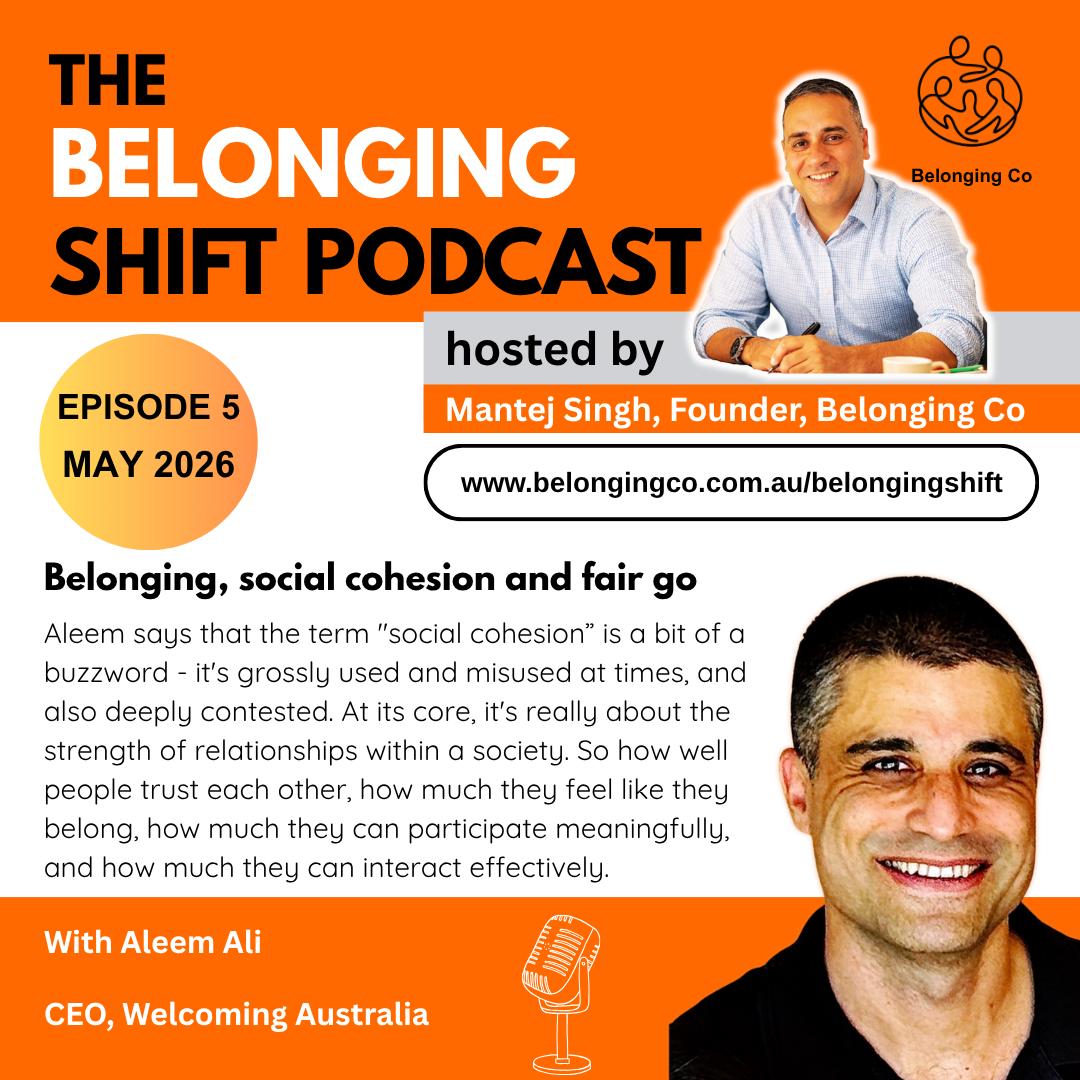
In this episode of The Belonging Shift, host Mantej Singh speaks with Aleem Ali, CEO, Welcoming Australia. Aleem says that the term "social cohesion” is a bit of a buzzword - it's grossly used and misused at times, and also deeply contested.
At its core, it's really about the strength of relationships within a society. So, how well people trust each other, how much they feel like they belong, how much they can participate meaningfully, and how much they can interact effectively. The conversation explores the concept of belonging, social cohesion, and the challenges of creating a sense of belonging in diverse environments.
The conversation also delves into the core Australian value of “Fair Go” and how it needs to be applied fairly to everyone. Aleem also talks about his personal experiences, and the impact of economic strain on belonging, and the role of leaders and institutions in fostering belonging. The episode emphasizes the importance of simple acts of kindness, and the need for principled leadership in creating a sense of belonging for all.
Aleems’s advice for leaders and practitioners for making the #BelongingShift
Shift 1: Accept diversity as the reality of your organisation and community - not a side agenda
Shift 2: Move from fear and assumption to listening, learning and genuine relationship-building
Shift 3: Prioritise micropractices - simple acts of welcome, respect and kindness that build trust daily
Shift 4: Question inherited systems and redesign them so they work for todays context
Shift 5: Try to understand your own inherent biases and prejudices
Listen to the full conversation using the links below or scroll down further to read the full transcript.
If this episode sparked a new idea, challenge, or possibility, share it with someone who’ll benefit or connect with Mantej to support your organisations work.
Connect with Aleem and Welcoming Australia
Aleem Ali is CEO, Welcoming Australia. Aleem has spent more than two decades seeding and mentoring the development of leading initiatives and social enterprises that advance inclusion, belonging and justice for diverse communities. He is the Deputy Chair of Oxfam Australia and a mentor and advisor to various startups, community enterprises and government agencies. As the CEO of Welcoming Australia, Aleem is working with leaders and organisations across the country to cultivate a culture of welcome and advance communities where people of all backgrounds belong, contribute and thrive.
Connect with Belonging Co
Belonging Co is a social and cultural inclusion consultancy helping executive leaders and organisations to strengthen inclusion, engagement, and participation outcomes across workplaces and communities — grounded in a unique belonging approach and a community perspective.
For more information, see links below
Book a FREE discovery call to discuss your needs.
Follow and connect with Mantej on LinkedIn
Follow and subscribe to The Belonging Shift Podcast
Listen to audio
APPLE PODCASTS | SPOTIFY | YOU TUBE | AMAZON MUSIC | RSS FEED
Read transcript
Hello everyone. Welcome to another episode of the Belonging Shift, the podcast where we talk to leaders about community, place, leadership, and the future of belonging. My name is Mantej Singh. I'm the founder of Belonging Co., which is a social and cultural inclusion consultancy here in Sydney, Australia. And I'm so glad to have here with me Aleem Ali, who is the CEO of Welcoming Australia.
And we'll get to learn a bit more about Aleem and Welcoming Australia. But welcome Aleem to the Belonging Shift Podcast. Thank you so much for your time And I think this conversation is so important in today's Australia and today's world about what does welcoming mean?
How we welcome people to a country, to an organization, to a place, and and where does this sit in the context of social cohesion, in the context of belonging for a diverse Australia, for a diverse world?
So as we start, can you tell us a bit about yourself, who you are, what do you do, and why does a sense of belonging matter to you?
Hello, it's wonderful to be here. Mantej, I'm joining you from Turabal Yagara Country in McGanjan, otherwise known as Brisbane. a bit about me. So my first and my last name, as you've introduced me are Arabic, Aleem Ali. my middle name, which you may not be able to guess by either my appearance or my name, is actually Sean, spelt like the sheep.
And so I grew up in an intercultural, interfaith household. my dad's background is Indo Fijian, he was born in Fiji but his ancestors in part were Germatea indentured under the British Empire, who were brought to Fiji to farm because the first peoples quite rightly were pushing back on colonialism. and then on my mum's side, I'm Anglo Irish. and so I grew up in a household where I would go to the mosque on Friday with my dad. I would go to Sunday school at the local Baptist church with my mum. and that seemed perfectly normal as a kid growing up in the northwest of Brisbane. until I went to primary school and I realized that I was very different. Particularly in the seventies and eighties in in an Australia that was really just beginning its journey of multiculturalism. I was born a year after the white Australia policy was formally disbanded in this country. and so growing up in that context was kind of quite eye opening. I I have this quite vivid childhood memory of coming home from my first day of primary school. and my mum said, How was your day, Aleem? Like your first day of primary school and I just looked at her and said, and I don't know where this kind of concept came from. in my little four almost five year old brain and experience, but I said, I don't belong.
She was like, what do you mean? What did someone mean to you? I was like, I'm so different. I'm so different. because for me, kind of diversity was my reality in in so many aspects. and I kind of walked into this context of primary school in the late 70s in Australia and went, what is going on here? So that was kind of my early formative experience. I had a beautiful household, very ⁓ welcoming was kind of part of who we were. everyone was welcome to sit at our table, although actually we sat on a grass mat and ⁓ ate on the floor. and that's kind of informed a lot of who I am. My parents were quite without me realizing at the time, quite pioneering, both in terms of their inter cultural and interfaith relationship. ⁓ I remember going to rallies and and marches for land rights for Aboriginal and Torres Strait Islander people in this country. I remember we boycotted the local supermarket because it was owned by a South African corporation under the apartheid regime and somehow by not shopping at this shopping centre we were pushing back. on apartheid and or at least not being complicit in it. and so that was very much my formative experience. And then eventually kind of that's informed my professional career as well. So for the past ten and a half years I've been involved in and led an organisation called Welcoming Australia. And our core business is essentially belonging. Our our vision is an Australia where everyone belongs and
We work with local councils, sporting codes and clubs, universities, workplaces to help them have a more planned approach to diversity, inclusion and belonging and ensure that everyone has a chance to participate in social, cultural, economic and and civic life.
Thanks, Aleem. So Aleem, we we're talking about belonging and you you said belonging is deeply personal to you from your childhood years to now leading an organization that is almost has the mission to create a sense of belonging across Australia. That's that's quite a journey. And so I want to ask this question about because belonging is a word that many people say is this it's a buzzword, right? It's not policies, strategies, and a lot of people put it there. And in the work that I do with organizations that I've and I worked across many organizations over the years, people tend to use words that are the social currency at the moment without actually engaging with or fully understanding what it stands for and then embedding and integrating that into that organization's work. Because it feels nice to use a word, that's the social currency at the time.
So for people who are listening this to this podcast and have opinions about belonging, or j are just using belonging because everybody is. how would you describe belonging if you can't use the word belonging?
Good question. you know, we were colonized and federated on a White Australia policy that only formally ended, in the early 1970s. long history of colonialism. And I think we assume that being part of something you know, and and feeling like you have ownership of that thing, which is broadly I think where belonging fits in our frame and have agency in that as well, is always a good thing, but but it's not necessarily it's it's quite a loaded and layered term. We use belonging as a construct in this country to exclude a lot of people. And there there's a very clear narrative at the moment that some people may or may not belong. And depending on, you know, whether they meet the criteria and they, you know, have the so called right values, then, you know, you can actually be excluded. And belonging, we're very clear to use words like belonging for all, everyone belongs, in a country where, you know, nearly half of us have a at least a parent who was born overseas if we're not born overseas ourselves. but i it's really interesting loaded word I think that people sometimes very well meaning just assume belonging is good. But actually we're using it to try and draw a line between who we think belongs and who doesn't belong and try and build some quite exclusive constraints around.
So what what what I'm hearing from you is that belonging can also be taken in negative directions. ⁓ belonging in a positive way, what does it stand for, in your opinion? If somebody if you go to somebody and says we want people to belong here, what what are we actually asking them to needs to happen?
Yeah, yeah. So we we kind of think of belonging as being on a spectrum. and so that starts with well, I mean, on the I guess the the more exclusive side probably begins with fear and a lack of understanding of diversity and inclusion. and and I think it's okay to acknowledge that. I think it's okay to acknowledge that because of our history as a country, there are entire communities where the majority, even up to ninety nine percent, particularly in some regional and remote communities, of the people who are in those communities, are from an Anglo Celtic or Anglo Saxon background. So their concept of lived experience and diversity is often purely through media.
And purely through what they see. And so there is a lot of you know, people who haven't necessarily met someone from an African Australian background, or wouldn't necessarily consider someone who's Aboriginal as a friend that they could invite around for dinner. And I think it's really important to actually name that and address that and give people opportunities to build relationship. and relationship is absolutely the starting point of belonging. and then we kind of say, well, you know, shifting from fear and learning and education to welcoming, you know, what does it look like to welcome people? we talk about receiving and migrant communities, so the receiving community is anyone who's established in a community. what does it look like to essentially open your doors to welcome them to your workplace, your neighborhood, your street, your house? that's kind of the starting point. You know, you kind of invite them in in both a literal and a figurative sense. And then there's inclusion. how do we include them? How do we give them a voice? How do we give them an opportunity to work and to go to our schools and to participate in community life? and and then kind of the next stage, which is ongoing, is this sense of belonging when people have agency. So they feel like they have control of when they can come and go. They feel like they have a voice. They feel like they can participate actively in, you know, work life, community life, social life. and they identify broadly with the community that they're in. doesn't mean they have to look like their neighbor. It doesn't mean they have to eat the same foods or believe the same things as their neighbour, but they genuinely have a sense of belonging in that context. That that's broad description of belonging, isn't it, Aleem? From not having fear to having agency. And that's the journey many people have to take.
So the question that we missed was around social cohesion. This word about social cohesion that's everywhere. people in the sector talk about this word social cohesion and we want to achieve social cohesion. We want to reach this destination of social cohesion. So for people who are listening and in this context of belonging, what does social cohesion mean and what are some of the things that need to occur, what sits under it for us to get to social cohesion? And is it a destination or is it a way of doing things?
It's a really good question. It's a term that is a bit of a buzzword, as you know. it's grossly used and misused at the moment to mean everything from just maintaining the status quo and being quiet and playing along through to something that is you know, deeply contested and needs to be redefined. But I think one thing we do broadly agree on is that there's actually no agreed definition of social cohesion, but from the our context and understanding, it's really about the strength of relationships within a society. So how well people trust each other or not, how much they feel like they belong or not, how much they can participate meaningfully, and how much they can sort of interact effectively. across different groups. And so there's kind of f four or five key ingredients around trust. So trust in neighbours and strangers and institutions, belonging to community, neighborhood, broader identity, participation, so sort of access to civic and economic life, and that kind of interaction piece around genuine engagement across different groups. It's not a fixed state. We don't arrive at social cohesion. social cohesion at any point in time can feel great for some people and not so great for others. And so it kind of requires this ongoing investment in community. and it's often unevenly experienced. So some some people or communities will feel its absence, you know, if quite will feel its absence more acutely. through racism or exclusion or economic marginalization. And so to try and give the simplest framing, I think social cohesion is how well a society holds and works together when things get hard. It it's essentially the primary indicator of community resilience. And community resilience is how well does a community work together and respond to and during a crisis. I think it it's a combination of all those things around trust, belonging, participation, interaction and how we feel that we are going against all those measures.
Okay, so if I sort of build on that, Aleem, that's a really good definition. And you're saying it's not a destination, it's a way of about your sort of outcomes and process. a destination. How can leaders in organizations and institutions support social cohesion, support the goal and outcome of social cohesion? What do they need to do differently?
Trust is a critical element of social cohesion. I think the more that institutions and leaders of institutions can be transparent. can demonstrate the values of integrity. you know, there's a broader conversation and argument about so called Australian values. But, you know, when I was growing up in this country, one value that was forever communicated to me that I kind of held to was this sense of a fair go. and people believing in the idea of a fair go. And if our institutions and leaders are offering a fair go to some people but not to other people, then I think that can really have quite a detrimental impact on social cohesion as well. So I I think trust is critical and how institutions and leaders build and maintain trust is really important. Thanks, Aleem. think I've got the podcast title now. Fair go has to be fair for everyone. I think that's what this is all about. This is what the belonging and inclusion and social question hang on that societies and communities change. And we have to embed our values equally for everyone. It can't be values for some and different values for other people.
So before I get to my next question, I want to ask this thing. You talked about belonging, that we shouldn't be belonging to everything, also. So I guess this it's a controversial question, in the sense that as countries, workplaces become more diverse, any place or space becomes more diverse, and we advocate for belonging for people new to that place, whether it's a workplace, whether that's a community or a country, does that challenge the sense of belonging that people people already there have? And does it make them feel that they're losing something? And how do we address that?
Yeah absolutely. I I think it can. I think people can feel like their sense of identity is being contested. And and you know, and particularly depending on the context, belonging and social cohesion are most under threat or most contested when people feel economic strain. And so y you know, we're we're in a global context where we're absolutely in economic turmoil on on a whole range of of levels, whether that be because of geopolitical crises or policy. or technological advances like AI, you know, people are calling into question, you know, the types of jobs and careers that that we're going to have into the future. you know, people are grappling with how do we pay rent and how do we afford ⁓ increasing inflation and and and the increasing cost of food. And so in those contexts, belonging and social cohesion are always become quite contested and you know take a dip if you want to chart that on some kind of graph. because people are concerned. They're concerned for their future, they're concerned for their livelihoods, they're concerned for their families.
And rather than sort of having an inclusive mindset, we go, well, hang on, if they're getting access to the same services that I get access to, does that mean I get less now? I'm already feeling challenged. I'm already feeling like it's hard to pay the bills. and it's very relatively easy and it's quite human to look for someone or something to blame. and rather than blame the structures that we live in, rather than blame you know, tax policy or blame extractive capitalism, we kind of go, well, they're new. It must be their fault. it's quite a human response. And I think whilst there are people who profit from that, who profit from fear and profit from division, I don't think we're very good in this country at having those conversations. Let's talk about what you're concerned about. Like, can we have that conversation Why you think this person who's moved into your neighborhood or who's coming into this country threatens your livelihood? And how do we have those conversations in a way that isn't so binary, you know, right and wrong, left and right, in a more meaningful way. And I don't think we're very good at that.
Aleem, you put it so well that, you know, somewhere it's it's a human thing, right? So we can't say people are just you know reacting badly. It it is it is kind of coming from somewhere. Is it is economic pressures, it's fear, it's fear of the unknown, I guess, in some cases, that and trying to then make sense of it, and this is how it comes out in some cases. That's kind of what you're indicating. So how do we course correct? How do we course correct this situation where people are reacting in human ways to difficult, complex situations that are putting pressure on them themselves? and how do organizations, leaders, and institutions tackle this sort of dynamic, this situation that's not just unique to Australia, that's happening worldwide as well in a in a way. So that that's my question. But before I get we get into what are the solutions, I want to understand from your perspective, from your experience at Welcoming Australia, what do leaders, organizations and institutions commonly misunderstand or commonly misinterpret about this situation and dynamic
Yeah, it's a good question. I think leadership And words matter still, and principled leadership. And I think that broadly in a context where people feel like they're not being listened to, they're not being heard, that, you know, things are actually quite tough for them on a day to day basis, then they're looking for people who will listen and who will kind of lend an ear to their concerns. And and I think that's why we're seeing a rise in populism.but people are looking for someone who will listen to them.
My sort of challenge to leaders often behind closed doors is be someone who listens before you speak. Be someone who's willing to then process that information and respond in a meaningful way. I tend to find that even though people can have quite rigid views about things, when you can bring them together in a way where they might still feel uncomfortable to have some conversations, but they s at least feel reasonably safe to talk about what is concerning them. That a lot of those prejudices can kind of disappear pretty quickly. They kind of learn that you know, the the person that they've never never met before when they had quite clear stereotypes about who they might be and what they might do with their lives, once they actually sat around a table and maybe shared some food together that suddenly their entire perspective shifts. And I think that's a really difficult thing to do in the pace of our life. But the more that we can do some of those simple things, I mean we did this as an organization when we were just starting out, we we sort of encourage people across the country to just host a welcome dinner. Just invite someone from your street that you may not have n ever really met. that you may never have shared food with and you know, three or four neighbors in your vicinity invite them over for a meal. and it's often the simple things like that that can have the most profound and radical difference.
so you what you're saying is you simple acts of kindness matter. If you can get on the same table, then you can actually have a conversation to listen. So a lot of the work that you do and in in the in the work that I do with organizations is advocating for building that table and getting people to it. Once people are on the table, you you would hope that they can actually differences are easier to sort out.
And Professor Katomi Gatwiri, who's a researcher and academic now based at Flinders University, has developed this framework called the Racial Dignity Framework. and it was based in interviewing literally hundreds of people across the country about their experiences of racism and discrimination and what she learned through that research was actually the things that have the most profound effect. what she calls micropractices. So the ways that people feel most welcome and most included is the simplest things. It's smiling at people. It's taking the time to learn their name and get it right. If you find it difficult to pronounce or it's not a it's not a name or a culture that you've necessarily experienced or been used to before. It's giving people space to speak and have a conversation. It it was just this She almost felt like the research had failed because she was like, Why why is this so simple, yet we're missing it? And when she actually dug into it all, it it was those those little micro things that we kind of assume might be too easy, but is actually what is most human to every single person that really has the most profound effect in bringing people together.
Yeah, so well said, Aleem. And I in the work that I did on anti-racism and cultural inclusion, I also found that those very things that you know yes, we talk about advocacy and representation and sort of big policy shifts and big policy changes, but on a daily human basis, those micro behavioral changes that actually have the most profound impact. So I totally agree with you on that.
So if it's it's so simple for all of us by simple acts of kindness to create a sense of belonging for people different to us. And I wanna also say I think belonging is not a one-way street. People already here I do not have to create belonging or have responsibility to do it for people new to Australia or new to an organization. We all have a responsibility to create a belonging for each other. So everyone has a equal responsibility. Because that's the argument I get all the time that w why is, you know, new people entitled, right? whereas I think if you're coming new to a country, you also have to make sure that you understand the values and laws of a country and abide by that and are respectful to people that are living here much before you. And so it goes both ways, isn't it? It's not just a we're not advocating for one way sense of belonging. Is it Any thoughts on that?
No, absolutely. I mean, belonging is built on relationship and relationship is o always two way and reciprocity, you know, is vital and central. it is important though in that context to recognise that there are significant barriers to people coming to any new context. And as much as we can do as you know, this what we call receiving communities to ensure that those barriers are removed so that relationship can form and exist is important as well. and some of those are just implied and and it is that fear factor of I don't understand your culture, I don't understand what you believe. and we, you know, all have inherent biases and prejudices. and so part of it, you know, for ourselves is to try and understand why we're afraid and, you know, take the responsibility of ourselves to kind of dig into that a little bit. and then for people who are new to a context, absolutely. I mean, in my experience, I've never met someone who is a recently arrived migrant or may have been here for decades who didn't come to this country with the expressed belief that they were here to make a better life for themselves, make a better life for their families and to positively impact the community they're in.
So Aleem sort of building from there, if you had to identify one thing, what what is the hardest constraint that gets in the way of doing these simple acts of kindness or doing these, you know, big policy shifts to create a sense of belonging, what is the biggest constraint?
one of the biggest constraints is the systems that we just assume are the way that things have always been and always will be. I think we we frequently expect these systems that we create to guide us, you know, almost like cattle through a gate, rather than going, Well, why does it have to be like that? And can we reinvent that so it actually works for who we are now and where we're going in the future, rather than forever having to kind of work within this constraint?
Thanks, Aleem. I what I want to sort of talk about now is what is your advice to leaders, organizations, institutions, people at the top who have the power and the influence to make decisions. what they should what should they be doing differently in the context of what we've been talking? which is around that we have to reinvent our systems, we have to have simple acts of kindness, we have to understand the marginalization and barriers that people come with and in the constant context of economic pressures, global shifts. this is the belonging shift. So I'm gonna ask, what are some of the belonging shifts leaders and institutions need to make? What are the top five things that need to change?
I think it you know, part of the starting point is diversity should be your reality. Like this is the world we live in, this is the country we live in, you know, statistically. yeah, you know, we're highly culturally and linguistically diverse and you know, a whole range of other intersections of of gender and sexuality, etcetera. but often I think Depending on how long the organization is around and how big the institution is, when leaders look into their organization, they may not actually be as diverse as they would like to think, or that diversity might stop at a certain level, right? And so one of the first questions that needers l need to ask is Is my organization representative of the community's and the context and the markets that I operate in. and if not, why not? And how can I, as a leader, address that within my organization? you know, that should be the baseline. I think the organisations and the businesses that are truly successful are the ones that just kind of accept that diversity is their reality. How can they include everyone as much as possible? And then how are they ensuring that they're engaging with the diversity of people in their community.
Thanks, Aleem. we are in a diverse Australia, we are in a diverse world. And if institutions and organizations don't understand the community, then they can't be productive and innovative in response to that community. So imagine an executive leader who has the power to change the course of culture in their organization or how they engage with the community. What is your final words to them if they are listening?
This comes back to micropractice. I think I would suggest to them to find the three or four people in their organization that are least like them, like least in in whatever measure, whether that's, you know, culture, language, gender, age, whatever that is, and Take them out for a cup of coffee and just sit and listen to their whatever they want to share, but you know, their their story, their professional journey, how they engage with the organization, where they see that the organization could improve. 'cause I think we learn the most often from the people who are least like us. and and just be willing to just kind of listen and learn without necessarily having to even respond or try and fix anything. I think as simple as that sounds, that would have quite a significant flow on effect both in your organization and potentially how you do business.
Thank you, Aleem. you're not sort of called out for big policy shifts and big changes and big budgets.
You said start meaningfully, start genuinely where you are, because that's what it's about. Engage, find difference around you, embrace and engage that difference and start there. And I think if you can start there authentically and well, the rest will build on from there automatically. Is what your message is. Thank you, Aleem. And thank you everyone for listening to this belonging shift podcast brought to you by Belonging Co. which is a social and cultural inclusion consultancy that I founded last year to do this very thing to inspire Australia to inspire organizations on belonging and the possibilities of belonging around community, place and leadership. So if you are interested in more such conversations, stay connected and follow the Belonging Shift podcast and let's
Create a sense of belonging across our communities, across Australia, through simple acts of kindness, one day at a time, and and then that will accumulate into an Australia where everybody belongs Because as Aleem has said, those things add up, or those simple acts of kindness add up, and then they collectively create a fertile ground where bigger shifts and systems change and policy work can occur. But it that's the foundation.
Thank you, Aleem, so much for your time it has been really great to talk to you.
