
Episode 6: Belonging, workplace inclusion and daring to reimagine it
In this episode
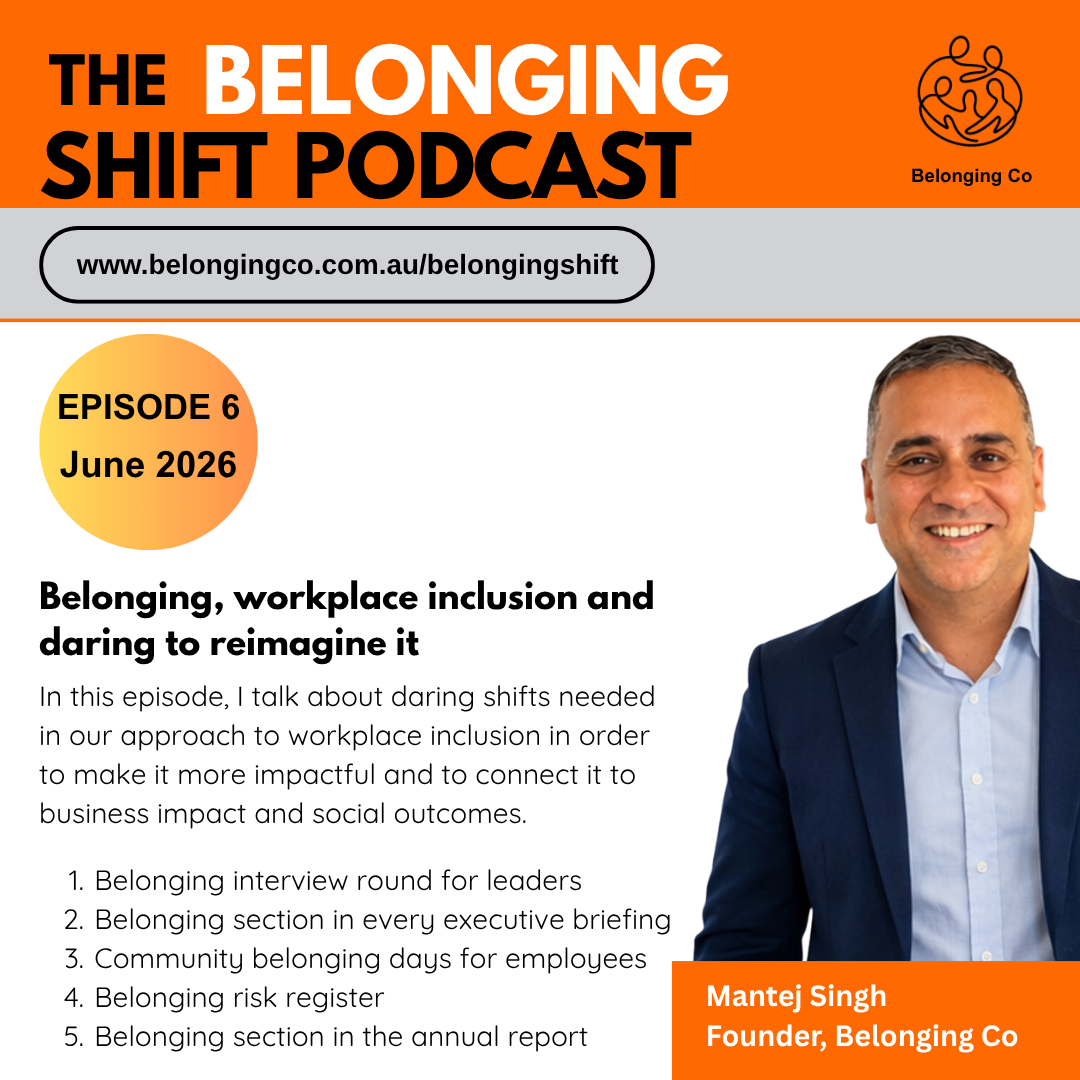
In this episode of The Belonging Shift, host Mantej Singh explores a daring approach to transforming workplace inclusion by shifting from conventional models to a systemic, belonging-centred design. He presents five innovative shifts that actively embed belonging into organisational culture, decision-making, and community engagement.
Mantej challenges leaders and organisations to move beyond surface-level diversity efforts and embrace systemic, belonging-centric reforms that influence societal cohesion and belonging. Rethink how you assess, embed, and report on belonging—because the future of inclusive workplaces depends on it.
He asks the readers to think about what would we change or shift if we had the power to redesign workplace inclusion from scratch and were asked to be daring. What would we stop? What would we start? And what would we do differently? That is where the real belonging shift begins.
Mantej’s advice for leaders and practitioners
As long as belonging depends on discretion, it will always remain uneven. It'll always favor some and not favor others. And the solution to this, is a belonging mindset, embedded into the system and architecture of an organisation.
I want to name the deeper distinction here. The current workplace inclusion approach asks, how do we include people in the system or the existing system? While a belonging approach asks, why does the system exist? What kind of system are we asking people to belong to?
If I was allowed to be daring, I would propose 5 shifts to support this:
Shift 1: Belonging interview round for leaders
Shift 2: Belonging section in executive briefings
Shift 3: Belonging community days for all employees
Shift 4: Belonging risk register
Shift 5: Belonging section in every annual report
Listen to the full conversation using the links below or scroll down further to read the full transcript.
If this episode sparked a new idea, challenge, or possibility, share it with someone who’ll benefit or connect with Mantej to support your organisations work.
Connect with Mantej and Belonging Co
Mantej brings to this work 20 years of experience across community engagement, social outcomes, placemaking, arts, and diversity and inclusion. As part of this, he has managed community and cultural facilities, curated community programs and exhibitions, and led place activation projects. He has driven complex inclusion and community participation outcomes and won awards and recognition for his work. Mantej also brings to this work his own personal and observed experiences of bias and exclusion, and how it manifests in workplaces and communities.
For Mantej, inclusion and belonging are not abstract concepts or professional buzzwords. They are values that have guided career choices, partnerships, and ways of working for many years. Belonging Co is a social and cultural inclusion consultancy founded by Mantej to help executive leaders and organisations to strengthen inclusion, engagement, and participation outcomes across workplaces and communities — grounded in a unique belonging approach and a community perspective.
For more information, see links below
Book a FREE discovery callto discuss your needs.
Follow and connect with Mantej on LinkedIn
Follow and subscribe to The Belonging Shift Podcast
Listen to audio
APPLE PODCASTS | SPOTIFY | YOU TUBE | AMAZON MUSIC | RSS FEED
Read transcript
Hello everyone, welcome to episode six of the Belonging Shift Podcast. In this episode, I'm going to be talking to you about being daring in reimagining our approach to inclusion in our workplaces, if we are allowed to be daring. My name is Mantej Singh, and I'm the host of this podcast called The Belonging Shift, where we talk to leaders about community, place, leadership, and the future of belonging.
In the month of May, I talked to four great leaders about approach to belonging in community engagement, community development, and social cohesion. In the month of June, I have four episodes coming out that will go into systems thinking, business impact, and the idea of fairness for workplace inclusion. But before that,
As always, I wanted to share my perspective on the approach to inclusion in our workplaces and how to be daring about it, how to reimagine it. So let's get started. And this is my perspective. lots of people will have different perspectives as well, but I am viewing it from a belonging mindset, and I am viewing it from the perspective of people who don't work in diversity and inclusion.
Whether they are leaders, whether they are people on the ground in customer service and operations. But how does belonging and inclusion matter to people in our workplaces if you if that is not your core job? That's what I feel we need to start with.
So let's get started. As we all know, workplaces are diverse. People with different life experiences from different life stages and different needs come together to create business outcomes and performance. And the premise of workplace inclusion is that if organizations fairly support the diverse needs of these diverse people, then everyone will be happy. And when people will be happy,
Who decides what is fair?
They would have a strong sense of belonging and therefore will be more productive. That is the theory. And the only flaw with that model or that theory is that who decides what is fair? And the only solution to that is that it should not remain discretionary decision for a few people to determine what would be fair for a lot many other people or for majority of the people in a workplace.
Because as long as belonging depends on discretion, it will always remain uneven. It'll always favor some and not favor others.
And the solution to this, in my view, is a belonging mindset, in a sense that it's embedded into the system and architecture of an organization. I want to name the deeper distinction here. The current workplace inclusion approach asks or it often asks, how do we include people in the system or the existing system?
While a belonging approach asks, why does the system exist? What kind of system are we asking people to belong to? And that is a very different question and that is a very different frame. Because if the existing system in any organization or in workplaces in general, teaches people to shrink, to hide their whole self, to perform or to mask themselves, to achieve dignity.
Then it's just not a workplace problem because we spend a lot of time in our workplaces, and what we experience in workplaces contributes broadly to social inclusion our and our approach to that, our understanding of that, and our communities where we live, work, and play. Because our experience in our workplaces shape our sense of agency, shape our sense of belonging.
And then we that contributes to our overall sense of belonging in a society, in a community and a country, whether we feel trusted, respected and valued, our experiences at work shape ⁓ our thinking around that quite a lot. So when workplaces get inclusion right, they also contribute to social cohesion beyond the organization. Because people take that sense of trust, dignity, participation and fairness across difference home with them.
Into their communities, it contributes to their sense of belonging. So I want to ask you: if you had the power to change the approach to workplace inclusion from a belonging mindset, and you were asked, what would you stop? What would you start, and what would you completely redesign or reimagine? What are you going to do? I'm now going to share five things that I would do and I would change and reimagine.
In the way we practice our approach to inclusion in our workplaces. And I would like to hear from all of you, as as you hear to this podcast, to think about them, to reflect on them, and to come up with your own ways of how you would reimagine workplace inclusion if you are allowed to be daring and
If you're allowed to start from a completely clean slate and to shape the area of workplace inclusion in your own way.
So here is what I would do, and here are my five top shifts.
Shift 1: Belonging interview round for leaders
The first thing that I would do would be a belonging interview round, especially for executive leaders, CEOs, board chairs, people who are on a board. And what would a belonging interview round look like?
And I'll get into that shortly. But firstly, I want to talk about why is this shift so important? Because we currently select leaders and executives based on their ability to handle ⁓ operational complexity, handle finances, budgets, make strong decisions in pressure environments, complex decisions, and understand risk and and work with that.
Which is a real skill people need at that level. But we do not test their ability to make these decisions with a sense of empathy, kindness, and respect for diversity and difference, or understanding of disadvantage, so that when they take these decisions, they are aware that those decisions
are not unevenly impacting different people or different communities. this is so important. Because if organizations that are run by senior executives and CEOs and board chairs do not understand social cohesion or how belonging is built in our communities and our workplaces, then the decisions they take
Complex decisions will have long-lasting impact, not only on organizations, but ⁓ communities, a society, will be uneven as well. And it will impact public trust, it'll impact community relationships, and a lot more. So now coming back to what should this belonging interview round include? I wouldn't want this to be a generic, you know, values question about diversity.
so I wouldn't want this to be just about asking, demonstrate how you value diversity and inclusion. Because the answer to that in most cases would be, of course I value diversity and inclusion. It's so important to me. I've led delivery of diversity and inclusion action plans, or I was sponsor of a staff network, or I led an accessibility review. I'm not saying those things are not important, but I would say those are outputs. Those are things that happened. But those are not outcomes.
What what we need to test for is a leader or an executive sense of awareness and understanding of belonging.
The mindset, but also belonging as an outcome. So I would propose in this interview round questions like, Well, why is the sense of belonging important to you as a leader? How do you factor your own power, privilege, and your own biases in your decision making?
When did you realize that you were wrong from a belonging and inclusion perspective? And how did you address that? Because the answer to these questions will tell a leader's awareness of where they are strong, where they are not strong, and what do they do about it in in the context of belonging and inclusion?
Now, let's take a pause and think. If you tested leaders for these questions and you weighted these questions or gave them equal or almost equal weighting to when you were asking them questions about complexity, budget, and risks, then my friends, we we are going to have very different recruitment outcomes. Because that is going to really show what kind of leaders value. diversity and inclusion and belonging and what don't. And you would be able to see it. a lot of people can criticize this and say, like, you know, ⁓ we will get really substandard recruitment outcomes and that'll have a big impact on risk and and and competency in in handling organizational sort of complexity and risk. I don't agree with that. I am certainly not advocating for recruitment
To you know select leaders who have less business acumen and are and are rather more strong in belonging and inclusion. Quite the contrary. I am advocating for is leaders that have exceptional business acumen, but at the same time have a very strong belonging mindset. Because if leaders are going to shape culture, systems, and people's working lives, then
I would want them to understand the conditions, the barriers, the strengths that shape that experience. what we need to stop doing is hiring for exceptional business acumen with no test for belonging. And then handing belonging and inclusion to leaders as extracurricular projects. Because then it becomes an act of compliance and symbolism. It's fun, but
It doesn't go deeper because there is less genuine understanding of why these things matter. And I'm not saying representation doesn't matter. I think people from diverse backgrounds into leadership might help, but I think more than representation, I would ask for leaders who valued belonging.
Who had a belonging and a systems change mindset because those kind of leaders will automatically create fair processes will bring up leadership teams that are representative of the communities we serve. So the first shift, as I said just now, will be creating a belonging interview round for senior executive leaders.
Shift 2: Belonging section in executive briefings
The second change or the second shift that I would make, I would put put belonging section into every executive briefing. I have written and drafted many executive briefings. And when you look at the structure of any executive briefing in a corporate or a government organization, it has a section on finance, it has a section on legal, it has a section on risk, it's asked for recommendations. But I have not seen a section on belonging. Because if belonging and inclusion
is not there in your executive briefings, then it is very clear that it's not important.
If finance gets a section, if legal gets a section, if risk gets a section, then belonging should get a section too, if it's important for the organization. What I would want to see happening is that every executive briefing and in all every organization has a section which says how does this impact on belonging and inclusion as an outcome? Whatever the decision, whatever the recommendation.
Because I don't feel belonging is separate from business impact. I think it is so intrinsic to business impact because every executive decision has an impact on people.
And as we said earlier, if that impact is uneven, then it is not fair. And I'm not saying that, you know, get into never-ending analysis paralysis and test every decision against 15 different diversity categories. No, I don't think that's practical either. But I think it should ask at a fundamental level that have you considered this decision from a belonging mindset. if you have that across every executive briefing, will start will will almost force people to consider belonging in the work that they do. Which is which is why I'm recommending this as a second shift.
Shift 3: Belonging community days for all employees
The third shift that I would do, I would establish community belonging days every year. And and what that means is that every employee should have some allocated days each year. The number doesn't matter as long as it's equally available to everyone.
So this is not corporate volunteering or a photo opportunity or charity which comes from we're gonna help the needy and the less fortunate.
And this is not also a using community as a branding opportunity. But many times belonging and inclusion is practiced in workplaces where you sort of pit diversity against diversity and it's theoretical. Everybody is fighting for fairness that benefits them. it is sort of acknowledged through days of significance.
And therefore it's not real at times. People benefit and gain from real contact, real lived experiences. So I think it's really important that people get an opportunity every year for a certain number of days to go and visit a community organization that is different from their usual identity. So from your own personal experience, you go and visit something.
And learn about people that are different from you, the barriers they are facing, the challenges they are facing, the strengths they bring to the table. Because that real contact generates empathy, generates kindness, generates curiosity, and that shifts behaviors, which is what the whole purpose of workplace inclusion is. But sometimes when we actually are in workplaces, because of lack of clear contact and clear exposure.
We are not able to do that. So I think that's really important. So I would advocate for community belonging days every year. And that spending some time with people different to you could improve customer insight, could help people think differently about policies, ⁓ the relevance of services, or how leadership makes decisions. And I think community belonging days should also be co-designed with community partners and they should be properly resourced.
And based on reciprocity. So we should also invite communities to come to organizations and spend time and connect with the work we do in organizations. And that people to people contact across diversity and difference and disadvantage will go a long way in contributing to a sense of belonging and inclusion both inside the workplaces and externally in the community as well.
Shift 5: Belonging risk register
My shift four. Would be to create a belonging risk register. Now, this is going down the compliance route. I do and I do get it. But I think it's really important because we have risk registers. Most organizations have lots and lots of risk registers with capture things like from you know trips and falls to you know financial risks and governance risks and sometimes health and well being risks risks. But what I would advocate for
If I have to be really daring, is to create a belonging risk register. And what this register would do is to identify the risks to not achieving a sense of belonging for employees and sense of belonging in the work we do as organizations. Because most D&I work asks what program should we run. A belonging risk register would ask where the system is already failing people, what is contributing to a lack of belonging.
So this register should not sort of list issues by diversity or you know interpersonal issues. It should be a way of naming at a systemic and structural level where the system across the board is producing exclusion, distrust an unequal access or invisible harm for people.
And creating this register should ensure that exclusion, low trust, or cultural harm and disengagement were treated as real organizational risks. And and a daring version of this idea would require leaders to report on belonging risks with the same discipline that they apply to financial, operational, and safety risks. And if we do that, that that is automatically going to uplift our approach to belonging and inclusion.
And in doing so leaders will also have to lift their awareness of belonging and inclusion.
So this risk register will enable leaders and managers to see the patterns before they become complaints, reputational issues Most importantly, this should make leaders accountable for identifying and reducing barriers across systems and teams.
So a belonging risk register would also shift the conversation from do we have initiatives to where is a system and structure producing exclusion over the years?
Shift 5: Belonging section in every annual report
And the last shift, shift five, will be about every organization should articulate in their annual report. How they are contributing to building a sense of belonging in a diverse, modern new Australia. Because every annual report in most organizations would have a section on how they're supporting diversity, how they're supporting you know, well being, how are they supporting sustainability. But very few corporate reports or annual reports in organizations have a section on belonging and social cohesion. lot of people will ask, Well, how's what's that got to do with workplace inclusion? I'll explain. Because workplace inclusion does not sit in a vacuum. Every organization shapes the social fabric of communities, places, and larger society, from where it hires, who it backs, whose identity is affirmed, whose knowledge is valued. and how it serves communities and what kind of relationships it normalizes across difference. A daring organization with a belonging mindset should publicly articulate how it is helping build communities and places where people from different backgrounds can participate.
And feel visible and experience fairness. Now that is a much bigger question than how many inclusion initiatives did we run this year? Because now it becomes about social and community impact and outcomes.
And if all organizations articulated and documented how they contributed to a more cohesive, fair society, they will not be able to do so without valuing these things internally, without having diverse workforce represented at all levels. So by shifting the focus on belonging and social cohesion in our work,
We will automatically champion those things in our workplaces.
And we do we all do spend a lot of time in our workplaces, as I said earlier at the beginning of this podcast. So if we experience belonging and inclusion, dignity in our workplaces, we will take that out in the community and that'll contribute to the social fabric of Australia as well. So
So what this was look like in an annual report is that how has our organization strengthened participation, fairness, trust and connection across difference within our workforce, through our services and the and then the communities that we serve?
These five shifts that I've talked about today. will move belonging from aspiration to a systems infrastructure. And the future, in my view, is not more inclusion language or more days of significance. The future, if you have to be daring, is organisations redesign. So belonging is built into the architecture of the organization, into the governance of the organization, into every executive briefing, into every annual report, and into the way the leaders are recruited. Because that is the only way to move us away from optics towards outcomes.
How would you reimagine workplace inclusion if you are allowed to be daring?
So that's the five shifts that I would recommend if I was able to reimagine workplace inclusion. So I want to now leave all of you listening with one question. What would you change or shift if you had the power to redesign workplace inclusion from scratch? Not politely improve it, not tweak it, not add another event, but actually redesign it and you were asked to be daring. What would you stop? What would you start? And what would you do differently? That is where the real belonging shift begins.
And if you need help in that journey, reach out to me at Belonging Co. I work with leaders to review their approach to workplace inclusion and broader social and community outcomes from a belonging mindset. Or talk to anyone else in your network that you feel is good in that space, someone that has done this work on the ground, felt it on the ground, and can help you and guide you from real experience. Let's all make this belonging shift together.
In the coming episodes, we will explore belonging across place, community, and leadership with real practitioners, real stories, and practical shifts you can all apply. And I look forward to all of you being there. If this episode sparked a new idea or gave you language for something you've been carrying, share it with someone who needs it. A colleague, a leader, a friend. That's how this conversation grows. thank you for being here. I'm Mantej Singh.
And this is the belonging shift. I'll see you next time.
