
In this episode
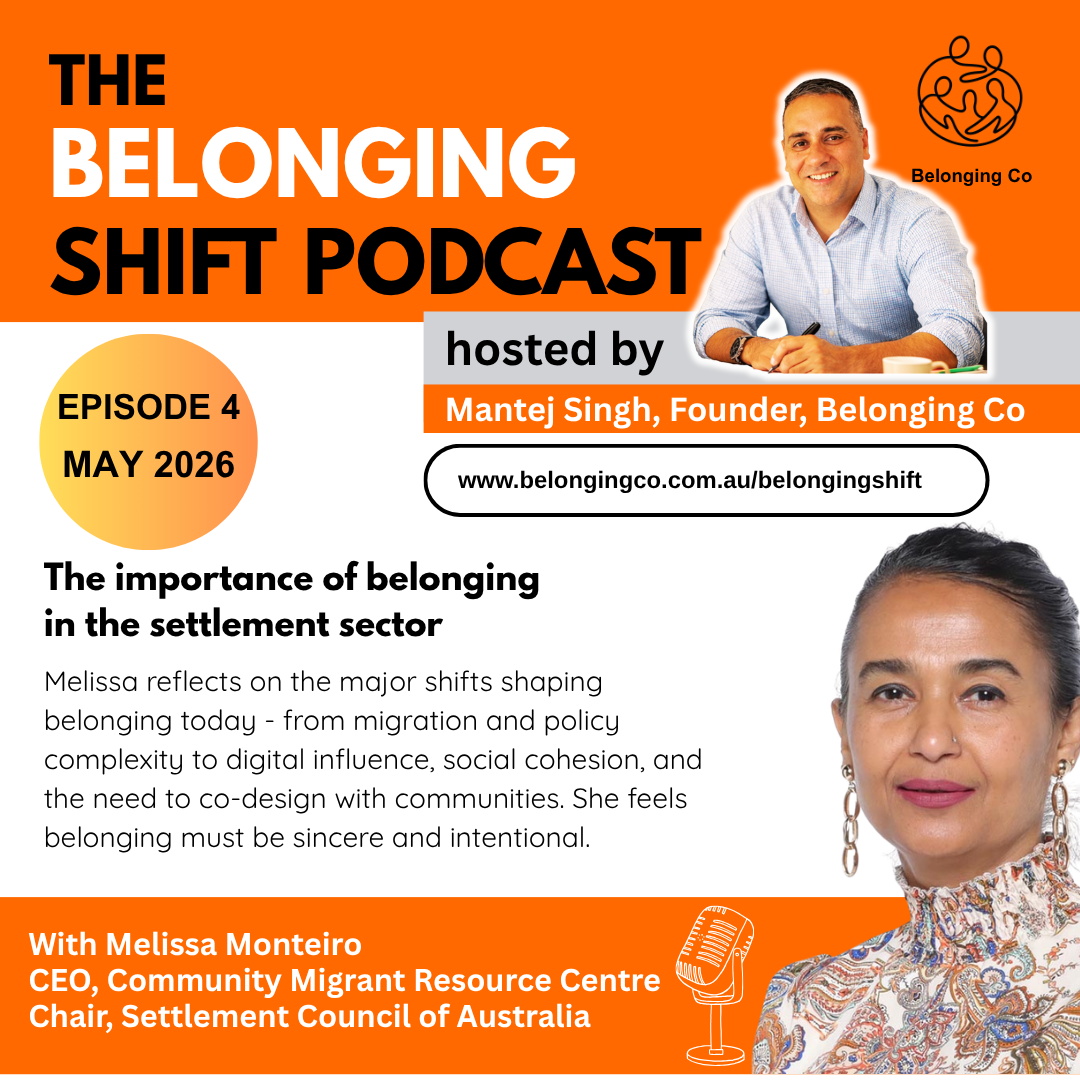
In this episode of The Belonging Shift podcast, host Mantej Singh speaks with Melissa Monteiro , about belonging, migration and settlement. Melissa Monteiro is Chief Executive Officer of the Community Migrant Resource Centre and Chair of the Settlement Council of Australia (SCOA)
Melissa shares her insights from over 25 years working with migrants, refugees, and diverse communities, emphasizing that belonging is foundational and must be intentionally cultivated. She highlights how in order for migrant and refugees to thrive in Australia, belonging becomes the most important element in their settlement journey.
Melissa says that there are major shifts occurring in this space right now. Communities are more diverse, people are traveling more, there is more mobility, people are being more digitally connected. Our identity is very layered, people belong to local communities, but at the same time we are part of this larger global family. There's economic pressures, there is misinformation, there's racism, there's radicalization that is spreading even more. All this is countering social cohesion, and hindering our sense of belonging.
Melissa’s advice for leaders and practitioners for making the #BelongingShift
Shift 1: Co-design with communities
Shift 2: Build long-term partnerships
Shift 3: Harness the potential of shared spaces
Shift 4: Listen and create environments where everyone feels heard
Shift 5: Start with a genuine motive and intention and don’t be defensive if you get it wrong.
Listen to the full conversation using the links below or scroll down further to read the full transcript.
If this episode sparked a new idea, challenge, or possibility, share it with someone who’ll benefit or connect with Mantej to support your organisations work.
Connect with Melissa and CMRC
Melissa Monteiro is Chief Executive Officer of the Community Migrant Resource Centre and Chair of the Settlement Council of Australia (SCOA), representing approximately 180 organisations across Australia’s settlement sector. She is also Member, Women Peace and Security Coalition of Australia.
Melissa’s work is grounded in an intersectional approach, addressing the layered impacts of gender, migration, race, and socio-economic inequality. She has led the design and delivery of prevention and early intervention initiatives that respond to the strengths and needs of diverse communities. Melissa is a strong advocate for inclusive policy and systems reform. She serves on multiple national and state advisory bodies and has partnered with Western Sydney University on research, including studies on the sexual and reproductive health of migrant and refugee women. She has been recognised as a Pro Bono Australia IMPACT 21 award recipient and appointed as a The Salvation Army Multicultural Ambassador,
Connect with Belonging Co
Belonging Co is a social and cultural inclusion consultancy helping executive leaders and organisations to strengthen inclusion, engagement, and participation outcomes across workplaces and communities — grounded in a unique belonging approach and a community perspective.
For more information, see links below
Book a FREE discovery callto discuss your needs.
Follow and connect with Mantej on LinkedIn
Follow and subscribe to The Belonging Shift Podcast
Listen to audio
APPLE PODCASTS | SPOTIFY | YOU TUBE | AMAZON MUSIC | RSS FEED
Read transcript
Hello everyone. Welcome to the Belonging shift podcast here in Sydney, Australia. with me, Melissa Mentero, who's the CEO of CMRC and the chairperson of the Settlement Council of Australia and member of the Women, Peace and Security Coalition of Australia is here with me today on this podcast. Welcome, Melissa.
Thank you so much, Mantej. Good to be here and good to speak with you all. Thank you. everyone listening, I'm Mantej Singh, I'm the founder of Belonging Co, which is a social and cultural inclusion consultancy based here in Sydney, Australia. And in this podcast, we are bringing people from diverse areas to explore the shift that leaders need to make to build trust. participation, inclusion and belonging in our societies, in our communities, in our places. And I couldn't think of anybody more experienced in this space across leadership, place and community as Melissa is. And I've known Melissa for a long time.
So let's start the conversation,
Melissa, So tell us a bit about yourselves. Who are you? What do you do? And What does a sense of belonging matter to you in your area of work?
Thank you, Mantej. As you've just introduced me, I am Melissa Monteiro. CEO at the Community Migrant Resource Center and Chair at the Settlement Council of Australia, and a very proud member of the Women, Peace, and Security Coalition of Australia. For the last 25 years, I have worked alongside various groups of women, migrants, refugees, humanitarian entrants, newly arrived communities, supporting newly arrived communities as they rebuild their lives here in Australia.
At the very outset, I'd like to say that mantej, belonging for me, it's all about acceptance. I have worked closely with this group of people for nearly now three decades and one of the things that stand out to me the most is the importance of this one word, belonging. Why does belonging matter in our area of work? Because it is foundational. It is not something that is an add-on. It is not something that you choose. It is not something that is gifted to you. is something that is everything. So belonging is acceptance.
And in order for these migrant and refugee groups to thrive in Australia, belonging becomes the prerequisite. Belonging becomes the most important element in their settlement journey. I have the opportunity of also being the chair of the Settlement Council of Australia. Again, the Settlement Council is that umbrella organization with 180 members across the country. And we are all striving towards that one purpose of helping newly arrived refugees and humanitarian entrants settle in this country. But you can settle when you feel belonging. So a sense of belonging is what is foundational for me.
If someone doesn't feel safe, doesn't feel respected, doesn't feel that they have been seen, they won't access our services. Settlement is nothing without this feeling of being accepted and having this belonging in you. They will not feel trust. Mantej trust is the most important. and very important that people have that trusted relationships with people around them, with the institutions that are working around them. And it's important for people to participate that will help them to accelerate their employment opportunities, will help them to feel accepted in their civic life and contribute in whichever sphere of life that they are in.
Really well said, Melissa. And you've talked about what belonging means for people who are settling in Australia, what belonging means, what's the thing that sits under that phrase. And I want to take a step back and ask you a more sort of personal question. In your journey of arriving and settling in Australia, what has belonging meant to you personally?
Genuinely feeling welcomed. There's a sincerity and a genuineness that comes along with this belonging. And I've written in my book, In the Girl from Mumbai, and on a number of occasions I've actually spoken about my own journey, which I'm really very fortunate and I say blessed in my book, because I do feel blessed to have had that genuine, sincere, welcome from people around me
The organization is thriving because we are helping migrants on their feet, refugees that are brand new to the country, people who are seeking refuge here from other countries. And that's what I've been able to provide to people. So personally, it means having this genuine sense of welcome, sincere welcome.
thanks Melissa. I think that sincere welcome is really important. I reflect on my own journey as well and there has been many people that have supported me along the way both in career and social settings and I think that sincerity of support is really important
So if you reflect on your journey, how you've led Community Migrant Resource Centre over the years, the interactions, the experiences that you provided and the organization has provided. What shifts are happening right now in your area, in your sector that are changing how people are experiencing belonging?
Before I answer the second question, Mantej, a very important key, personal, sincere belonging can also be defined for me as having felt acceptance. And I feel acceptance is that one foundational element again is when you say acceptance and unpacking acceptance, and I've done that. for very many years with our teams, with my team at the MRC. Acceptance is showing up as you are. I am who I am, and I'm not changing who I am in order to be suitable for you to make me feel belonging or accepted by you. So acceptance is being who I am, and that is very critical for us for any new arrival to the country. You feel accepted and the sense of acceptance and belonging which starts in your own family.
Your family is that core system that gives you that identity when you are born in your own family. your parents, your culture, immediate family, your relatives, your relations, all form that buffer around you, that protection, that cotton wool around you. And then you go out into the community, the wider community, and then you go into the still larger community. So there are different tiers and layers around. that form this little cushioning of welcome and acceptance. So if I fall, I know that I will bounce back only because I'm well cushioned. I guess that's the other just good way of expressing what acceptance is all about.
And you are who you are. You don't have to hide who you are. And Australia, we're so fortunate that we're able to practice our own culture, to practice our religion, to speak our language, and to be who we are to follow our traditions as long as we are able to understand what our responsibilities as long as we know that we have to respect the law of the land. And that's very important that in our giving back, it is two-sided. Australia gives us, but we give back. in bountiful and I feel that when migrants and newcomers feel the sense of belonging they want to give back even more. When belonging is restricted and limited or not felt then that giving back is even limited
I'm reflecting on this conversation we were having last week around, you know, belonging cannot be demanded, but it cannot also be given. It lives in the space between the two. What shifts are occurring in this space? What have you seen shifting in the last two years, three years? What have you seen shifting in the last two years, three years?
Now more than ever before, are major shifts, Mantej. Major shifts when it comes to migration. When you look at, I'll just start with the global, the big picture. When you look around the world, communities now are shifting. communities are more diverse, people are traveling more, there is more mobility, people are being more digitally connected, our identity is very layered, people belong to local communities, but at the same time we are part of this larger global family.
technology that is bringing together people around the globe in seconds. migration patterns are changing. Countries are opening up. Countries that opened up many years, till two years ago, are now shifting and relooking at their migration programs. Migration programs are being shared every day. by countries and governments. We're learning from each other. Australia, I'm really happy to say, one of the proudest and the best migration programs. It's been tried, it's been tested, and I know other governments around the world have actually learned from our success of our migration program. And because of the Settlement Council, I work every day on the field with over 200 organizations.and I know that our migration program is literally the best. I work with government also on an ongoing basis and we know and we exchange information all with a view to making people feeling more belong as they belong more to this country. Economic pressures are changing, Mantej. The cost of living stress is amplifying social tension again. People are feeling more economically insecure.
Sometimes that can reduce empathy. increases the narrative of us versus them. And that, again, is a hindrance to belonging. When we want people to belong, these hindrances should move away. All these blocks shouldn't be in that path. I think digital influences have changed dramatically. Online spaces shape belonging in more bigger ways now, in more powerful ways, both positively and both negatively. There's misinformation, there's racism, there's radicalization that is spreading even more. Today, more young people are getting attracted to the internet and to various AI that could be not productive to that degree. And when I say not productive, it's countering social cohesion. It is having an impact on our social cohesion. That's one of the other biggest changes that I'm seeing happening in our young people. With young people, I would say there's a generational shift advantage. Young people expect inclusion. It's a baseline.
It's a given. It's not something that people think that is a gift, as I've said before. It's a generational shift, And I feel that the older generations are less and more reluctant to those kind of embracing those newer changes. Finally, Mantej, I'll say it's policy complexity. Visa and temporary migration statuses affect psychological safety. And that is something that I'm seeing in my work on a day-to-day basis because we're dealing with people that are coming, that are new arrivals, that are coming from war-torn areas especially our refugee and our humanitarian entrance. And that for me is one of the biggest areas of making people feel that uncertain or the uncertainty of the future that they had when they come to this country is even more and more complex compared to what it was before. So these are the key changes that I think.
Belonging cannot be passive. It has to be intentional. And these, in order to combat these changes, we need to understand how these are having implications globally and what are the changes that are happening here nationally and locally. So they all connected to each other.
Really fantastic summary, Melissa. People would love to hear this perspective. And when I listen to you talking about this interconnection between global, national and local, and as they say, think globally, act locally. And you've talked about intentionality, that it cannot be something belonging is not something that happens by chance. It's something that we are intentional about. When you Reflect on all that, What do leaders, organizations and institutions commonly misunderstand about belonging and what do they get wrong? Because if it's that simple, then everybody should be able to do it. So what are people not doing it? What's preventing them?
Okay, so it goes back to, I'd say, a misunderstanding of or a lack of understanding of what belonging really is. In order to understand what it is, a lot of the corporates and a lot of the people in my journey that I have dealt with They think that belonging is an initiative that I must do as a corporate You have the celebration of days like Harmony Day. Let's have an initiative. Let's have a cultural day. Let's have a diversity training. Let's have a strategy around this one day. Let's just bring together and have a multicultural lunch on that day. Let's just get. a picnic or a picnic in the park or something like that. And sometimes I just get taken aback and it brings a smile on my face when I think how far removed people are from what actually, harmony many days about
So leaders commonly misunderstand what the actual word is and try to have this little fix to it. And it's very tokenistic. And it's like I can tick my box because I have done an activity. Belonging is not an HR initiative. It's not an activity. People disconnect from it.from business outcomes, think they think that belonging impacts their productivity. And so in order for me to increase my productivity, in order to keep retention and innovation and reputation as a corporate, let me just do these activities. But that's not what belonging is about. When people feel they are safe,
When people feel that they belong to your corporate, to your organization, they'll contribute more. That is for me what belonging is about. But a lot of our corporates and a lot of our, not just community corporates, even sometimes government or agencies that I'm dealing with, I think they don't understand. and or misunderstand, can I say, what belonging is rather.
Inviting someone into a photo is not the same as sharing that power. The sporadic one-off things are not what belonging is all about. Belonging is not planned. You don't plan. It should be part of you. You don't work so hard to make somebody feel that they're part of your family. It should come naturally.
No, thanks Melissa. I think you almost read the preamble of why I set up my organization, because I've experienced both as a person receiving this sort of tokenistic symbolic thing and then in sometimes in roles being asked to do that, probably unintentionally, but certainly being asked to do that. And I agree with you that it is, it is, we've got to move beyond activity to a process, a journey and intention.
So we were talking about leaders. So what in your opinion gets in the... You've talked about some leadership mindsets, but if you have to pick up three things that are getting in the way of progress on belonging, what are and how do leaders need to tackle it?
Okay. So I think it's fear of backlash. People are so scared. It's a no-go zone. Fear of being called sometimes too political or too whichever side they come from, either too right or too left, or trying to be center and, you know, apolitical organizations fear losing their funding. Very often I think there's a lot of fear and fear is something that I think people are very uncomfortable about. They're not sure which way to go. Fear of getting into those topics because that could be fear of race or it could be fear of being put in a basket or fear of sharing that power with somebody. So there's a lot of fear in various dimensions of fear. But I think those are the key things that are actually preventing people from associations. Sometimes making those associations. So you don't want to be branded or having that associated. I don't want to associate with you because that will that will make me branded that I am in that party or I'm in that zone or that group of people. So fear is something that I think also adds to this. Mantej I've seen also structural barriers, short term, long term, in community organizations, it depends on funding cycles. These are all barriers that I think community leaders feel, community led solutions. people are trying to do little initiatives, they pop up, come up, and then they just die off and you don't see it for the next six years or 10 years, know, things are not sustained. in order to have anything that is sustainable, a lot of effort has to go, a lot of strategy has to go, a lot of thought has to go into it. I'm saying from a community organization point of view. And honestly, finally, sometimes I think we just don't have the right policies and our policies don't align with our lived experiences. People are tired. There's fatigue in organizations. There's competing priorities. And belonging can just slip down the list. It's the last thing on people's agendas and people's minds. People don't even think about it. So these are all the barriers that I'm thinking that can come up.
So if those are the barriers, Melissa, then what's the solution? What's the fix? What's the cure to those barriers? And and before you answer that, I want to contextualize this - So for those leaders who don't have lived experience, who don't have access to lived experience and are up there at the top dealing with corporate strategy and organizational strategy or public policy or designing of public places what's your advice to those leaders considering the barriers you've just said? that why is belonging important? How should they address these barriers?
So for people who don't, I'd say you co-design because that is not your strength. I think whatever we do, programs are stronger when they are shaped by communities around them. Don't try and do it yourself, but co-design it with people and get people on this journey with you. If you are not working with people from these backgrounds, then you hire people from lived experience.
You'll be amazed at what people can bring when they actually are involved in the process of this co-design from the start. Have long-term partnerships. People can see authenticity and people can see genuine and sincere sense of belonging. start with a genuine motive and intention. And that will go a long way. And finally, belonging, I just want to say, is... Don't be defensive if you get it wrong. You're not going to get everything right. And it's okay as a leader. You're not going to get it right. But have that will and commitment to want to get it right.
In order to have that shared sense of belonging, that space has to be shared. That for me is my summary, Mantej, We're all in this space together and that shared, that space is shared among people from all walks of life.
Melissa. Before we finish, is there anything else that you would like to advise leaders as a final sort of comment or feedback or something they can take and reflect on?
Make everybody feel heard. You want to be seen and you want to be heard. You want to be accepted. and that all goes together. Thank you for having me, Mantej. It's been an honor. It's been a privilege. And I look forward to sharing some more insights with you as we go along, because we want everybody to thrive in this country. And we want people to give back to this country. And we are at a very good time in this country where we have got the opportunities. like no other country I'd say, and this is the perfect time for this to happen now. Thank you once again and congratulations on the good work that you're doing with Belonging Co. I really wish you success in this journey of yours. and I am really very delighted that you even embarked on this podcast series and I'm really fortunate to be part of the series of the very start of your series. So thank you for having me and all the best to you. Thank you.
Thank you, Melissa. I think it was really important to have you as a foundational speaker in this podcast. And thank you so much for sharing your wisdom and experience in the community sector. And thanks also to many people who would be listening to this, to the Belonging Shift. If this episode sparked a new idea, a challenge, a possibility,
Share it with someone in your network. Stay connected for more conversations and practical insights, leadership, inclusion, community, and the future of belonging. I'm Mantej Singh, founder of Belonging Co. And thank you very much, for your time.
Thank you, Mantej.
