
In this episode
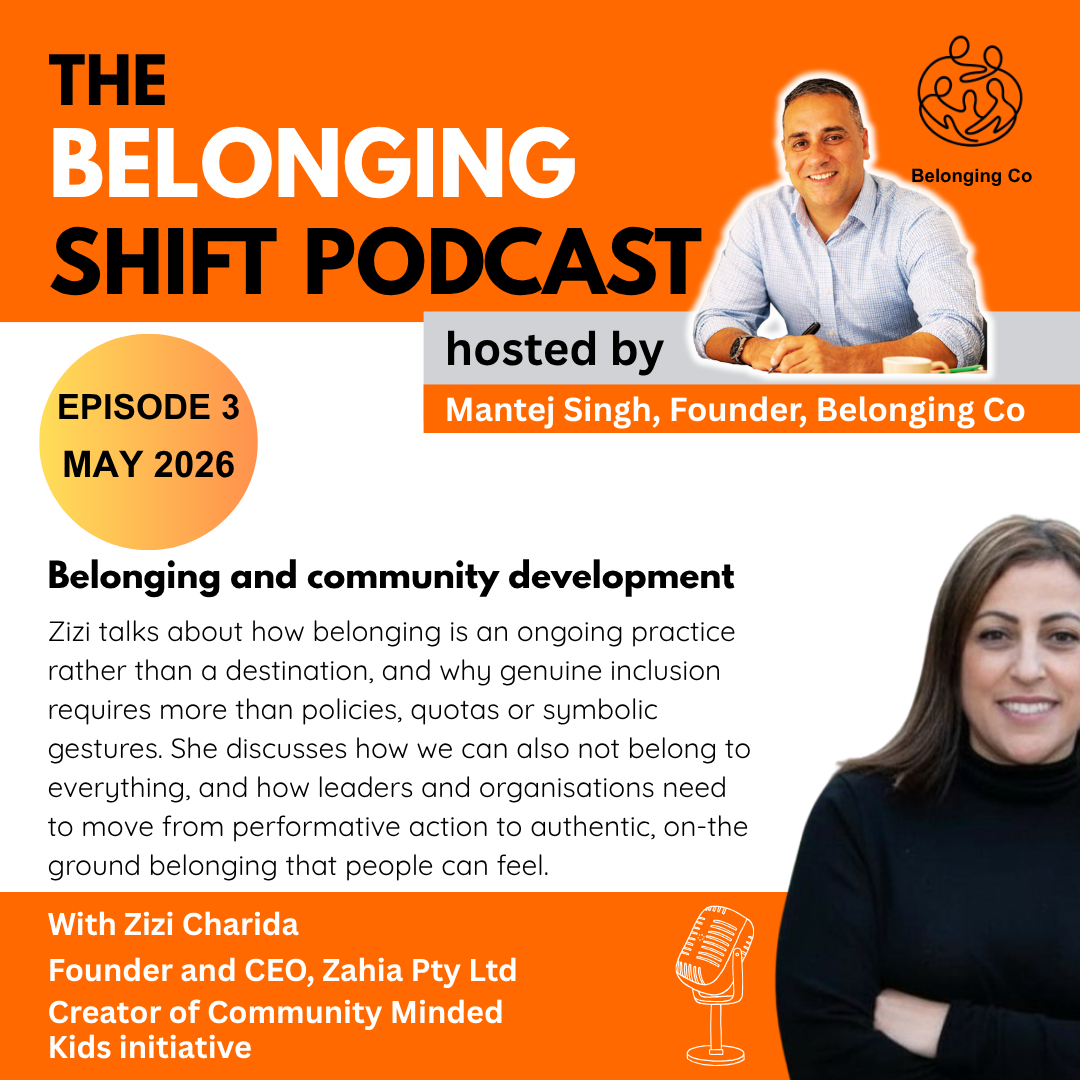
In this episode of The Belonging Shift, host Mantej Singh speaks with Zizi Charida, Founder and CEO of Zahia Pty Ltd and creator of Community Minded Kids, about belonging, community development and going beyond buzzwords.
In this insightful interview, Zizi shares her three decades of experience in asset-based community development, emphasising the importance of genuine belonging, systemic change, and authentic leadership.
She draws on her extensive experience of working with young people and communities and says that if we don't create the environment in which young people and communities feel like they are connected to something that's important and that accepts and embraces them, they will look for something or someone that does that. And that something or someone may not be healthy for them.
Zizi and Mantej talk about how belonging is an ongoing practice rather than a destination, and why genuine inclusion requires more than policies, quotas, or symbolic gestures.
Zizi’s advice for leaders and practitioners for making the #BelongingShift
Move beyond tokenistic actions and build a genuine culture of belonging.
Look at systemic issues, not just individual experiences.
Treat belonging as a continuous journey, not a one-off initiative.
Build connections before jumping to solutions.
Belonging is created with people, not delivered from the top down.
Listen to the full conversation using the links below, or scroll down further to read the full transcript. If this episode sparked a new idea, challenge, or possibility, share it with someone who’ll benefit or connect with Zizi or Mantej to support your organisations work.
Connect with Zizi and Zahia Pty Ltd.
Zizi is passionate about community-centred development, social justice, and helping people feel genuinely connected, respected and empowered. She cares deeply about bringing power back to communities and creating authentic belonging.
Facebook: @ZahiaPtyLtd
Instagram: @letstalkcommunity2day
Exclusive 20% discount offer for Podcast listeners for June 2025on purchase on the Let’s Talk Community™ Megadeck, created by Zahia PTY LTD which includes 200 photo cards featuring asset-based questions and powerful imagery designed to strengthen dialogue, creativity, and collaboration.
Engage Belonging Co
Collaborate with Belonging Co to strengthen trust, meaningful engagement, and participation across your workplace and community outcomes — grounded in a unique belonging approach.
For more information, see
Book a FREE discovery call
Follow and connect with Mantej on LinkedIn
Follow and subscribe to The Belonging Shift Podcast
Listen to audio
APPLE PODCASTS | SPOTIFY | YOU TUBE | AMAZON MUSIC | RSS FEED
Read transcript
Mantej Singh (00:00)
Hello everyone, my name is Mantej Singh. I am your host of the podcast Belonging Shift, conversations about leadership, community, place, and the future of belonging. In this podcast, we talk to leaders, practitioners, change makers on the topic of driving belonging and inclusion in our workplaces and our communities. And I'm so glad to have today with me
Zizi Charida, who I've known for many years. Zizi has been in the community development space, ⁓ a really well-known practitioner for about 30 years and was the founder and CEO of Community Minds an organisation She founded, led, and worked with young people across the education system in communities Zizi has now recently started a new organization which I'm sure will do amazingly well. It's called Zahia Private Limited.
It's a community development organization. And one of the main prominent initiatives is a Let's Talk Community, So welcome, Zizi It's really good to have you here.
Zizi (00:58)
Thank you, Mantej. It's a pleasure to join you and thanks for having me on your podcast.
Mantej Singh (01:03)
Yes, thank you. And so we are here to have a conversation about belonging and what needs to shift Zizi. And we're so looking forward to hearing your perspectives on that.
Who are you? And why does a sense of belonging matter to you?
Zizi (01:17)
Thanks, Mantej. we use a lot of labels, I guess people have called me a community development practitioner, community leader. And I just really am, I guess, a person who really cares about community and centering that in our lives and in our world.
I've been doing community development work, probably for, yeah, as you mentioned, close to three decades.
My father was a refugee and there was a lot of experiences they went through. So this sense of community and social justice and people having dignity and preserving people's humanity was something I think was with me as a child. And then going into my adult years and graduating university.
it's something that I was like, wow, this is really bringing together all the things that matter to me. So I've taken on various roles in the last sort of 28, 29 years. But the core thing
in all those roles was really keeping community at the centre and building communities kind of like from within as opposed to kind of externally trying to build community. And I think that's what drives me is bringing that power back to community and people.
Mantej Singh (02:28)
love it, you know, bringing power back to people. That's what I'm really passionate about as well. And that is so much needed in today's world. It's giving power back to community. It's giving agency back to community. So in that context, in the context of your work,
Where does belonging come into it? how would you describe the outcome of belonging? If you can't use the word of belonging, what needs to
Zizi (02:49)
Great question, Mantej. I love that question. And as much as we use the word belonging, it's such a buzzword. We hear it everywhere. It's on documents, it's in policy, it's in conversation. We talk about it at forums. I think belonging, there's sort of two parts to it. Belonging, there are general aspects or parts of the definition of belonging that I think can't be argued.
but then belonging does look different to different people. So it's looking at it kind of in both those with that lens. Belonging, the importance of belonging in my work is you can't have community and you can't have healthy thriving communities if you don't have this thing called belonging. Having said that, I don't think belonging is a, ⁓ it's not a noun.
Mantej Singh (03:14)
Mmm.
Zizi (03:36)
to me it's a verb, it's a doing. And I think the way my work I feel like is important is I don't just talk about belonging as a concept. It's something that we actually have to do and live. So it's way of thinking, it's not a policy and it's not a practice. It's not something that you can go to a workshop and someone can say, well, I'm gonna, you know,
you're going to walk out of here and know how to do belonging. I think it's a journey of learning and a journey of growing. And I think it's also a journey of testing our own assumptions and challenging ourselves.
Mantej Singh (04:10)
Now, keep going.
Zizi (04:11)
Yeah,
yeah. Sorry, did you want to ask me something?
Mantej Singh (04:13)
No, no, I'm just curious because
I do run belonging workshops.
Zizi (04:18)
No, I didn't mean it like that. No, no, I think that your work is super important because you're not saying, you're not putting it on a platter for someone and saying, this is how you do belonging. I think your work is important because you unpack a lot of things around misconceptions of belonging. And even I would say as far as to say challenging malpractice. And your work, guess, highlights that it's a journey of learning and growing as opposed to just arriving somewhere and kind of saying I could do this perfectly. So as much as it seemed like I was saying it's not important, if anything, ⁓ your work now is not only, I think, important, it's necessary ⁓ because we do need those tools and that kind of understanding around belonging.
Mantej Singh (04:50)
when people are honest and authentic and they can, they can see different perspectives because that is at the foundation of belonging that we can recognize and acknowledge someone else with a different perspective of the same situation and see it from their perspective, have empathy for that. And I think that's so crucial for belonging ⁓
Zizi (05:15)
Yeah. Totally, totally.
Mantej Singh (05:29)
So let's unpack this a bit further. would happen if some belonging was practiced or as a way of thinking embedded properly, what would happen? What would change with belonging in mind as opposed to when it was not in play?
Zizi (05:41)
That's a good question. I'm going to answer the, you did ask me in your initial question, what does belonging mean to me? And I think I might just touch on that and then kind of answer this question. So I think, when, when, when someone says belonging to me, it really is just, it's a few things. One of them is being able to feel kind of, guess, seen and heard. So I think that's an important part of belonging.
But the big question is, always kind of ask when we talk about belonging, what are we belonging to? What are we trying to connect to? And more often than not, we find ourselves in situations in a workplace or a community or even a country where we're trying to find this thing called belonging, but sometimes the values don't align. And this become...
can become an issue. So the question of what do I want to belong to is really, really important because I don't think that we can belong to everything. nor should we belong to everything. But having said that belonging is an innate natural desire that we're born with. We're actually social beings, we're community beings. So this connection to something
is important. So if I had to define belonging, it would be connection. It would be the acceptance of who I am authentically in a space or place. And it's also the feeling of I can be who I am without feeling what I feel, what I think, what I do, what I practice is threatened. And I think that it's sort of almost like a sense of safety.
So belonging for me comes with a level of safety. ⁓ So it's that sense of I'm okay to be here. I'm respected. I'm seen, I'm heard. People may not agree with me, but there's room for me to be me in that space. Yeah. That's my...
Mantej Singh (07:23)
that's really good. And I think as long as that is within the laws and the values of, know, we should all be allowed to have a sense of belonging, as you said, have a sense of connection to be yourself without feeling threatened is I think the core of belonging. So let's build on that further.
Zizi (07:53)
Yeah. Yeah!
Mantej Singh (08:00)
When you look at this definition that you've created of belonging, that you can be yourself without feeling threatened, you can have a different perspective without feeling unsafe, in that space, can you reflect on your practice over the last three decades and look at now in Australia and the world, in Sydney, in Western Sydney, what shifts are happening right now in this sector?
Mantej Singh (08:25)
that are changing how people experience belonging.
Zizi (08:27)
Yeah, look, I think here's the good news. I think and a lot of people would argue otherwise. I think we're getting better at it. I do think we are getting better at it. there's practitioners like yourself and others that I know in this space that are actually doing some good work around that and having those really important conversations. I do see that the impact of
global events and conflicts is affecting communities, particularly in like Southwest Sydney, Western Sydney, where we work. And I feel like that's created a bit of friction in communities across Southwest Sydney. And I think that those, how can I say it? It's those kinds of events that I think are
making it harder for us to either feel a sense of belonging or if you're the dominant culture, because I still feel, I know this sounds like kind of language of the 1980s or 90s, but you know, if you're part of that mainstream dominant culture, the question I think then becomes, because I think there's a power dynamic, Mantej, when it comes to belonging, because sometimes it's worded in such a way that it's given to people, like,
Mantej Singh (09:23)
Yeah.
Zizi (09:39)
We're gonna make you feel like you belong or help you feel like you belong or we're going to... So it's almost like it's something that is given, whereas it's gotta be a two-way... It's obviously a two-way street, but it's like, who are the ones that are talking about belonging in this space? And I think that where it's getting better is that there are more people...
from diverse backgrounds. And I'm not talking just culturally, I'm talking like the whole spectrum of diversity that are talking about belonging. So we are seeing that, think, Mantej, which is great, because it was a topic that I feel was dominated by certain people. I think that's shifting, which is good.
Mantej Singh (10:07)
Any other shifts that you think are occurring in this space?
Zizi (10:22)
what does authentic belonging and inclusion look like? We don't want it just to be in policies or in our strategic plans or things like that, gathering dust on the shelf. We actually wanna know how that can work on the ground. And that's why I'm starting to see a lot of organizations moving away from that kind of, I call it surface level, like that token.
You know, like for example, like our board has a cultural diversity quota we're meeting or we have a gender, good gender representation. And on the surface that looks great, but in practice, like what does it actually look like? And so I'm kind of hearing a bit of cynicism around things like celebrating, you know, cultural diversity days and you know, what I call kind of like performative.
Mantej Singh (10:59)
Yes.
Zizi (11:16)
performative actions. And so I can say to answer your question around the shift is I am seeing a shift around leaders. We're talking like senior positions and managers in charities, community organizations, local councils, having that conversation around how do we go from the token of Harmony Day or let's have a cultural potluck day where we all bring dishes from our culture and have a lovely day.
I think we are getting a bit more serious about what does it look like to have a culture of belonging rather than a policy of belonging.
Mantej Singh (11:52)
I think that is so well said Zizi and that's kind of one of the reasons and that's the driving force behind the work that I'm doing as well is to go from that surface level performative tokenistic inclusion and belonging to actually to go to practically how do we do this? I think that is so important. So I'm really glad you raised that point.
Mantej Singh (12:12)
And I want
to sort of understand from you in your opinion, as these shifts that you are saying are occurring, what in your opinion do leaders and institutions commonly misunderstand about this and get it get wrong, so to speak?
Zizi (12:25)
Yeah. Yeah. I think there's a couple of things. I think that a lot of managers and leaders get into the like, let's fix it mode. So I think that a lot of managers tend to isolate the issue and bring it back on the person as the problem rather than the actual system being the problem.
Zizi (12:43)
right? if I had to advise leaders or managers, would be, it'd be, don't just look at the person and isolate that issue. Look at more broadly, what's your workplace culture actually saying about you as an organization?
you know, for me, workplace culture is really about the interactions that happen formally and informally. So you might as an organization have all the right policies, all the right kind of formal, I guess, of practices. Like they look good, you're doing the right thing.
Zizi (13:18)
But are we creating a space where people do actually feel like they're belonging and can connect? So it's a lot of different things, and it's not about being perfect. So my advice would be that
We're not gonna make everyone happy all the time. Belonging isn't about that. It's having a space where we're actually saying, hey, there are gonna be sometimes a bit of friction, there are gonna be those differences, but it's actually being in a space where you're safe, psychologically and physically safe to allow those differences and those frictions to happen.
Zizi (13:51)
in that But yeah, I guess for leaders, I think just really having authentic open conversations. Get to know your staff and teams on a very personal level. I think it's really important to ask people, what does belonging mean to you, just like you're asking me? And getting people's perspective on, these are the things that actually make me feel seen, heard, and valued.
Mantej Singh (14:17)
So seen, heard, valued and being open to listening to people. I think those are really great ingredients for belonging. And I think if I can add to that, once you've heard, you've made people safe and they've expressed to you, it's a commitment to acknowledging it and not diminishing what is being said. It's a commitment to doing something about it. Because I think
Zizi (14:22)
Yeah.
Absolutely.
Mantej Singh (14:37)
A lot of the time belonging and inclusion and all of this fails. When you've heard everything, people have expressed, be vulnerable, told what's impacting them. And we are not able, we are so caught up in the momentum that we have, that we've created, that we are not able to say, no, this is not working. I've got to shift and change and accept that what I had designed isn't working well for a lot of people. I've got to, and it's ego, isn't it? To acknowledge that what you had envisioned,
Zizi (14:46)
Yeah.
Yeah.
Mantej Singh (15:04)
the pathway has to stop, that you were wrong, and you've got to do this differently now.
Zizi (15:04)
I, I, yeah.
It's really hard to be challenged on something, particularly if it's a thought that you've held for a long time. But there's another thing to this, Mantej. Belonging isn't something given. It's a dance. It's relational. It's not transactional. So the solutions are never top down. It must come from the bottom up. So in other words, we need to have those conversations around
Mantej Singh (15:16)
Mm.
Mmm.
Zizi (15:34)
what is belonging and I think belonging, it's a word, right? Like there's a lot of things that sit around belonging. So I think belonging is something that we need, but we all have a part to play. Even the person that doesn't feel that sense of belonging has a part to play. And I think that gets missed a lot.
Because a lot of conversations, Mantej, as you would know, would be like, oh, these are all the things we can do to help people feel like they belong. But there's a responsibility we all have in creating that sense of belonging for everyone.
Mantej Singh (16:08)
what I'm hearing from this conversation is belonging can neither be given and belonging can either be demanded and it sits somewhere in that space between giving it to somebody and demanding it from someone. It's a space where we have to do that dance together of belonging, as you say.
Zizi (16:14)
Exactly.
It's the
think about it, it's not an entitlement. Belonging is a human need and desire that we need fulfilled. And that's why it's dangerous. And I'm going to say this. This sounds like a bit out there, but it's dangerous, particularly with children and young people. If we don't
Mantej Singh (16:28)
Yes.
Zizi (16:44)
And if we don't create the environment or the soil in which they feel like they are connected to something that's important and that accepts and embraces them, they will look for something or someone that does that. And that something or someone may not be healthy for them.
Mantej Singh (16:54)
Hmm.
I think that is beautifully said Zizi because that happens all over the world. don't genuine belonging, somebody else fills that void is not healthy and that causes harm to people, to society and that's not what we want.
Zizi (17:14)
Absolutely.
Mantej Singh (17:15)
I want people to walk away from this conversations with listening about what are the things they need to shift. So my final question to use is, is in your opinion,
Zizi (17:22)
you
Mantej Singh (17:26)
What are the shifts and by shifts, mean, practical things people need to do differently or stop doing or start doing. in order to create a sense of belonging in our workplaces, in our communities, in our society?
Zizi (17:30)
Mm.
Hmm.
All right. Well, the first one is belonging isn't a destination. It's a continuous journey. That's the first one. It's not something that, and again, it's people like you, that are really important. That's why I encourage people, don't just engage Mantej as a one-off, you know, like you need to be engaged on an ongoing basis because I think it's something that we really need to work on as part of a journey.
right? And I think we've sort of touched on that before where we don't want it just to be a flash in the pan kind of thing. So that's my first, the first thing. The second thing would be don't just tick a box. So move away from that, the surface level kind of broad expectations we have and get a bit more authentic and genuine in your interactions and as well as
the decisions you're making as a leader, really think about what does that say to you? What does that say to others internally in your organization, but also externally?
such and such program, we've ticked all these boxes. So I think they're all great. I'm not trying to minimize or diminish those important things, Mantej but there needs to be more added to that to actually create what I call a culture of belonging. I guess the other thing too is don't just jump into something if there is some friction or there is
Mantej Singh (18:46)
Hmm. Hmm. Yep.
Zizi (19:01)
a case where someone isn't feeling a sense of belonging, I think we need to move away from that. Let's fix this problem. But look at it from a bit of a bird's eye view of your organization and kind of say, okay, so we have this issue, but more broadly as an organization, what are some systemic issues do we need to address?
Mantej Singh (19:13)
Hmm.
Zizi (19:24)
so that there is this sort of culture of belonging. The fourth thing is as much as we try to help people feel included and we're well intended in that, sometimes it can come across as a bit.
What's the word? Offensive?
and token. I think because they think they have to do a certain thing to make, to help someone feel like a sense of belonging. But I feel like you have to have conversations before you actually propose a solution. So there's a thing I call and that I teach this to people, it's called connections before content. So make connections first and then
naturally a solution or a proposition that you have is going to be more effective.
⁓ the fifth one would probably be
Test your assumptions.
And always check in with yourself because belonging as external as it seems is first an internal process. So check yourself, be open to learning, admit when you're wrong. Admit when you're wrong. And also I think, you know, as much as, I said, belonging is an external thing because we want to belong to something.
I think the best thing that we can do on an individual level, and this is to everybody, not just to leaders, Mantej, is if we can learn to belong to ourselves, and by that I mean be true to your own values, what you care about, be authentically yourself. And I think that that's the first process of belonging before we even feel any need to connect to something externally to us. I know that's a whole other talk show.
It's a whole other segment. But I think we need to understand that belonging isn't this external thing that sits outside of us.
it sits within us and then gets translated externally.
Mantej Singh (21:11)
Zizi, I was quiet because it was so beautifully said. In the last five minutes, you've almost brought 30 years of experience and wisdom in this last two, three minutes. And I think I'm really thankful to you for that.
And we have to get away from this fix it mindset that we have to do it to people or give it to people. with self and it starts with looking at system and it needs this way of working, which is about building connection, testing assumptions, not getting acknowledging when you're wrong and being on this mindset. It's not something you tick off, but you have to be in this state of mind on a daily regular basis.
and your authenticity in approaching belonging with people.
Zizi (21:48)
Yeah, totally.
It does kind of does start with that leader and what you what you talk about and how you talk about it gets trickled down all the way to the bottom of your organization.
Mantej Singh (22:01)
You know Zizi, thank you so much. Really great points and I'm sure many leaders who are looking at this and hearing at this from a position of self-awareness and who are sort of generally approaching how do they make a shift towards belonging will really take a lot from this conversation and your wisdom. Thank you so much for your time this is Mantej Singh, your host for the Belonging shift Podcast.
Zizi (22:20)
Thanks,
Mantej Singh (22:24)
If you need somebody to help you on your belonging journey, reach out to Zizi or reach out to me or any other person that you think can guide you in your journey that you connect with that you have a sense of belonging with. and if this episode
And this conversation sparked a new idea, a challenge, a possibility. Share it with your network. Stay connected. And let's have more conversations about belonging implementing belonging. Thank you, Zizi. Thank you, everyone. Have a great day.
Zizi (22:51)
Thank you, Mantej.
