
In this episode
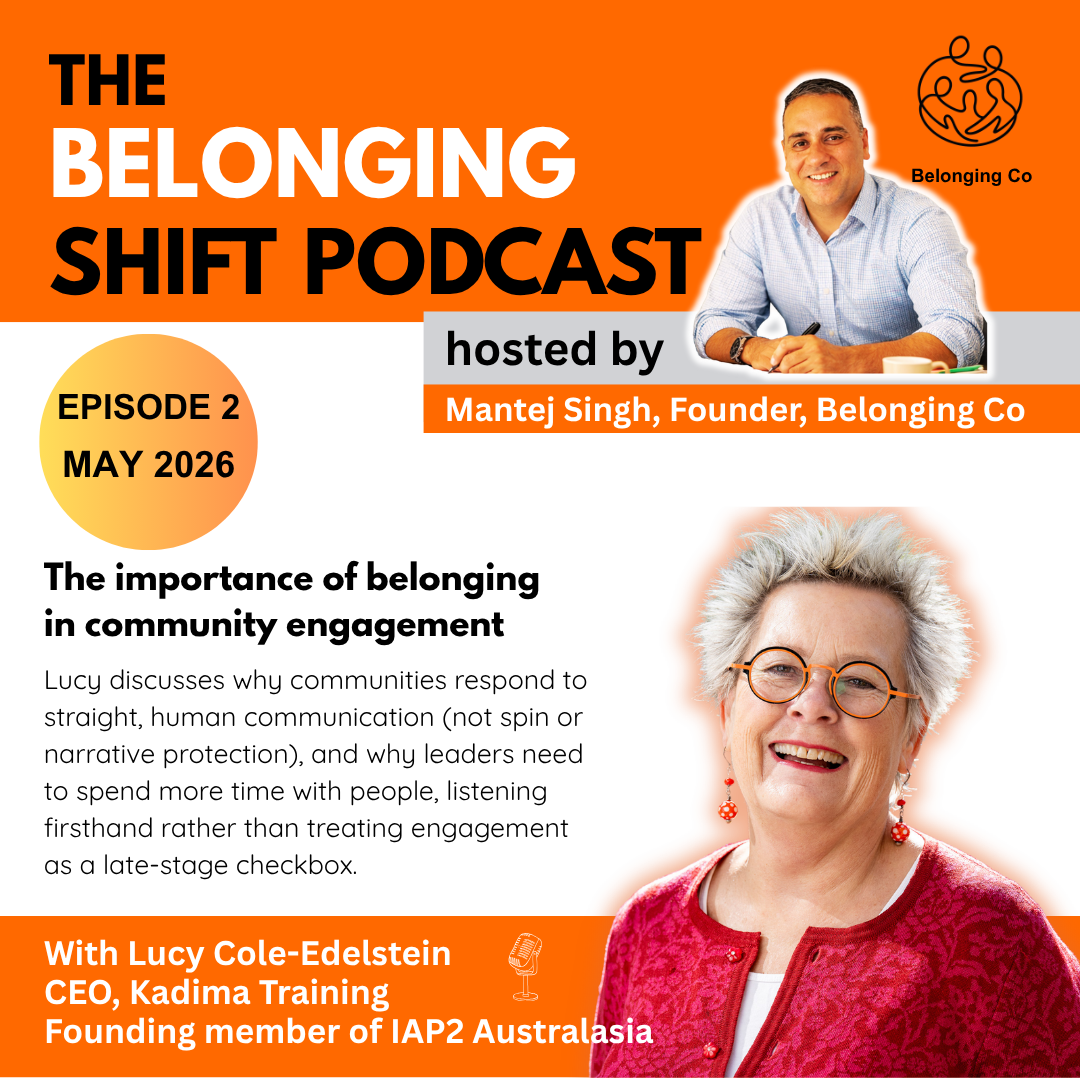
In this episode of The Belonging Shift, host Mantej Singh speaks with Lucy Cole Edelstein about what it takes to build genuine belonging through community engagement.
Lucy Cole-Edelstein has an esteemed 30-year career as a community engagement consultant. She was a founding member of IAP2 Australasia and won multiple national and international awards for her engagement and facilitation. During this time, she built and led teams, founded and onsold her own community engagement agency. Lucy recently founded Kadima-training that sticks! that helps community engagement consultants thrive.
Reflecting on 30+ years in the field, Lucy discusses why communities respond to straight, human communication (not spin or narrative protection), and why leaders need to spend more time with people, listening firsthand rather than treating engagement as a late-stage checkbox.
Together, Mantej and Lucy, explore diversity, inclusion and belonging in Australia, including why things like translation and interpretation alone are not enough, and how partnering with community and multicultural organisations can help reach particular groups – while still keeping connection, trust and shared power at the centre.
Lucy’s advice for leaders and practitioners
Reflection 1: Many people have no idea of the challenges for people who are different
Reflection 2: Engagement has become a transactional thing
Reflection 3: We see engagement as a risk when it is actually risk management
Reflection 4: Community engagement has to evolve beyond spin - tell it like it is
Belonging Shift 1: Have the humility to say I don’t know
Belonging Shift 2: Build relationships and connections with your community
Belonging Shift 3: Get on the ground, spend time with real people
Belonging Shift 4: Partner with community organisations to better connect with people
Listen to the full conversation using the links below or scroll down further to read the full transcript.
If this episode sparked a new idea, challenge, or possibility, share it with someone who’ll benefit.
Connect with Lucy
Lucy is passionate about engagement and supporting emerging and mid-career professionals to have the success she has had. Importantly, she is passionate about great practice, challenging work and achieving success at work while maintaining a balanced and rewarding personal life. For more information, see the links below and connect with Lucy.
New course - Lucy is currently launching a new course for writing for professionals - a rapid onboarding course delivered online. Reach out for more information - there are a few spots left!
Connect with Belonging Co
Belonging Co is a social and cultural inclusion consultancy helping executive leaders and organisations to strengthen inclusion, engagement, and participation outcomes across workplaces and communities — grounded in a unique belonging approach and a community perspective.
For more information, see the links below and connect with Mantej
Book a FREE discovery callto discuss your needs.
Follow and connect with Mantej on LinkedIn
Follow and subscribe to The Belonging Shift
Listen to audio
APPLE PODCASTS | SPOTIFY | YOU TUBE | AMAZON MUSIC | RSS FEED
Read transcript
Hello Lucy, welcome to the Belonging Shift. This is the podcast where we talk to leaders with conversations on leadership, community, place, and the future of belonging. I am Mantej Singh. I'm your host for this podcast. And today I have with me Lucy Cole Edelstein, who has been a community engagement legend in the Australian landscape and is the founder of Kadima Training. Lucy, welcome to the Belonging Shift podcast. How are you? And
What can you tell us about yourself and your interest in belonging?
Lucy (00:27)
Hi, Mantej, thank you so much for inviting me. Look, I was really interested by this concept of what belonging means to me, because I don't think anyone has ever asked me in a professional sense what belonging means. And it really made me reflect on the fact that I think personally, I have always wanted to belong. I think that that's a kind of...
basic instinct of all of us that we feel this need to belong. And I just really like the idea of belonging in terms of community engagement, which is where I've spent the majority of my career. And I think belonging is a word that has been missing from our practice because I think a lot of the work that we do is about
Obviously, we engage with people, we want to know what people think about something and we want to help their voice be elevated to have an impact where it can. That's the promise that we make. But at the heart of that is recognising that people belong either to the community that they're in or the place that they are or the culture that they live or all of those things and more. And I think
bringing a belonging kind of mindset really shifts how you would think about community engagement. So I guess that's a very long answer to say that I think belongings absolutely fundamental to the human, to human existence. And as such, it should be center place and I think help shape the practice that we undertake.
Mantej Singh (02:09)
No, I'm very interested to hear that you talk about the concept of human existence as today is the 7th of April here in Australia and people are traveling and astronauts are traveling to the other side of the moon and here we are talking and it's looking at our Earth and here we are on this side the talking about what belonging means on this planet Earth. So I find that very interesting as a juxtaposition.
because we've travelled far and wide in terms of technological advancement and in terms of that a sense of belonging is something we are still working on in various societies. So before we go any further, Lucy and dig deep into this idea of belonging and what does it mean for community engagement, can you tell our listeners a bit more about yourself, your practice, so that they can know what you're about, the journey you've had to get to this point?
Lucy (02:59)
And I guess that, you know, again, putting that belonging kind of mindset over it really gives it a different slant. I started out life in a very, you know, like most of us, I've had several lives, certainly several professional lives, but I've also had several personal lives. And when I kind of started my working career, I was in my mid-twenties, I was a single mother, I didn't have any...
formal skills or training. And I was working in administrative jobs, but I was working in a non-government organisation for mental health. And I really, you I had a passion for and an interest in, and I suspect a talent for advocacy. And so I realised pretty quickly that I liked this space of working.
in a job that had meaning, that was making a difference, that was shaping and improving services that people received and helping people who, and we're going back a long time, over three decades now, people who didn't have a voice.
And so from there, realised that I wanted to work, that I was interested in policy, I was interested in advocacy and I was interested in making a difference. So I went into government in a policy role and I was really fortunate. I got to work across the policy sector in a department, but I also worked at the service level as a director for services directly being delivered. And I also got a stint in the minister's office. And so it really gave me...
this wonderful kind of snapshot of how decisions are made, how government actually works, you know, that link between the decision makers and the departments. And ⁓ then I went into the private sector and I went into the private sector as probably one of the very, very first people designated a community consultation practitioner. I was very uncomfortable about
going into consultancy and selling myself, but just fell in love with the project-based work and that opportunity to bring creativity to methodology and stuff. And we were right at the forefront of community consultation, as it was called then, and communities were actually grateful that they were being asked. That was a new...
a new concept. Nobody's ever asked me what I thought before was a common thing that people said to us. And I really quickly realized that what was the most important and rewarding thing for me was when people came up to me at the end of the process and said, I don't, I don't necessarily agree with everything that you've done, or the decisions that have been made. But I understand why you've made them.
I know that you heard my voice. became for me the kind of guiding light. I think that going back to belonging, the thing that I fell in love with, with community engagement was I've never met a group of people, I've never worked with anybody that I haven't learnt something from, that I haven't been inspired by.
that haven't made me laugh or touched me in some way. And that again, it's all that thing about belonging. I think that learning how to engage with people across the country on all sorts of different issues from all sorts of different backgrounds has been one of the most rewarding and exciting parts of my job. So I ended up as a consultant, I started my own business.
I sold my business to a multinational, didn't make a fortune, but made enough to pay the mortgage. And now that I have the golden handcuffs off, I'm reinventing myself in training. Not because, yeah, not because I don't love consulting, but because I just want a little bit more free time and project work can be a bit unpredictable. But I'm training around the areas that I love, which are how to be a great consultant.
Mantej Singh (06:36)
Fantastic.
Lucy (06:50)
and also around community engagement, particularly facilitation. So how do we have hard conversations in contested and contentious?
Mantej Singh (06:59)
Now that certainly is really important. Hard conversations are important to make decisions, but hard conversations are also needed to make sure that the conversation is equitable and inclusive so people can make balanced decisions and serve a wider community. So Lucy, you talked about how you set up your community engagement consultancy, you're reinventing yourself in terms of becoming a training guru and advising consultants.
So when you reflect on your sort of very esteemed diverse career across 30 years and you look at what was community consultation and what is community engagement now.
And you sort of think of belonging. What are the shifts that are occurring in this landscape or what has occurred in this landscape over the last 30 years, in your opinion?
Lucy (07:44)
lot has changed. 30 years ago, the only engagement that was occurring was really around large environmental impact statements because it was required under the New South Wales planning laws. And I'm talking about New South Wales at this particular point. Most of my career has been in New South Wales. But I was involved nationally with various organisations. So I know that it was fairly reflective of elsewhere. Now there is a lot of community engagement.
And that's been really led by local government. Local government does more engagement than any other part of government. And so it should, it's the closest to the people. And so now we're engaged all the time on everything from freeways to playgrounds to water management to electricity prices. So that's a really good thing. I think that in the early days when we really didn't know what we were doing and we didn't have the internet.
The process was slower. So, and what that did was actually, it created some foundations that we didn't recognise at the time. So when I first started out, if I wanted to do like a stakeholder analysis, you know, a very basic thing that everybody does, understand who you need to talk to, I would...
I would have to ring up local council. There wasn't a webpage. I would have to ring up local council, talk to several different people, ask them about their communities, ask them about what's happening, et cetera, ask them about who I should be talking to. And then I would kind of almost go through a tree of people. Each person would give me another number and I'd ring that other number and I'd talk to them. So I created this, I understood this community.
I had the demographics- I had all the same information that I can get now from the internet. I had the demographics, I knew the geography, I knew all that kind of stuff. But the difference was that I had touched base with multiple people in that time. And so two things happened. Number one, I had this richness because I had all those side conversations and comments and tidbits that you get when you actually connect with somebody. But it also meant that when I actually started engaging,
I didn't engage as a stranger. would say, I'm Lucy. ⁓ you're Lucy, because I'd already had a connection. a relationship. And so there already was those first foundations of trust, of respect. We'd had time to kind of, you know, I'd explain the project, et cetera. So I think for me, the biggest difference now is it's not just that
this great modern technology, it's made everything much easier for us, it has, but it's given us something to hide behind. I remember attending something not that long ago in my own community, was something that was affecting us, large piece of infrastructure. And the project team arrived and they had no understanding of how my little suburb in Sydney,
was actually quite different from other because every community is different. ⁓ And nothing in there, they had a generic presentation of, I don't know, well over 50 slides, less than two of which pertained to our part of the project. And it really felt like they didn't know who we were, they didn't care who we were, and they weren't actually particularly interested in who we were. And I think
Mantej Singh (10:42)
Correct, correct.
Lucy (11:04)
that what we've lost is that ability to really connect and really how does this feel if this is being done to me as opposed to me doing to you. I would say that's one of the biggest changes. The other change that I think we've seen is with the blissful ignorance that we had 30 years ago, we didn't have
media savvy or shy people controlling our narrative. were actually able to be far more open and now there is such a reticence, there's such a fear of losing control of the narrative, of the wrong thing being said, of everything coming undone, of something coming back to bite you, that it's very hard to get
up communication that is straight and I think Australians we're just so down to earth we know how it is tell me how it is love I can cope with it much better than this bunch of spin which just makes everybody you know so they're the two things that I've noticed I
I have some other observations specifically about inclusion, but I suspect that you'll have some questions you'd like to ask.
Mantej Singh (12:14)
No, no, I think
it's a good lead up into that. think you've identified some two very important things. One is around technology, connection and tell it like it is, which is really important and build connection and being sort of people shouldn't feel it has been done something to them. I think that is I've been in community engagement. I've experienced that myself on both sides. So my question is, Australia is not just one person or one kind of people.
We have 50 % culturally diverse, 20 % people with disability. We are gender diverse. There's people from all kinds of diverse backgrounds in Australia and across the world. So when you look at the shift that's occurring, how does that play now in terms of diversity, inclusion, and belonging? As you just said, your suburb is very different to somebody else's suburb. And within your suburb, there are diversity all across Australia.
What does, what does, what's the future of community engagement in the context of diversity, inclusion and belonging in our communities?
Lucy (13:09)
And I think that this is such an interesting topic because, you know, you and I have spoken in the past. I I spent a lot of time from very early in my career. In fact, the first presentation I ever did for the International Association of Public Participation when we were trying to, was the first event we did when we were trying to actually find out if there was enough interest for us to create an IAP2 chapter in Australia.
Lynn Carson, Professor Carson came to me after that and talked to me immediately about the voices that weren't in the room. And in those days, we called those people the hard to reach voices. Now, Carson's interest was deliberative democracy and 30 years later, we have this whole range of deliberative engagement, which is fantastic. But the way we approached the hard to reach voices was, I know.
Mantej Singh (13:43)
Yes.
Lucy (13:57)
we'll get translations, we'll get interpreters. And so if we translate into the top five languages, well, that solves that problem. And I think I said this to you the other day, Mantej, I was so chuffed with myself the first workshop that I ran because I had one table with a Cantonese interpreter and one table with a Mandarin interpreter. I mean, how innovative am I?
The reality is, and speaking as somebody who is married to somebody of non-English speaking background, I have a neighbour to one side who is non-English speaking background and until recently I had a neighbour on the other side who was also likewise.
So these things really get to the heart of what it's like to be of a different culture in this country. It doesn't matter how long you live here, if you look a little bit different, if you sound a little bit different, that is a barrier that exists.
I think most Anglo background Western Australians have no recognition of that. They have no idea what that is like. Just very simple things like, So I think that we have not certainly community engagement.
has failed big time in this regard. The best work that I have seen done is when, and this is something that I have done, is when we have partnered with multicultural organizations to help us reach particular groups. that has been really successful and empowering. And so, you know, we ask them to run workshops for us in language.
or we ask them to recruit people and be with us while we engage with those people, that has worked very well. But it still, it still others them. It them different. And the part of all engagement, and I particularly include deliberative engagement in this is...
humans respond to what is happening here and now and to this, we respond to connection, we respond to the conversation we're having and the feeling, the vibe that we get from each other. Can I trust you? Do I like you? Do I believe what you're saying? So when we bring sources of information into an engagement project from another source, so here is what disadvantaged people said about this.
It has some resonance, but it doesn't have as much resonance as actually hearing somebody who is socially disadvantaged sharing that.
Mantej Singh (16:23)
Yeah, I think it's much more than translation, Because you can translate something, but if you can't connect to person's identity, give them a sense of equality, a sense of shared power, and sense of belonging, you can have the best translation that person's not going to share what they ⁓ feel and want.
Lucy (16:40)
And it's also,
Mantej Singh (16:42)
So Lucy, if you had to sort of identify three or five top things for people who are listening, especially for leaders working in the community engagement space, CEOs who have community engagement people reporting them listening, what, according to you, gets in the way of progress on inclusion and belonging within the community engagement sector or community engagements practice?
Lucy (17:05)
I think two things top of head, top of my mind. Number one, I just don't think we spend enough time with people. I think we spend an inordinate amount of time figuring out what we're going to tell people. We spend very little time thinking about how we need to listen or actually listening. So we just assume a 14 day or a 30 day period of time is ample.
Mantej Singh (17:20)
Yes, yes.
Lucy (17:33)
when the reality is engagement is like a snowball. takes time for it to, people are away, they're sick, they have work, they have commitments. It takes a while for stuff to filter through. So I think that we spend very little time just actually being with people. And I think we could learn a lot. This is what interests me that...
Indigenous First Nations people have drilled into us for the last 20 years. You can't talk to us the way you talk to each other. That's not the way we do stuff. We do business differently and you have to sit and you have to be patient and you have to just wait for, you know, until we're ready. And that actually is right for every community. So I think that time is one thing.
I think for leaders, would say go and be there. Just go and see who your people are talking to and what people are saying about your project, et cetera. Not as the leader with your shiny suit and high heels, just as you being there to hear what people say because...
When you hear what is important to people firsthand, it makes a very big difference. And all the projects that we all do, they're all important. I'm not advocating that every project should sway to the whims and wiles of communities. That's not what engagement is about. is about understanding how something impacts people or a community.
and whether those impacts can be mitigated or accounted for or incorporated in some way or not, and coming back and explaining what those decisions are. It's about hearing what people have to say, considering it. If you can do something, do it and say so. If you can't do something, say so and say why. And if you're looking at it, say, this is what you want.
don't think we can do it that way, but it's a good idea or there's something here that we want to look at further. So that's what engagement is about. Engagement leaders, people leaders of organizations actually hearing firsthand makes a massive difference.
organizations where the leadership actually demonstrates that it's listened directly to customers. But when I work with those leaders, they are impacted. Of course, it's very hard to know when you hear somebody's story, it's hard not to be impacted. So they're the first two things I would say. The second thing I would say is that
stop considering engagement as a risk. it is actually one of your biggest risk management tools. If you know why people have issues or concerns about your project, you have an opportunity to address them. earlier you address those, the more trust you build and the more likely it is that your project will get ahead. So this business of leaving engagement
to a ticker box thing at the end is what undoes engagement. There is no point coming out, well, when you've had all the decisions made.
Mantej Singh (20:38)
Oh, it absolutely does make sense. So be on the ground, listen to people directly, hear what they're saying. And the second thing you said is sort of, know, be real about engagement. Don't see it as a risk. Don't see it as risk management, but see it as risk management and an approach so that you're well informed and engaging. And so as we sort of
Lucy (21:01)
Yeah.
Mantej Singh (21:03)
heading towards the finishing line here, Lucy, I wanted to ask if you reflect on these two things that you've just said, consider belonging as an outcome and consider diverse Australia. What prevents leaders and organizations from doing what you just said? Because it sounds very simple. We go on the ground and genuinely embrace community engagement and stop the spin. What is preventing people and what is your advice?
to people to say, you know, get out of this trance, let's do this. What do you want them to shift? Because this is the belonging shift and we are talking about what needs to shift. So what needs to shift from your perspective to build belonging within community engagement, especially for a diverse Australia?
Lucy (21:44)
think when I go back to that first anecdote about explaining how back in the day we used to pick up the phone and find out, one of the questions that we had to ask was, know, how do I, you what's the best way to talk to this community? know, so where is the best place to meet and what's the best time and what would be most convenient? I think that for working with diverse communities, what we lack is humility.
the ability to say, I don't know, I want to engage with your community and I don't know the best way to do that. Can you help me? And that I think is the biggest thing that we could, it's the biggest shift that we can make because that allows people to come forward and say, okay, well, and to say the real things, which is I'm not spending my time.
if you're not genuine about actually listening to people. your mouth is. And this is what my community is like and this is how my community has been done over in the past. And this is what works for us and can you incorporate that? Like I think that conversation, it builds trust, it builds understanding, it builds knowledge and it sets the foundation for a relationship. And I guess,
For me, the shift is that most engagement is treated as a transactional thing. I'm gonna do this thing to you. I'm gonna come away, I'm gonna report on it, done and dusted. For most organizations though, the relationships are enduring. The project continues in that area.
Mantej Singh (23:05)
Hmm.
Lucy (23:17)
It's about building relationships and not losing those relationships.
And if you're really
Mantej Singh (23:21)
Hmm.
Lucy (23:22)
So I think that the relationship shift and the humility shift, I think if we could get those two things moving, Mantej, I think we'd really have a different approach. And I think it would be a far more fulfilling approach for practitioners and projects, as well as for the communities that we work
Mantej Singh (23:22)
Mm-hmm.
Thank you Lucy very much. So here we are at the Belonging Shift with Lucy talking about community engagement who's identified three key shifts. Be on the ground, be real, have the humility and engage people with meaning and genuine intention behind it. And that's the key to engaging a diverse Australia towards better impact.
and outcomes ⁓ through community engagement. Thank you Lucy so much for the conversation. I really enjoyed it. And for people.
Lucy (24:09)
did too, Mantej.
I love talking to you. Always ask me questions that nobody else asks and I just think that that is the best thing ever.
Mantej Singh (24:15)
there you go.
Fantastic. And so this for people listening at home, if this episode sparked a new idea, a challenge, a possibility, share it with someone that can benefit from this conversation, share it across your network and inspire people in leaders to be better at community engagement, to be more humble, to be on the ground, to make a difference and really use the power of community engagement to build a better new Australia for our diverse communities.
Thank you very much, I'm Mantej Singh, your host of The Belonging Shift and signing off till we're here next time. Thank you, Lucy, very much.
Lucy (24:51)
Cheers.
