
In this episode
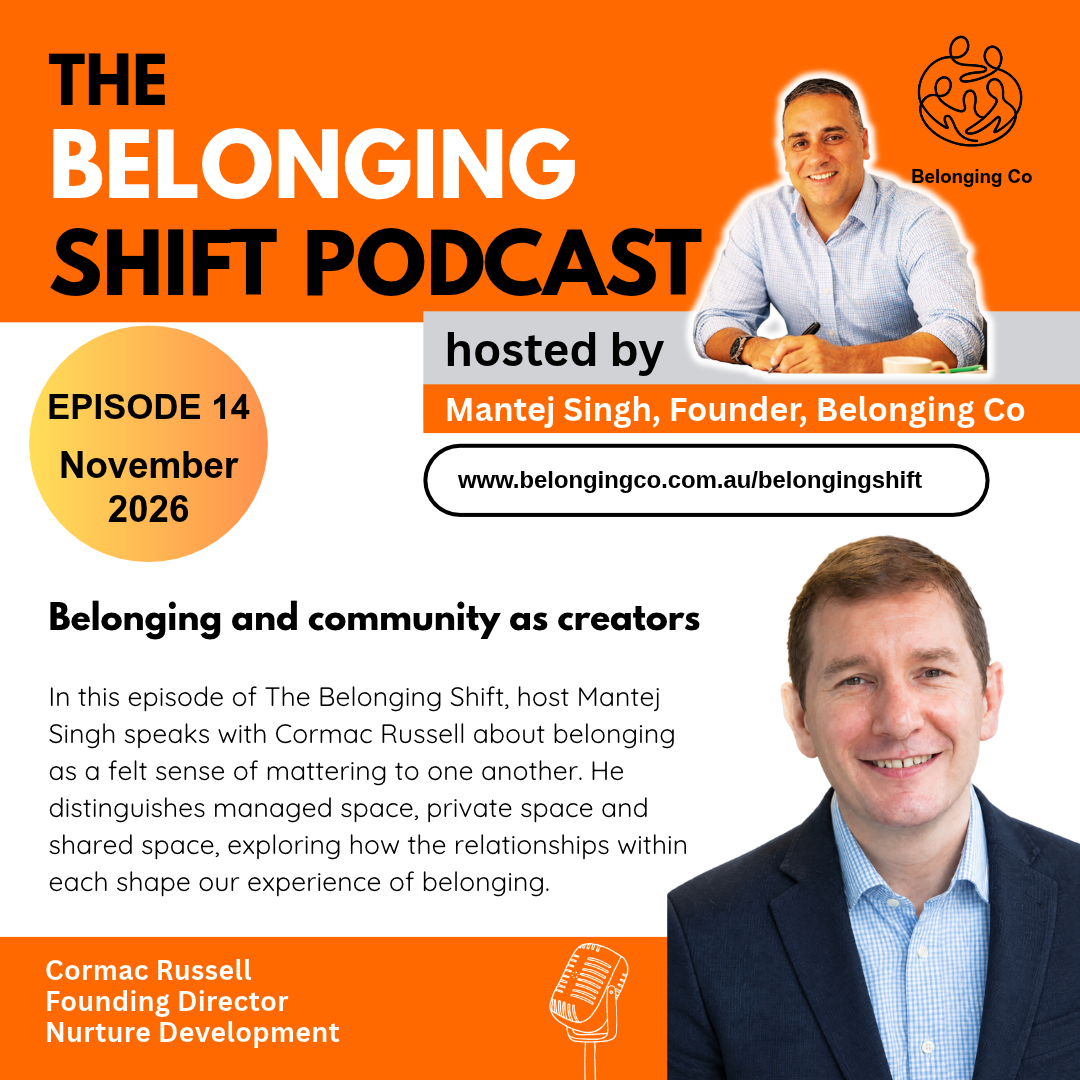
Scroll below for Audio, Video and Transcript
Cormac explores the differences between managed, private and shared space, and why communities should be recognised as creators of belonging rather than consumers of services. He invites leaders to shift from delivery to discovery, build on what is strong in communities and relocate power so people can discover, connect and mobilise their own capacities.
He also acknowledges the discomfort of stepping back. Institutions sometimes need to lean in, particularly in a crisis, and sometimes need to make room for communities to take charge. His invitation is to ask better questions, remove barriers and strengthen community capability rather than replace it.
Cormac’s invitation is to become community-centred: ask what people can do together, support community-led solutions and be on tap, not on top, while providing excellent services where they are needed.
Cormac’s advice for leaders and practitioners for making the #BelongingShift
Shift 1: Move from delivering belonging to discovering the capacities and relationships already present in communities.
Shift 2: Start with what is strong within people and around them, rather than defining them by what is wrong or missing.
Shift 3: Explore community alternatives first, then back them up with excellent services where needed.
Shift 4: Change the triage system: ask what communities can do, what they can lead with support, and what institutions must do directly.
Shift 5: Relocate power and strengthen community capability. Be on tap, not on top, and know when to lean in or step back.
Listen to the full conversation using the links below or scroll down further to read the full transcript.
If this episode sparked a new idea, challenge, or possibility, share it with someone who’ll benefit or connect with Mantej to support your organisations work.
Connect with Cormac
Cormac is a social explorer, an author and a much sought-after speaker. He is the Founding Director of Nurture Development.
Over the last 30 years, Cormac’s work has had an enduring impact in 42 countries worldwide. He has trained communities, agencies, NGOs and governments in community-based approaches in Africa, Asia, Australia/Oceania, Europe and North America.
His most recent books include The Connected Community: Discovering the Health, Wealth, and Power of Neighborhoods (co-authored with John McKnight; Berrett-Koehler Publishers, 2022) and Rekindling Democracy – A Professional’s Guide to Working in Citizen Space (Cascade Books, 2020).
He is currently working on a new book project on Community-centred leadership; the book will be called: “The Pedagogy of the Powerful.”
Connect on LinkedIn: Cormac Russell | LinkedIn
Website: ABCD Training and Resources - Nurture Development
Cormac’s TEDx talk can be viewed here
Connect with Mantej and Belonging Co
Belonging Co helps leaders drive participation, trust and engagement
Belonging Co delivers strategies, engagement, and programs for organisations and leaders wanting genuine impact across cultural inclusion, community participation and social cohesion.
For more information, see links below
Belonging Co website: www.belongingco.com.au
Book a FREE discovery call
Follow and connect with Mantej on LinkedIn
Follow and subscribe to The Belonging Shift Podcast
Listen to audio
APPLE PODCASTS | SPOTIFY | YOU TUBE | AMAZON MUSIC | IHEART RADIO | RSS FEED
Read transcript
Mantej Singh (00:00)
hello everyone. Welcome to the Belonging Shift Podcast here on a bright sunny day in Sydney, Australia. My name is Mantej Singh. I'm the host of the Belonging Shift Podcast. I'm also the founder and director of Belonging Co., which is a social and cultural inclusion consultancy here in Sydney, which aims at working with leaders and organizations on building participation, engagement and trust in the work that organizations do in our communities.
And to speak with me on this topic, today I have an international guest, I followed this guest's work for a very long time. so please welcome Cormac Russell, who is the founding director of Nurture Development and a member of the Asset-Based Community Development Institute, and a very well-known speaker and thought leader in the space of
empowering communities, I must say, and giving power to communities. So welcome Comac to the Belonging Shift Podcast.
Cormac Russell (00:51)
It's a absolute pleasure to be with you and thank you so much for inviting me on. Looking forward to a great conversation.
Mantej Singh (00:58)
thank you, Cormac. I hope your journey in Australia and your travels have been safe and powerful and impactful. but let's uncover a bit more of what you've discovered about Australia and our approach to belonging, but have an international perspective as well.
So let's start and can you tell us a bit about yourself? Who are you? What do what do you do? and why does a sense of belonging
matter to you in your area of work.
Cormac Russell (01:22)
As a human being, first and foremost, I think the central sense that you are not just an isolated individual, but you matter to others is so important to being well. And not just that you matter to others because others are being nice or they're being charitable, but because they really understand that life their life is enhanced because you're in it and
And and that's reciprocal. That's one of the most fundamental human needs, I believe. The need to belong. And so that I think I want to situate belonging at the heart of who I am as a person. That's essential to my personhood. And
And and also that I'm in kin with the places that I move through and that move through me is is key.
So a lot of what I do
is I get to travel around the world and hang out with amazing people like you and and share our desire to get better at being human together. And there's lots of different ways to be in relationship with people, but I'm particularly interested in community
I think that for me community is a verb, not a noun, and it's something we do. So I'm really, really excited to be in conversation with folks in Australia these last few weeks and in Singapore as well.
about what does it mean to be in community in a place where you're also thinking about your relationship to economy and how can I belong? Actually, it's an interesting kind of question. How can I belong to a local economy in ways that are actually also welcoming of outsiders, tourists and whatnot, but also really saying to the the vendors in that local economy, we belong to each other and I'm prepared.
to invest in you if you're prepared to invest in me. and so place is is really a key feature of my work. I think another feature of my work is I'm really interested in starting with the whole story. I'm not afraid to lean into hardship and you know trauma, but I also want to recognise that there's a lot that's strong in communities of place, which we don't always recognize. We don't always take time to discover.
So a lot
Mantej Singh (03:31)
Mm.
Cormac Russell (03:32)
of my work in essence would be I'm really interested in how you can discover, connect, and mobilize the strengths that exist in communities and animate the ones that are lying in wait, but maybe are sleeping. So a way of thinking about that
Mantej Singh (03:47)
Yeah.
Cormac Russell (03:48)
is to talk about community animation. How do we animate the communities that we live in?
Mantej Singh (03:53)
really great to hear the origins of your thinking
And many people intuitively feel what they want the change to be, but sometimes don't have the words or the connection or the network to to to grow into that and to become what they want to be. and and it takes belonging to a group or network or a community or a thought to to to develop further.
so we've been talking a lot about belonging and and the concept of belonging. what does belonging mean to you personally? and how would you describe belonging if you can't use the word belonging?
Cormac Russell (04:22)
It's a it's a felt sense you know, they feel it, I feel it, that felt sense that we're in a connection, we're in a relationship where we matter to each other. and it's not performative. It's not a a game that's being played, it's a way that, in a sense,
We are being with each other. So it feels very much like something that we're being rather than something that we're doing. But so like I can be in activities with people, they can share similar passions to mine, uh, and not feel that sense. And I can be with people and doing absolutely nothing and feel that sense. So it's quite quite kind of mercurial or existential, uh, it feels to me.
So where are the spaces where I have the experience called belonging? Well, a way of thinking about it for me, my experience anyway, is I can be in a space that's managed for me by somebody else.
And I'm not sure that in my lived experience, that's where I would expect to find or I would go looking for belonging. Now I can be also in so we call that managed space. I can also be in private space. I can be in maybe meditation or a practice like yoga or whatever it might be. And I can feel, you know, on a good day that that could really
I could feel at the end of that, boy, you know, I know I was on my own, but I feel like I belong to the universe. You know, it's
Mantej Singh (05:50)
So
Cormac Russell (05:51)
a kind of a really powerful sense of interconnectivity. or I belong in my body. You know, I actually feel happy in my skin, right? and then there's what I think of as so that's private space and managed space. And then there's the third space, which is what I think of as shared space.
Where I'm really sharing life with somebody else. Now, my money would be on the third space as a really rich place for me to find a sense of belonging outside my own skin. and my money would be on the managed space as being the space where I can only belong if I play by certain rules. So if I'm prepared to be a client.
If I'm prepared to follow the system. you know, and that that's okay. I And I know that despite the
The different kinds of relationships that I can have in each of those spaces, I experience a different quality of belonging. So if I'm spending my life in a managed space and I'm defined by a label like
intellectual disability or ex-prisoner. I think what I would really struggle with in that is the lack of belonging, which really values me and what I bring. I belong
Mantej Singh (07:04)
Hmm, hmm.
Cormac Russell (07:06)
because of what I don't have. I
Mantej Singh (07:09)
Yes.
Cormac Russell (07:09)
belong because somebody has said, you have a deficit and this is the
Mantej Singh (07:13)
It's a deficit model.
Cormac Russell (07:14)
place for you. Right? So to me, and they could say, well, you belong to the category of people
Called, you know, people who have served time in prison. And you know, to me, I think I I get that sometimes it could be lovely to be in a group like that because you don't you don't have to explain everything to people who have that peer experience to you.
Mantej Singh (07:34)
Mm, mm.
Cormac Russell (07:35)
that changes how you see yourself. It the environment shapes how you experience the world you move through. And
Mantej Singh (07:41)
Mm.
Cormac Russell (07:42)
it changes how you think of who do I belong to? What am I a member of? Who misses me? All of that starts to change.
Mantej Singh (07:50)
So you you this this idea about managed space, private space and shared space, Cormac as you've talked about, that's essentially about how the how the how we view the planet, isn't it? through to environment and our built environment. That's how we experience it. So if you look at it at a community level, a neighborhood level, cities, countries, and you travel the world talking about
asset-based community development, belonging, inclusion. When you look at all of that collectively, especially the last five to seven years, last two years, the world is changing. there's lots going on. socially, very diverse views and thinking about how how a society should function, what's important, especially in the context of belonging and inclusion. So from your perspective,
What
shifts are happening right now that are changing how people are experiencing belonging?
Cormac Russell (08:35)
In many respects it's not uniform. as you'd the changes that are happening are manifold.
so the diversity and the difference is what I tend to pay attention to rather than what's being standardized or what's being industrialized.
one of the shifts I see as emergent is that shift away from the idea that belonging is something that you can deliver or provide or commission or procure. It's none of those things. You can't. You can certainly enable.
conditions within which belonging emerge as a result of what people do and how they do it with each other. But we can't prepackage belonging and deliver it as a service.
And I think that's just a really important distinction that we're not we're not in a space where we're trying to do something to people or for people, but we're trying to create conditions within which people are themselves becoming more self determining, more interdependent.
And I think what falls out of that self-determination and interdependence are experiences which we describe in the rear view mirror called belonging. Right. but there are also things that I think I'm seeing communities do, which give me a lot of hope. So intentional practices in neighborhoods. and that could be anything from you know the emergence of park run groups.
right through to very, very intentional getting together to have conversations about how we make sure that, for example, food in our local neighborhoods is circling in a way that actually ensures everybody can be fed. and again what I love is that by thinking about the place as the unit of change,
Not the city, not the state, not society, which can be very abstract terms and a scale at which most people, unless they're credentialed, don't feel like they have a valuable contribution to make. Well, I think in the neighborhood, some of what I'm seeing, and there's lots of work to be done, but some of what I'm seeing is we're figuring out that's a scale at which lots and lots of people
Who might not get involved in traditional ways like volunteering are actually able to get involved. That the threshold is low enough that people can bring their gifts, can bring their contributions. So I'm seeing more of that than I did when I started my work.
So to summarize what I've said, I think I'm seeing some really promising shifts in how professionals and institutions think about their work, away from that kind of engineering model to a more gardening model. And I'm seeing communities recognizing that they too have work to do and that they have a function, they have important roles to play, which aren't just about
private interest or personal
Mantej Singh (11:25)
Hm.
Cormac Russell (11:26)
gain, but are actually about how can I work with people I, you know, share the neighborhood with neighbors and with associations to build power from the ground up. So
Mantej Singh (11:37)
Mm.
Cormac Russell (11:37)
that's that's important. So you know you could think about the institutions as relocating power and communities as reclaiming power.
Mantej Singh (11:46)
Right. I think that's a really good point about relocation and reclaiming around power. And that's a good segue into my next question, which is about if we want to facilitate and enable belonging as an outcome, then how do we get it to happen? What would be your advice to leaders and organizations and institutions?
What
in your experience, what do leaders and organizations commonly misunderstand about belonging as an outcome?
Cormac Russell (12:10)
Well, one of the classic misunderstandings, as we said already, is that it can be delivered. I would argue that it's better to shift that modality from delivery to discovery and start where virtue is already afoot. So start with this idea that this complex adaptive system called community may already be doing what we think it needs to do, but we're not able to see it. So
The danger is if you're stuck in delivery, you just assume that what it's missing is belonging. So then we start trying to do things. We start poking at the system in order to make it work better, like a mechanic does with an engine. And of course, as we know, communities are not engines. They're complex and they're adaptive environments. So that that that willingness, that's the first shift. Shift away from
from delivery to discovery. The second I think is again sort of similarly, don't assume that there's something missing or something wrong with that system. Try and start wherever possible with what's strong within the system because otherwise you're not going to actually be able to really create the conditions where the system itself can actually produce belonging.
Because actually belonging is what happens naturally when people are co-regulating with each other. So a lot of what if you wanted to be, you know, if you wanted to be kind of deficiency oriented, you might say a lot of our communities are dysregulated. But often the reason they're dysregulated is not because of apathy or lack of care, but because of disconnection. And and and a lot of that has to do with the way we're designing our communities, the way our policies sometimes
pull people apart rather than bring them together. So I think that shift from what's wrong to what's strong and starting with how do we find ways of building on the capacities, building on the capabilities. So
in that way, I think we're starting with what's we think is wrong rather than what's strong.
And how do we free people up to be stronger, to be more connected?
Are we pulling people into service land? Or are we really trying to animate the life world first?
Mantej Singh (14:20)
Mm.
Cormac Russell (14:20)
because you know, if we do that, we're going to create much more sustainable and much more socially determining ways of being well, which create much more natural supports and much more natural buffers. Then of course we can back that up when needed.
with excellent services because maybe somebody does need some counseling or training. But I think the trick is not to start there. so that's the third thing. Shift away from this idea that your service has a monopoly on all the best solutions.
Mantej Singh (14:49)
Hmm.
Cormac Russell (14:49)
And start with a community alternative first. Is there a way we can actually animate natural, close to home solutions? The answer may be no there isn't, but start there. So
Mantej Singh (15:01)
Mm.
Cormac Russell (15:01)
You know, that might be around kinship solutions, it might be around extended community solutions, it might be peer lead. But starting there, I think, is a really, really good way to think. So those three shifts again from delivery of a service to a discovery of community capacities, including in the people you think have a problem.
Mantej Singh (15:21)
Mm.
Cormac Russell (15:21)
From that idea of what's wrong with them to what's strong within them and around them, if I can connect them.
Mantej Singh (15:29)
Mm.
Cormac Russell (15:29)
And then that final piece of can we can we flip the script from the service knows best to the community and its connections are they know in different ways, but they may have knowledge which just doesn't exist inside managed space. It exists only in shared space. And that's that's important. So a way of packaging all of that is is is you could ask whose knowledge counts?
And often the answer will be the institution's knowledge counts. And if that's true, then often what we're saying is we're discounting the knowledge and the the life world, the reality experiences of the people we serve. And that's not that's just not a great way to be a leader, to be a steward.
Mantej Singh (16:13)
my next question is around how do we make it happen? Because I I think what you are saying is very simple, it's powerful. I can relate to it straight away. But a lot of people who are probably not from that world or not connected to this concept want to control the outcomes, control the narrative, or have a absolute control of what is gonna happen.
how will it happen? How will the institution do it? And it's all about the institution. So if you
Cormac Russell (16:37)
Yes.
Mantej Singh (16:38)
have a leader and an institution that is completely opposite or far removed from what you are talking about, how does that leader or institution get there? What what must they do in order to get better, get to that outcome that you are saying?
Cormac Russell (16:49)
Well, what what you're describing there is the dilemma which has been created by a way of providing services to the public called new public management theory. And
Mantej Singh (16:59)
Mm.
Cormac Russell (17:00)
it's been a very unfortunate public narrative that we have used not just for public services but for charitable and not for profit services as well. It's that idea, as you say, that
you measure you measure the impact that we have by measurability, scalability and efficiency.
a way of being, first of all, is really important because leadership in part is about really asking better questions rather than always being the one with the with the answers. That takes humility. That's a way of being. Humbling
Mantej Singh (17:30)
Mm.
Cormac Russell (17:31)
yourself to say, actually, we maybe we've we've engaged with communities in a social contract that is actually
a busted flush.
So to your practical question, how yes, you know, yes, but how do I do it? Well, the first step is we've got to decommission some of the stuff that's getting in the way of it.
So part of you know the practicality of doing this is kind of
Recognizing our systems are organized in silos, and they're actually segmenting us and fragmenting us rather than building community, which is the condition within which often belonging emerges. It's consequent of a sense of community.
Because you have people on the ground who are immediately getting feedback, both in terms of when things are not working well, but also when they are. And you're you
you if you're a strategic leader and you don't have that, that's the first thing you need to fix.
What is out in the community? Let's go and see if we can discover, connect, and mobilize that. And
Mantej Singh (18:30)
Hmm.
Cormac Russell (18:30)
sometimes that's the answer, you know, can we do more community animation and less prescribing and diagnosing and you know, providing structured answers?
Mantej Singh (18:42)
so my last question to you, Cormac, we've had a long conversation from managed space, private space, shared space. we've talked about communities and we've landed down to this very important question of become a community animator.
So, my question to you is in this context, because my aim is to inspire the belonging shift in organizations, so people move towards belonging and this community animation as you are describing it. So, in that context, what is your advice to a CEO or a leader who is listening to this podcast now? That what are the specific things or the mindset shifts or the belonging shifts as I call them?
that they must take in order to move from a service delivery control model to becoming a community animator and to making everybody else in their organization a community animator and champion. What are the shifts they need to make as a leader and as an institution?
Cormac Russell (19:34)
there's lots, but but one of the most important and everything else kind of falls out from this is to recognize we currently have a triage system. So we have a way of making sense of how we can align our services with what we perceive to be the needs of the people, right? And it starts on the basis of first of all asking them what's wrong with them. And then it goes from there to try to figure out how.
They can align services to address what's wrong. Okay, so that's that's that's the piece piece I think that's kind of dominant. So it's very much a conversation about what can our systems do for people? And how can we do that for as many of those kinds of people as possible? That's the conversation we're in right now. To my mind, that's an institution-centered conversation. So everything we've been talking about is about shifting from being institutionally centric to being
Community-centered, being a community-centered leader. Now you might rightly say as a listener, hang on a second here. We still need services, and that's correct. So here's how I think you could honor that fact, but also center community. Change your triage system. Start from the triage perspective, saying, first of all, what is it that communities
could do about this issue if we relocated some authority, provided some animation or facilitation, and maybe even gave a little bit of equity, but small amounts of equity, to enable the folks that we think need a service to explore whether they can actually find community solutions. That to really intentionally make it your business
in every part of your organization to start there. And don't hand that function over to your community engagement department because all you're doing is siloing it. That's not a great look for leaders. Leaders try to change culture rather than just silo functions. The second then is is that you know your second part of the triaging is is there something
That could be done in relation to this issue that is led by community with some of our help, but where we're on tap, not on top. And we can lead by stepping back so that the community becomes more powerful. So we become an extension of their capability, not a replacement of their capability. And then the final question is what's left for us? What is it that's left that we must do for?
these people for this community. I think you can't it's not always possible. In a crisis, you sometimes just have to get in and roll up your sleeves and do fur. But if we could start with this question of, you know, what what is it that communities need that they can begin to address more locally, more sustainably, we'd recognize a very core principle, which is people can't know what they need until they first know what they have.
And a lot of the time our current triage system ignores what people have and just focuses on what they don't have. What that's going to do is it's going to keep inflating demand. So demand is going to go up. That's going to burn our colleagues out because they can never meet that tsunami of need. And sadly, then trust will go down. and all of these aspirations around belonging to a great organization.
that's purposeful, that's making change happen, will actually be diminished as well. So everybody loses with the current triage system.
Mantej Singh (23:05)
Mm.
Cormac Russell (23:06)
And so I think that new triage has system is a real profound shift in leadership from my institution has a monopoly on all the answers to let's be humble. Institutions are an essential but not a sufficient part of the answer. And let's go upstream to where the root of the issues are and actually
Lift communities up, not as consumers of our services, but as creators of democracy, of well being and of belonging, and then add value to that. Then I think people will say, of those leaders and of those institutions, my goodness, they really knew what they were about. And we know that because their legacy is we're more interdependent, more connected, and we now have a culture of belonging.
Wow, they're good.
Mantej Singh (23:52)
I think Comic, there wouldn't be a better moment to finish this one. That's fantastic. Communities as the creators of democracy, participation, and belonging. that's fantastic. And I think that's an aim for leadership in organizations. And there are some leaders that are going to be able to embrace it. And there are some leaders that might struggle with that, of letting go of control. What would you say to them if they're if somebody's struggling with letting go of control or or afraid that
the communities will take over a lot of that stuff and it might go in directions that they don't want it to go.
Cormac Russell (24:19)
Yeah. Well, my sense of it I often think about and you used the term earlier on about leaning in.
Mantej Singh (24:24)
Mm.
Cormac Russell (24:24)
Sometimes as institutions we need to lean in. There's a forest fire or a flood we need to lean in. And sometimes we need to lean back.
And look, if you're shifting from having been a leader that was very institutional, about measuring things, about you know, needing to have a way of accounting, I get that. You're going to feel a hinge effect. You're going to feel a bit of a twinge as you lean back sometimes. And you're thinking, what's going to happen here? You're thinking about risk, you're thinking about, you know, reputational damage. And so I get
those dilemmas and I don't want to be dismissive of them actually. so sometimes it's enough to just try to be good enough to to try and say, are there spaces where we're currently taking on functions that actually would be best taken on by community?
Mantej Singh (25:10)
All right. I think the necessity of today's time is community animation and leaning out and letting community take charge, as we've heard from Cormac Russell. Cormac, thank you so much for being on the Belonging Shift podcast. It's and and it's been a privilege to listen to you
Cormac Russell (25:22)
In my pleasure. Thank you, Mantej
Mantej Singh (25:25)
and with all your wisdom from all across the world, brought here down under. for people listening. This podcast is brought to you by Belonging Co.
Which is a social and cultural inclusion consultancy in Sydney, Australia. If this episode sparked a new idea, a challenge, a possibility, and if you wanted to help people lean in, be becoming better community animators, share it with someone in your network, stay connected for more conversations on the Belonging Shift podcast on leadership, inclusion, community, and the future of belonging. Thank you everyone. Have a great day. I'll see you next time.
Cormac Russell (25:58)
Thank you.
