
In this episode
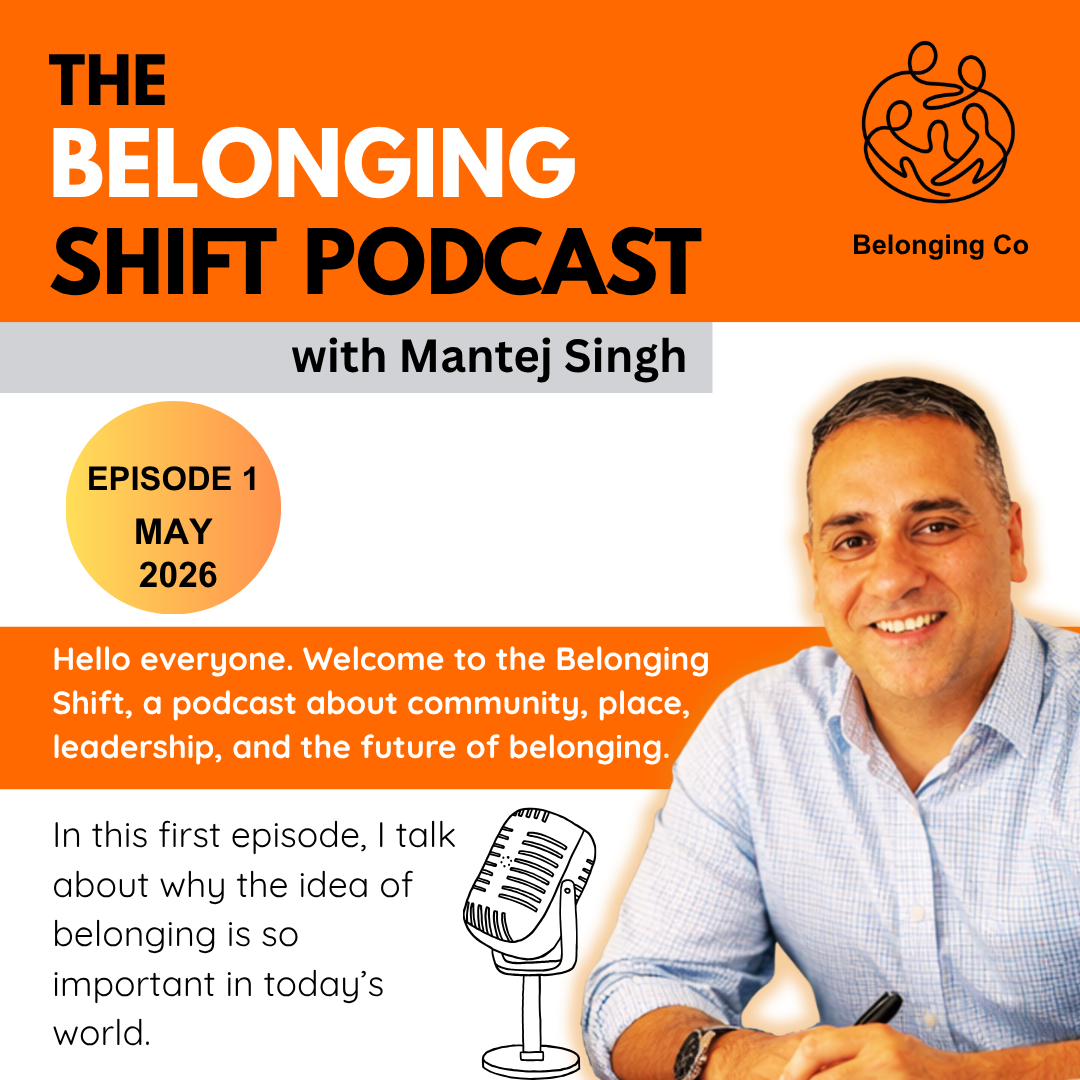
In this episode of The Belonging Shift, host Mantej Singh explores why cultivating a mindset of belonging is essential — not just for inclusion’s sake, but for tangible impacts on community engagement, organisational performance, and societal cohesion. Mantej emphasizes that belonging is a universal need that intersects with diversity, equity, and systemic change, urging leaders to rethink how they embed belonging into their work. He emphasises that belonging is the new standard for communities, workplaces, and services - and what are the related barriers we need to recognise and the practical shifts we need to make.
Barrier 1: Belonging is for minorities
Barrier 2: Belonging doesn’t affect performance
Barrier 3: Belonging is extra work
Shift 1: Think not just about workplace belonging
Shift 2: Belonging is about dignity and intersectionality
Shift 3: Listen early, listen genuinely
Shift 4: Focus on changing systems and structures
Shift 5: Accountability has to sit with leadership
The key point. Belonging isn’t soft— the more we approach it as a fundamental part of good business and community outcomes, the better our systems will work for everyone.
Listen to the full conversation using the links and transcript below. If this episode sparked a new idea, challenge, or possibility, share it with someone who’ll benefit. See podcast recording and transcript below.
Connect with Belonging Co
Belonging Co is a social and cultural inclusion consultancy helping executive leaders and organisations to strengthen inclusion, engagement, and participation outcomes across workplaces and communities — grounded in a unique belonging approach and a community perspective.
Read about Belonging Co services and approach or book a FREE discovery call to discuss your needs.
Follow The Belonging Shift podcast, connect with Belonging Co for more conversations on leadership, community, place, and the future of belonging, and to help embed a belonging mindset into your work and outcomes.
Listen to audio
APPLE PODCASTS | SPOTIFY | YOU TUBE | AMAZON MUSIC | RSS FEED
Read transcript
Hello everyone. Welcome to the Belonging Shift, a podcast about community, place, leadership, and the future of belonging. I'm so glad that you're here because in this first episode of this podcast, I'm going to be talking to you about why a belonging mindset or building a sense of belonging is so important for our societies and communities, for our business, organization, and leaders, and most importantly, how we all have a role to play in this.
I'm Mantej Singh, founder of Belonging Co, a social and cultural inclusion consultancy based here in Sydney, Australia. I will be your host for this podcast. I've spent over 20 years working across roles in community engagement, cultural outcomes, placemaking and inclusion. I've seen up close what happens when a belonging mindset drives community participation, business impact, and workplace trust. And also when the lack of it blocks the same outcomes.
Over the coming episodes, I'm going to be bringing in guests from diverse fields with unique perspectives on belonging. But before I bring in guests, I wanted to start here with me and the question that has driven most of my work. Who gets to belong? Who decides? And what do we all do about it? So let's start with belonging. What is it? B-E-L-O-N-G-I-N-G. The word is belonging. Belonging is when people that's you, me, everyone, feel welcome, feel safe, feel respected, and are able to influence what affects us without having to change who we are
Now, if you're about to roll your eyes because this sound soft or this sounds a bit as we say, dee-i-ish, stay with me for a few minutes and hopefully I can change your mind. And frankly, I'm not a DEI purist in the traditional sense also. My thinking sits at the intersection of place, community, and leadership. And perhaps it has a very different take on workplace DEI. And I do get the eye roll because a lot of this work triggers people differently. Some people hear the words belonging and inclusion and think, hey, finally, someone talking about me. Some people hear the same words and think, please, not another lecture on moral correctness. Trust me, I get both sides. I've led this work and have experienced the impact when it's done well, and I have seen the impact when it's done poorly and tokenistically.
The challenge is that we also get caught into language. If you work in a community-based role, we call this community development. If you're working in place-based outcomes, we might call it place-making. If you are in HR, human resources, people and culture, we call this work DEI, diversity, equity and inclusion. If you're working at a societal level, It is social impact. is perhaps now social cohesion as well. But underneath all this terminology and language, sit the very same fundamental concepts, Do I feel welcome? Do I feel safe? Do I feel respected? And how can I contribute to the same feelings to everyone else? So I'm inviting you all to be a bit more courageous. Think about this. not with terminology, not with jargon, but think about it in terms of business impact and think about it in terms of human impact. No jargon. Pure belonging or sense of belonging behind those two things.
Now we all want to belong in our neighborhoods, communities and workplaces. And as I said, belonging is what happens when we all feel seen, heard and valued. Who would have a problem with those things? But the truth is, we all want belonging for ourselves. But in order to get this outcome of belonging, others different to us have many times have to create the conditions or sustain the conditions for us to feel those things of being welcome or being safe, of being valued. so the challenge is, we have to create the conditions that help others have a sense of belonging and others have to create some conditions so that we have a sense of belonging. So if you could all do that easily, then it'll be a perfect place. But it's many times it's not. So what gets in the way of this sense of belonging and what are the challenges, barriers and solutions to this dynamic? And that's what this podcast is about.
And as I said, before I invited guests, wanted to talk about what I think about it. So I want to talk about three key barriers and five belonging shifts in this episode. And why belonging shifts? Because something has to shift for belonging to be better than what it is today. So let's first start with the barriers. What are the barriers to belonging? Now, there are many barriers, but in this episode, I'm going to talk about the top three barriers to belonging as I see it.
The barrier one is that People feel that belonging is about minorities and people on the edges. And when I hear that, it's such a big myth, and it's a myth related to the traditional model of years gone by. In Australia, where I live, nearly half the population is culturally diverse. More than 22 % speak a language other than English at home. More than 20 % have some form of disability. More than 17 % of people are 65 years and over. Mental health, loneliness, and affordability impact almost everyone. People in regional locations don't have the same amenities and opportunities as people in cities. Within cities, there are also disparities between suburbs. So this is no longer about people on the edges and fringes, and it is also not just about the usual types of diversity that we think of in terms of representation of different types of people. Belonging is about addressing not just diversity, but it's about addressing disadvantage and inequity. And that is now a mainstream community issue. And contributing to a sense of belonging and connection for our community should be a very high priority for everyone. Because when people feel they don't matter, they disengage. And we don't want people in our society, in our workplaces, in our communities to disengage from the system, from services, but also disengage from each other. So I think this barrier, the first barrier we have to shed and shift from is that belonging is about people in minority and on the edges and the fringes. It's not the case. Diversity, inclusion, belonging, are about as mainstream as we can get in today's because it's about everyone. We are all diverse. We all have some level of disadvantage. We have all have some level of inequity, and we all have to work together to address it for each other. That's what belonging is about.
The barrier two that I see that comes to belonging is this whole idea that belonging And inclusion is not about performance and revenue. It's the soft D &I sort of mindset. Because I think that that prevents people from engaging in it. Because as we've just talked, if diversity and disadvantage are in fact mainstream issues, then we have to accept the fact that they impact business, they impact revenue, and they impact performance in workplaces. Of course it does, because if our community is diverse, then so are customers, audiences, stakeholders, and our partners that we look for in partnerships in business. Ignoring that reality is being blind to the fact that our diverse customers and audiences will be looking for a sense of belonging in the services and experiences we are providing to them. And if that experience others them, marginalizes them, and doesn't recognize their unique needs, and at times their intersectional needs, then they will go somewhere else. To a competitor who provides them a better sense of belonging. And what that means is that if a property developer builds a development which doesn't have a sense of belonging, people will buy a property somewhere else. That's going to have a big impact on that property developer's revenue. If a museum or a gallery or some kind of a library doesn't offer people a sense of belonging or others them, then they will go to a different museum or a gallery or a park and then therefore that museum or a gallery or a park or a library will lose its audience base. So belonging doesn't matter for business impact and it's a complete myth that it doesn't. And when people don't get a belonging from a certain place, they will complain about it. They will talk about it to their friends and family. And then that affects how people perceive your organization. So I think belonging has a huge impact on business revenue and reputation. So you need to think about last time you walked into a place, whether it was a physical place or a digital place, and you felt like you weren't the intended user. And that can include things like confusing signage, lack of shade, no way to sit, a sense of lack of safety, toilets you couldn't find, a counter that you couldn't reach to speak to somebody. What are you going to do? You're not going to stay there. You will not recommend it to people and you're not going to trust it. And that has all got to do with belonging. Because if you feel you don't belong in that place, you will leave. And so therefore belonging, a sense of belonging shows up in loyalty. And loyalty, my friends, shows up in revenue. It always does. So we've got to break this barrier that belonging is not about performance and revenue.
The barrier three that we have to address is this whole idea that belonging and inclusion is extra work, that it has to be done in addition to everything else. And I heard it so many times and I think the people who are saying or thinking like that are actually doing the business a big harm. Because if belonging is a mainstream issue about mainstream community, then the solutions, the impact has to be embedded within the business. It cannot be extra work. But the challenge is that how do we practice inclusion and belonging now, especially in workplaces? The way we celebrate or sort of work on belonging and inclusion in organizations, On one end, we have symbolism. And by that, mean, celebrate the marginalized or the minority once a year on a day of significance with a morning tea and a panel discussion, hire some people who may look diverse, and do mentorship programs to sort of help uplift and fix people who are from diverse backgrounds. And at the other end of that spectrum is complex action plans, compliance reporting, representation targets. This is traditionally how DEI practice has been practiced. And there are policies. Now, I'm not saying that none of this matters. Of course it does. It has a huge impact because if you take out all of those things, the value for diversity, the value of inclusion will not be where it is currently. So it does matter. But I genuinely think that what happens is that when everyone is under-resourced and everyone is time poor, then all of these things does sound like extra work to people. because frankly, if everybody had lots of resources and lots of time, they would allocate people to do those things. The challenge is that many businesses, whether government, not government, do not have the resourcing. And so therefore, it becomes a structural and systemic problem more than a problem of whether somebody likes it or not, or wants it or not. So if we get into this debate of do we have the resources, then it's a losing argument. So we have to flip it, I feel, and say that belonging work solves and improves business problems. a belonging mindset, a belonging thinking improves customer service. It improves visitor experience. It improves business retention, how community uptake messages. It helps reduce complaints and creates a more engaged community. Now, suddenly when we think about all those things, it's not extra work. It is part of core business. So you don't have to do extra work. You just have to shift your mindset towards belonging. So that becomes really important. And that's why I've called this podcast, the belonging shift. Now I've talked about the barriers.
And now want to talk about the solution. So what are the solutions? How do we get this belonging shift? Now there are many solutions and it all depends on the context in which you're operating. So they can't be one size fits all solutions. But here are my five sort of high level takes to get thinking started and this conversation started on the belonging shift.
The first solution, I think, to shift towards belonging You have to think of belonging beyond human resources and people and culture and workplace. We have to place the work of belonging beyond that. That's not to say we don't value the work of DEI and belonging in HR, but we have to go beyond HR and comms. When it stays there, it becomes at times optics and branding. belonging is much more than that. So in my view, belonging, the work of belonging has to sit higher up in leadership and social impact and community outcomes. It has to be connected to business outcomes, increased revenue, performance, better parks, better places, better infrastructure. And Workplace DE &I, where I have many friends, certainly has a place within that ecosystem, but I don't think...workplace D &I is the entire ecosystem of belonging, which is much bigger. So I think the first shift we have to do is to think of belonging beyond human resources.
Shift two. We have to design places, services and experiences for dignity and intersectionality. And what I mean by that is we need to think about what would create a sense of belonging for anyone who is disadvantaged in the community. So that's a parent with a pram, a person with disability, an older person, someone who doesn't speak English well, a person new to Australia, a person from regional Australia.bSo when we start thinking about those things, about disadvantage, not just diversity, we automatically have to think about disability access, language access, affordability, cultural safety, intergenerational needs, so young and old. And then therefore these things don't become just nice to have, they are the core work. And when diversity is not siloed, which means it becomes intersectional. So what I mean by intersectional is, An older person from a culturally diverse background who has disability, that's three disadvantages a person has. There's intersectional layers of disadvantage. Or a young person in regional New South Wales is looking for a job. They also have disadvantage. A single mother from a migrant background in Western Sydney looking for accommodation. That is also a disadvantage. That's not just diversity. So I think we have to look for dignity and intersectionality and that's the shift we have to make. It can't just be about diversity.
Shift three is that we have to listen early. We have to listen early, we have to listen genuinely, and we have to recognize lived experience as expertise. So what I mean by that is that we have to bring communities and staff at the beginning of conversations, shaping the questions, the trade-offs, and what success looks like. Not at the end to socialize a decision or a symbolic co-design workshop. And so we have to move on this mentality of that. We've got to collect and spotlight stories and of disadvantage and discrimination and just show that we've engaged. We have to show impact. We have to give people who are sharing lived experience as people with expert knowledge on that lived experience, and we have to give them the due respect that they are there. We're asking them to share their expertise. So that's really important.
The shift four, is we have to focus on systems and structures as much as we do on behavior. So what happens sometimes is that we are often asking people who are impacted by disadvantage to become resilient and to create programs that help fix them up, to speak. But what, in fact, what we actually need to do is we need to redesign the system and make structural change. Because you can, give people resilience training or help them improve in their skills, but that the system and structure doesn't change then the lived experience on the ground doesn't change or sustain over time. And what we've done is we've sort of, we've ticked the box that we look, we help people, we help build capacity, but the system that sort of doesn't allow that capacity to automatically organically grow is still the same. So we've got to have a systems thinking mindset and that's the shift we have to make. It can't just be about fixing behavior.
And lastly the Shift 5. Accountability has to sit with authority, with leadership. So for this belonging work to be successful, leaders and senior executives and organizations and leaders in the community must genuinely understand the nuance, intricacy and importance of a belonging mindset. They have to spend time with people of color, with people with disability, with women, with men, with young people, anyone and everyone who is real and is impacted by disadvantage. And they have to be able to say, I'm responsible for doing something about this and I will do something about this. I, as the leader, will do something about this. And so we've got to get out from hiding behind strategies and action plans. We've got to take visible public accountability of making or driving the change.
So I want to challenge you. The branding optics and compliance approach to diversity and disadvantage does not work anymore. I guess it's never worked, but that's what we always had. So we celebrated that and it's 2026 and we need to evolve beyond that to an approach that works, that's sustainable, that's intersectional, that's integrated, that's holistic and do an approach and language that people can actually connect with that we're not sort of caught up in too much jargon and terminology that people can connect with that.
So I think I find that when we start talking about belonging as the language and building a sense of belonging for people as the main outcome, people can generally connect with belonging. And that sense of belonging can be applied to any context. It can be applied to community, place property development, retail, arts and culture, workplaces, human resources, and how we design our public places, parks, recreation experiences, it can apply to anything. That sense of belonging is universal. So I generally feel belonging has to be the main standard. And under that it's being welcomed, having a sense of safety, a sense of connection, an ability to contribute and thrive.
Now, the challenge is that our individual sense of belonging is shaped by a unique situations, our upbringing, culture, religion, immediate family and community, our values, and so many other factors. We're all so diverse. So how do we create this shared sense of belonging without flattening our unique differences, our identities, and in fact, the disadvantages we all uniquely experience. That's the work. And that is something we will explore in future episodes with our guests. I'm really looking forward to these conversations and I'm really looking forward to all of you joining us in these future conversations.
And if you need help, reach out to me at Belonging Co. Or to anyone else in your network that you feel is good in that space. Someone that has done this work on the ground, felt it on the ground, driven the impact on the ground, and ask them how can they help you or how can they guide you. Let's all make the belonging shift together.
In the coming episodes, we'll explore belonging, across place, community, and leadership with real practitioners, real stories, and practical shifts you can all apply. And I look forward to all of you being there. If this episode sparked a new idea or gave you language for something you've been carrying, share it with someone who needs it, a colleague, a leader, a friend.
That's how this conversation grows.
Thank you for being here from the very beginning.
I'm Mantej Singh, and this is The Belonging Shift.
I'll see you next time Thank you.
